Showing posts with label Four noble truths. Show all posts

Monday, November 24, 2014

The Four Unpleasant Truths, and a Kicker

Home, and we don't know what is causing this shortness of breath.  But we know I have a well-functioning heart, and no blood clots and don't have a strange lung disease brought on by my Rapamune.  I have yet to get a pulmonary function test, which they prefer to do outpatient.  We have a maybe:  maybe my breathing is impaired by having smoked a pack and a half a day for thirty years. And I grew up smoking passively in a household with two smokers.

But wait, this isn't fair - I quit in 1988.  It was hard, too.  I thought my lungs cleared up when I quit.

Karma isn't fair, but it's just.  All the time you smoked, it was damaging your alveoli.  Bad karma, bad.

But today is another day.  I was sitting doing the multiple eyedrops for post- and pre-cataract surgery and enjoying Tricycle Magazine, when I read this, in an article called The Present Moment.
No one denies the potential benefit from learning to calm or focus the mind, but many Buddhist teachers worry that an approach may be easy and give immediate benefits and yet risk discarding essential elements in the Buddha's teaching.
Wait.  I actually had a little dose of MBSR years ago, as part of a course in overall healthy living taught by my health club.  It did not just risk discarding the teachings - it carefully explained that it had nothing to do with religion.  It was about you feeling better and living longer.

A secular meditation practice is almost never sustained, and I'm here to tell you why.  Because sitting still doing nothing opens you up to reality, and that's the last thing most of us want.  Why is that?

This is a truth abundantly restated on the internet, which has enabled us to complain a lot verbally and visually. And in fact, it's religion - a restatement of the Buddha's First Noble Truth, the truth of dukkha, the suffering inherent in life.  So let me continue in this vein with my Four Unpleasant Realities.

1.  Life sucks.
2.  It's your fault that it sucks.  (a) You think it shouldn't, and (b) you keep trying to evade all the suckiness with distractions, positive thinking, and scotch and soda.
3.  There is a way to bring the volume of suckiness down a bit.
And here's the assignment -
4.  The way is a complex, sustained effort to meet the suckiness face to face, and change the way you act.

Huh?  What?

This was really funny when Tom and I came up with it at the breakfast table an hour ago, but it is not amusing me so much as I write about it.
~~~~~~~~
And there I stopped writing a week or two ago, and got distracted by the second cataract surgery.  Such is old age that I forgot about this draft until now. And I am again stuck with the subject.  Because nobody wants to hear about The Eightfold Path and behave themself.  So I'll cut to the executive summary, which is sometimes expressed like this ~


Sorry about all the black.

But it's true.  And the founder of the Zen I study, Dogen, said that when you get that, you've got it:  life is impermanent. YOU are impermanent.  Not only will you die, but you have no idea when you'll die, today, tomorrow, after you print out your to-do list.  And that goes for everything and everyone you love.  Get that, and you'll be motivated to be with the moment you've got.

So, it's Monday.  Did you need this on Monday?  Yes, probably.  I know I do.

Sunday, October 14, 2012

A Post About Desire That's Not as Interesting as You Hope

Oh, did I wrinkle your paper?
I'm not out to present the Four Noble Truths that are the foundation of Buddhist teaching in a scholarly way; there's a good treatment of them on Wikipedia in an article that nobody is contesting.  But in the Zen/Unitarian fashion, I have my own way of thinking about them.
1.  Life is generally unsatisfactory and sometimes damn hard.
2.  The reason we suffer is that we don't accept reality; we desire things to be different.
 I'll stop there, because my little story today is about that second truth - desire.

We often think of desire as being about strong cravings for big things, like having a certain person love you, but it can be all over the place in our lives, hiding behind the curtains, you might say.  That's where one popped out at me the other day. 

I was lunching with a friend and our talk wound down a familiar pathway about how we just can't catch up and get things done and get everything organized and nice.  Yes.  For quite a few years now we've been having that talk, which I think consoles us a little, as in "misery loves company," and if anything, we're both worse now than ever.  Or let's say, there are more messes around our houses than ever.  I mean, we've had many years to build them, and some good excuses.

I suddenly had a small realization: the problem isn't that we're messy; the problem is that we don't want to be messy.  See what I mean?  We desire our houses to be neat, clean, and organized.  We don't want to create messes all through the day, throwing unopened mail on the table, throwing dirty clothes on the floor, not hanging our coats up.

Now, I can only speak for myself, obviously, and it's myself I'm describing, not Gini.  I have more messy piles in my house, drawers, and closets than I can count.  And that is the kind of cat I am.

That was a saying I attributed to Sherlock.  In the way of male cats, he was utterly unapologetic about his behavior.  Knocking over the African violets?  He didn't care.  If you asked him, "Why did you do that?" his answer was delivered silently, with a look - That's the kind of cat I am.  Then back to washing his shoulder.  He was what he was, and in the fashion of all cats, he had no desire to please anyone else, or to change.  Cat lovers cherish this fact, which perhaps mystifies dog lovers.

I think that we humans are too estranged from our own animal nature.  It gets a chance to come out in singing and dancing and other physical activities.  Otherwise, we tend to ignore it and to focus on doing things  animals with large brains and opposing thumbs can do, like talk and compute and make things.   And we tend to think we can conquer our basic natures.  And I'm sure we do a lot of that; but all that human command draws a line somewhere when it runs up against the wall of our basic nature. 

And that's okay, too, is my point.  Basically, you are what you are, and you can't be taller than you are or have smaller feet or bigger eyes, or umm, keep things neat and tidy when you just don't have a neat tidy gene in your body.  And maybe the only problem is that you desire to be different than you are.  There's that word again.  Watch out for it.

Tuesday, July 17, 2012

The Truest Thing I Know

I know lots of important things, like Do the most important thing first  and There's always time for what's really important.  But the most important thing I've learned this last decade or so can be phrased in a piece of common folk wisdom:
It's always something.
Therefore, I make a point of enjoying the gaps between those somethings.

Buddhists may be noting already that this is a rephrase of what is called The First Noble Truth that Shakyamuni Buddha realized as he sat under the evening star:  Life is hard.  The word is dukkha, and I've most often seen it translated as suffering, anxiety, stress.  There are good reasons human life is hard.  All good things pass.  We pass, and we know we will.  We lose loved ones, friends, beloved pets, our health and vitality, our able-bodiedness, even our ability to think and recognize our world - and we know we might.  I know I probably haven't touched on the problems you and I have seen in our lives, and that you may be experiencing right now.

When I'm in a balanced mood I accept all that with the sort of equanimity with which we grandmothers sometimes say,  It's always something. (sigh)  If you can't accept this fact of life's difficulty emotionally, you can work on understanding that it is true.  Whether you like it or not.  And yet, this moment is safe.

Here I'd like to mention that these thoughts are growing out of me having a very good day.  A nice, quiet day following a lot of work yesterday, and some real visible progress on the major clean-this-house project, working right along with Tom, no conflicts.  I have seen enough suffering in life to realize the abiding pleasure of an agreeable relationship.  Today it is hot outside and the air quality bad, but we have electricity back, and our air-conditioner and Hepa filter are doing a good job in here.  My back doesn't hurt too much, and in a minute I'm going to prop up on a heating pad that works wonders for me.

I do live in an emotional hurricane zone, as Readers know.  I have a bipolar-ordered mind.  Right now I am neither depressed nor anxious-angry-manic, just right in that lovely middle.  Creative but not driven.  Not sick; maybe I've found the key steps to avoiding UTIs, maybe I can keep avoiding them. My history tells me those unlovely mood states will return and everything turn sludgy and gray, though I don't want to believe it.  I know it is my nature to get sick this way, that way; illness cannot be avoided (I know The Five Remembrances. which are at the bottom of this blog, by heart).

But today I can look around and run the mental gratitude journal.  And am not even arguing with the koan I have found most difficult of all:  Every day's a good day.  There it is, on the right, in calligraphy.  I am working on accepting that, preparing to see the shades of gray on those not-so-easy days.

Saturday, October 1, 2011

The Fifth Noble Truth

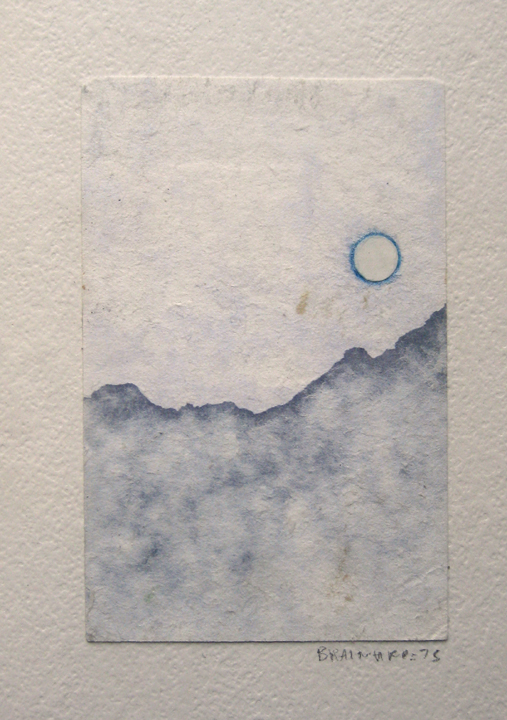
Moon, by Joe Brainard
Now, I prefer to think of the Buddha's founding insights as The Four Realities, but most places they are known as The Four Noble Truths, and you can look them up.  Over the years I have revisited them often, testing whether they make sense.  Now I have come to believe that something important is left out.  The Fourth Noble Truth lays out what is called The Eightfold Path.  It is a formidable prescription for effort in every area of your life, involving wisdom, ethics, meditation and mindfulness.  What is missing is how you begin.

I have seen hundreds of people begin meditation because they wanted stress relief, people who did not want to take it any further, to look at how they lived and what concepts they carried around in their minds.  Some of them last, in a way, going to a meditation group once a week or filling seven bowls with fresh (city) water every morning, but most don't.

You will not stick with it, you will not really do it - not even with that one little part, daily meditation - unless you begin with a fervent  vow to get yourself out of your misery.   That's going to emanate from really seeing and feeling your misery. 

I remember - feeling my way out of the dark room of cancer, a room cluttered with black boxes in which there was a door with just a crack of light around it to indicate it was there.  I'd known a few happy people.  I thought maybe happiness was possible.  That door out of my misery - it was clear to me that I had to get to it myself.  Medical science was adding to my misery, I won't go into that here.  My family had, as usual, failed me utterly, abandoning me after all showing up pro forma in my hospital room.  In my journal I noted it had been 17 days since my surgery, and my mother had not called me.  Ditto what I thought of as friendships - they didn't go to this level. They turned out to be social distractions.

The church brought me dinner every night for a week, but each of those women refused to come in and visit when I asked them to, and each time my heart dropped, I was so terribly lonely.  The therapist I had been trying to work with before the diagnosis was one more nice girl who wanted to explain me to understand my poor mother couldn't face my cancer.  Jesus, it was my cancer.  My minister wanted to show me how wise he was, told me she didn't choose to become an addict.  Everywhere I turned, no one heard me.  On top of this, what I had been trying to work with before the diagnosis was the appearance of memories of sexual abuse after my father's death. Well, I'm feeling bad just touching down on all this. That's about all the memoir I can stand.

I could sit on the bottom of that for only so long before I decided somewhere in my gut, Dammit, I've got to do something.  Some of us are like this.  We will goddamnit do something!  This sort of will - even courage - is a gift, a lucky accident of dna and karma, and a certain persistence was something I had cultivated in my life.  Lucky there.  And all I could think of to do was a healing visualization I'd heard three different unrelated times in my life.  More luck.

I knew enough about forming new habits to decide I would have to work at this, do it every single day.  I further decided I couldn't stand to spend ten minutes at it, but five was not enough, so I made it seven minutes (with the kitchen timer).  I tied it to a reward.  If I did it, I let myself watch the 11 a.m. rerun of Law and Order, which distracted me from my nightmare.  I did it sitting in my recliner.  Things unfolded from there.

I believe that realization of our suffering, and that vow, are essential.  You will not make that vow until  you understand that no one else can help you.  Happiness will not fall from the sky.  It will not "happen."  It's not in that "relationship" you hope will "come your way."  You have to get to work.  Only then will you begin to practice as though your hair is on fire.  That's the Fifth Noble Truth, or maybe it's the preliminary practice.


Saturday, July 16, 2011

The Eightfold Path

Following the Eight-fold Path?  Whoa, come on, not all that ethical shit. I like my [fill in your favorite intoxicant here].
A personal note: This morning I woke up hoping to not suffer like I did yesterday from the fire of high summer, which was occupying my center with a red energy of frustration, anger, confusion, and overwhelm. You can always find reasons for sensations like this, they're there in your life, and it's a challenge not to do that, just ride it out.

Some small exploration of the web led me by accident to this statement:
[Few Americans] (36%) identify Buddhism as the religion that aims at nirvana, the state of being free from suffering.
And this set me up straight with something like curiosity.  Yes, that is the promise of the Buddha's Four Noble Truths, the basic philosophy of all Buddhism.  You can easily find formal statements of them on the web, but I think of them like this:

1. Loss, pain, sickness, aging, death are inherent in human life, and they hurt. (Suffering, dissatisfaction.)
2. What makes them hurt so much is that we don't accept their inevitability, we strive to overcome our pain in a thousand ways. (Illusion, desire)
3. We don't have to be like this. It is possible to accept reality, and to reduce the power of our desires and aversions, and just enjoy life. (nirvana)
4. The way to do this is to practice meditation, cultivate wisdom, and refrain from harming in every aspect of our lives. (The Eightfold Path)  And this is a narrow way.
Now, wait.  Isn't this practice all about me feeling better just by meditating?  Or wearing a mala around my wrist? Cultivating mindfulness while I cook and eat wonderful food? Not feeling so much pain? Being calm and happy? Definitely that!
Ah, afraid not. That begins to sound more like everything American culture teaches us to desire - the (failed) promises of psychotherapy and shopping and plastic surgery and exercise and great vacations and brain plasticity, i.e. centered on personal happiness.  (Although maybe we could work with the plasticity idea, which is the evidence that we can train our minds.)

No, the Buddha says you have to behave a certain way to be happy. And that is not a self-serving way, au contraire, not a way of pleasure and gratification.  Following right speech, right action, and right livelihood are going to keep you pretty busy with various kinds of self-restraint.  It is not just about sitting froggily, though you know I advocate that. Meditation is the first thing to do, I think, the thing that can teach us how to slow down and be aware of what you're doing so you can try to live ethically.

Me, when I'm like this, right speech is a great challenge.  It often consists of keeping my mouth shut.  Time to meditate now.  And I will post the lovely cooling picture I took two days ago in the Park of Roses.  This is especially for Kit.
 

Wednesday, November 26, 2008

Where happiness is

More thoughts this morning on positive attitudes. Looking for joy is like knowing what you really, really hope is inside that Christmas package. If you do get it, there comes that moment when you feel let down.

Thinking about another way to say the Buddha's basic teaching.

1. You have a subtle, constant craving for a sense of absolute security* and constant pleasure** that, in the very nature of things, can never be satisfied.***
*impossible. Earthquakes, melanoma.
**impossible. Ask any alcoholic.
***you are a carbon-based life form that ages, gets sick, and dies, and so do the other life forms. No sooner do you get things exactly how you like them than something changes.

2. Your insistence on trying to fulfill your impossible dream leads to frustration and disappointment, and doing stupid things. You are like a child busy digging with a little tin shovel for buried treasure that doesn’t exist, and ignoring the beach and sea and sky.

3. You don’t have to keep acting like this.

4. You can change your purpose. You can decide to stop digging and experience actual reality, think straight, and live decently.
Then the legend tells us how; the Eightfold Path, which still makes a lot of sense.

Alright. So, experience Thanksgiving.