Showing posts with label Unitarian Universalism. Show all posts

Tuesday, August 5, 2014

Reverence and Otherwise

In the morning my thoughts float around in their zigzag way, and sometimes one lands on my hand. Today it was this:
All my deploring of things people do and the way things are has not helped matters.
This was triggered by morning coffee music with Pete Seeger, which was "Down by the Riverside." The thing about him, he meant it.
Ain't gonna study war no more,
Ain't gonna study war no more...
Now, the illustrious Pete, may his good work never end, meant it, he was against war and tirelessly sang and spoke about it.  And we still have war, don't we.  Oh yes, the bad bad karma of tribalism playing out in unfunny boy games in the Middle East.  God bless them, why don't they just give up their claims on a piece of earth and try to sneak into America like everyone else?

But one thing Pete did accomplish was give people, including me, a way to be in harmony together with our beliefs.  We all sang Guantanamero along with him, rocking a bit from side to side.  We all felt the sadness of the eternal cycle of unnecessary pain, flowers gone to young girls gone to soldiers gone to graveyards.  Gone to flowers.  The community we formed singing was a good thing, an excellent thing. I don't get to feel that much, other than in my women's meditation group, where the warm energy far from war goes round and round.

Last night Tom and I went out for ice cream, like our parents before us, though ice cream has changed since chocolate, vanilla, or strawberry.  Believe me, their toes would curl in alarm at the price of Jeni's Salty Caramel.

We got to talking a little about how as children we occasionally felt something in church I describe as shared reverence. I remember that especially on Easter morning and Christmas Eve.  Now I appreciate the sense of new clothes and spring hats - and white gloves on the ladies, back then - as a way of washing ourselves clean, resurrecting.

Tom went to a small-town Methodist church, and I went to a liberal Congregational church, but they had in common a shared acceptance of the Christian tradition.  In both churches there were those who got that it was not about the tribalism of Are you saved? but about love and unity. Certain stories were emphasized, like the parable of The Good Samaritan. It makes you sad to compare that with what is happening now on the Gaza strip.

I have had many good experiences in my Unitarian church, but have never felt that reverence in these 30-some years, despite our minister's many sermons on love.  I think this is because a percentage of the members there hate the very ideas of belief and mystery.  Atheists have long been vocal in the denomination. In my church, every summer we have a lay service by the Atheists and Skeptics, who affirm their belief only in what can be shown by science, which they revere more than I, who have been the victim of it.  In this service someone may talk about the mystery of life, but it is a head trip, not a spiritual practice, and does not go toward love and compassion. They would snort at the "notion" that Something loves us, and all is well.  They discard mysticism with the term "woo-woo."

I was recently told my group is woo-woo, O-kay, but I, too, have trouble with All shall be well when I watch the evening news.  Still, I enjoy experiencing the mystery and elegance of this great junkheap, even as I deplore the things men do.  For example, I am closely watching our tomato crop, pictured in its entirety here.
And, by way of the miraculous, I figured out how to download photos from my phone to my evil new computer, and then upload them.

Sunday, October 14, 2012

A Post About Desire That's Not as Interesting as You Hope

Oh, did I wrinkle your paper?
I'm not out to present the Four Noble Truths that are the foundation of Buddhist teaching in a scholarly way; there's a good treatment of them on Wikipedia in an article that nobody is contesting.  But in the Zen/Unitarian fashion, I have my own way of thinking about them.
1.  Life is generally unsatisfactory and sometimes damn hard.
2.  The reason we suffer is that we don't accept reality; we desire things to be different.
 I'll stop there, because my little story today is about that second truth - desire.

We often think of desire as being about strong cravings for big things, like having a certain person love you, but it can be all over the place in our lives, hiding behind the curtains, you might say.  That's where one popped out at me the other day. 

I was lunching with a friend and our talk wound down a familiar pathway about how we just can't catch up and get things done and get everything organized and nice.  Yes.  For quite a few years now we've been having that talk, which I think consoles us a little, as in "misery loves company," and if anything, we're both worse now than ever.  Or let's say, there are more messes around our houses than ever.  I mean, we've had many years to build them, and some good excuses.

I suddenly had a small realization: the problem isn't that we're messy; the problem is that we don't want to be messy.  See what I mean?  We desire our houses to be neat, clean, and organized.  We don't want to create messes all through the day, throwing unopened mail on the table, throwing dirty clothes on the floor, not hanging our coats up.

Now, I can only speak for myself, obviously, and it's myself I'm describing, not Gini.  I have more messy piles in my house, drawers, and closets than I can count.  And that is the kind of cat I am.

That was a saying I attributed to Sherlock.  In the way of male cats, he was utterly unapologetic about his behavior.  Knocking over the African violets?  He didn't care.  If you asked him, "Why did you do that?" his answer was delivered silently, with a look - That's the kind of cat I am.  Then back to washing his shoulder.  He was what he was, and in the fashion of all cats, he had no desire to please anyone else, or to change.  Cat lovers cherish this fact, which perhaps mystifies dog lovers.

I think that we humans are too estranged from our own animal nature.  It gets a chance to come out in singing and dancing and other physical activities.  Otherwise, we tend to ignore it and to focus on doing things  animals with large brains and opposing thumbs can do, like talk and compute and make things.   And we tend to think we can conquer our basic natures.  And I'm sure we do a lot of that; but all that human command draws a line somewhere when it runs up against the wall of our basic nature. 

And that's okay, too, is my point.  Basically, you are what you are, and you can't be taller than you are or have smaller feet or bigger eyes, or umm, keep things neat and tidy when you just don't have a neat tidy gene in your body.  And maybe the only problem is that you desire to be different than you are.  There's that word again.  Watch out for it.

Thursday, September 6, 2012

The Stranger in our Midst


It is interesting to me to see people in Zen quarters talking about a problem we have talked about in my Unitarian Universalist church: We are so white here! Why do we have just a sprinkling of African-Americans and other people of color? A friend of mine has the answer: A black woman  wouldn't dream of coming to a church where people wear shorts and flip-flops on Sunday morning. Actually, that is a kernal of a truth recognized in the book "Crowns," which is largely photographs of beautiful black women in distinguished hats.

The truth is that all institutions are based in specific cultures.  And there are always plenty of opportunities to welcome whoever walks in the door, even if every last visitor is the same skin color as you.  I am wide awake lately to the fact that people who, ah, seem different, who might be mentally ill, are routinely avoided.

Think Jamie Holmes, Colorado shooting suspect.  Just today the Houston Chronicle published a short article to the effect that teachers at both the U of Alabama and Iowa had recommended against admitting him.  Here's someone who was obviously smart, but too....strange....and that was in 2011, before he died his hair.  Anyway, he was Not My Problem.  Just don't admit him.

I think it may be a primal instinct to avoid people with a strange energy or aura or body odor or manner, however you want to think about the differences in people.  I imagine I had it too before bipolar disorder burned down my life in my mid-thirties.  Now I'm sort of the other way, to tell the truth - attracted to other people who have been broken.  The saying is, that crack is where the light can come in.

 This has brought me to a sad memory.  Some years ago I took off driving one morning, just east.  I can't describe what I had gone through with my family, but it was at a crisis, and people I tried to talk to about it weren't interested.  I liked to drive; it calmed me down.  You can kid yourself that you're in control.  I found myself near a town where there is a noted Zen center so I bought a local map and found it.  I'm not going to name the place because, I don't know, what good would that do?

I asked to talk to a teacher.  The woman who was at the desk and phone was very sympathetic; I remember she gave me an apple, and went off to talk to a teacher.  She came back looking embarrassed to say that the teachers were involved in a retreat, and could talk to me a week from Tuesday.  Something like that.

I suppose now that someone in charge was trying to deliver a big Zen message.  I got it, the kind of message that was, the kind of awakening they were selling.  That experience was part of what drove me to reject the puritanical high-attainment kind of Zen I was seeing in a local sangha, where people were unkind to newcomers who disturbed the peace of the sit.

All these years later, I still think it was unkind. At that time, I thought, they probably get a lot of crazy people.  Walking away, I noted all the Lexuses in the parking lot. I thought, They probably think they are training the leaders of tomorrow.

Thursday, August 30, 2012

Coming Out

Strawberries in their green hats


If you do not say 'good'
and you do not say 'not-good,'
then what is the nature of reality? 

I think I've written before about this koan, the first one I ever came across, not counting "What is the sound of one hand clapping?" since I didn't seriously see that as a koan until a few years ago.  The above question is in the little classic Zen Flesh, Zen Bones, which was the first such book I owned.  Maybe the first I ever saw.  I must have plucked it from a bookstore shelf because the word "Zen" signified to me a life of clean, orderly peace.  (Wrong again.)

You may react to it like I did - WTF?  Seriously, in that age before the internet and its acronyms, I wondered, But how can you not judge things and like things or dislike them?  Obviously, things are good or bad.  I wondered that every time I picked up that book and read it.  Maybe that means I was "carrying the koan," as they say; not trying to decipher it, not puzzling over it; just had it in there, not making sense.

I started to understand it when I began to do loving kindness meditation (metta), which is a structured kind of prayer or intention that includes "a neutral person."  Like many people, I discovered that I either liked or disliked practically everyone.  That slows you down, seeing that.   I was dividing the world as my alcoholic father taught me by example: either "he's okay," or "he's an a------."  I didn't think in those terms.  I just liked or disliked people, an in-law, the mail carrier, the checkout clerk.  I had to use strangers in that space.  That turned out well, but that's a story for another time.

Last Sunday morning, deeply depressed and distraught over the sparsely-attended funeral of a friend, I posted a post called "In Memory of a Wild Flower."  It ranged widely, blaming our minister, Mark, for not saying good things about her, for telling many things she had kept secret during her life; blaming others in the church who had not liked Teena or me or had let me down at one time; blaming her family for, it seemed then, not forgiving her even a little. I was ready never to go back to that church again.  I have taken this post down for now, and will repost it after I revise it in light of what has happened since.

What happened was that I heard first from Mark, and his long post was clearly compassionate.  I answered, he wrote back.  Then I ran into a woman I'd targeted in that post (though not by name), who must have heard about it, and put her arm around me and was so kind and reassuring that I burst into tears.  Meanwhile, I heard from friends who suffer as I do, some of them with serious diagnoses I had not known about, some telling me, "I'm not out of the closet on this," and thanking me for saying what they felt - that the mentally ill are stigmatized everywhere.  Thanking me for being out of the closet.  

At first, I also felt horrible, wished I hadn't posted it, wished I could have addressed the issues privately face to face. I should have known better.  But I was flailing around, drowning in hurt and outrage and, at the same time, the worst moodswings I've ever had.  Before long, though, I realized that the post had led to bonding with people whose stories I had not known, who carried around the same kind of hurt as me.  So it wasn't bad or good to have posted as I did. You can't say.

I don't regret this - displaying the kind of despair and fear we have to deal with, a depth of mental pain most people have never experienced.

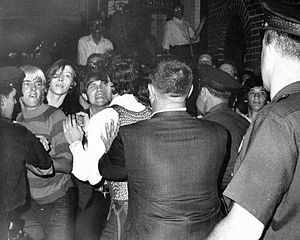
I was circumspect about my bipolar disorder for decades, so I don't blame anyone for staying "in the closet."  It is analogous to the situation gays and lesbians faced last century.  But we mentally ill don't have a Stonewall Inn where we can gather, from which we could fight back and hold proud parades.  We are lonely, and we may not deal with aloneness as well as people who have not been broken.  We are paranoid because we were scapegoated or abandoned by our families.  Many of us are not able to work and not able to pass as "normal".  We may be disabled by our moods and the severe side effects of the drugs we have to take just to keep from committing suicide.  

We see stigma where it might not exist - but that doesn't mean it doesn't exist.  It does, and it is powerful, because we don't meet this society's definition of worthwhile (successful, achieving) people, and we can't always restrain our tears or anger, and we have a harder time than most people finding effective ways to stand up to the stigma.  I wonder whether this will ever be any different.

Below, the first photo of the Stonewall Riots, which were led by homeless youth that slept in a nearbye park. The Mattachine Society newsletter reported that the Inn was their only safe place, so of course they fought for it. Other than that, "they had nothing to lose."
NY Daily News, June 29, 1969 - the Stonewall Riots     

Sunday, July 15, 2012

Listening to the Atheists

A tabula rasa
Normally, I don't think about what people believe about the metaphysical - that which is beyond the reach of science.  The American Zen I practice has nothing to say about gods or a god, nor does my church, Unitarian Universalism.  But my church goes to lay-led services for much of the summer, though the ministers are usually around.  And up came one to be led by the Agnostic/Atheist/Skeptic group.

You're familiar with the idea of a knee-jerk reaction - actually a very picturesque cliche, if you've ever had your reflexes tested with a little rubber hammer.  When I saw this service on the schedule, I had one of those, a mind jerk.  It went, "I don't want to go to that."

I am committed to attending church every Sunday, both for my own sake and for the sake of the church itself.  Every body forms that larger congregation.  So I had to think about this.  It took me no time to relate it to my former husband.  I sigh even as I write that.  It is so hard to retrain yourself

Pete (who is beyond caring now) identified himself as An Atheist, bold and loud.  It was one of the first things anyone would learn about him, accompanied with a scorching indictment of the Catholic church in which he was raised, and that was before the sexual abuse scandals.  Interestingly, UU seems to attract quite a few ex-Catholics; it is a place that welcomes people who want and need a church, but don't want to be told what to think, and especially don't want to be called sinners.  That word sets teeth on edge, believe me.  It had scarred Pete, too, to the point where he wanted an anarchic world with no such thing as ethics.  I know, scary.

He firmly believed that atheism was the only intellectually respectable position, and talked me into that on our second or third date.  Why did I say I was an agnostic? he asked. How could you possibly think there might be a god of any kind?  There was no evidence for it.  And so on.  He was older than me and a professor, and quite at ease with this argument, which he also made in the English classroom every chance he got.  He and his friends agreed on this to a man, and somehow social conversations often came around to how stupid Christianity was, how venile the Pope, there was no sin, people should be able to do anything they wanted to, and so on.

Hey, I was raised to be a girl.  In the fifties.  I was silenced by this for quite a long time.  Interestingly, while I was still married to him, when I felt a need stirring in me for a church, the only place I dared go was the local Unitarian fellowship.  There you are.  Even he couldn't argue with its firm lack of creed, its openness to humanism and scientific thought.  And it turned out to be the right place for me.  I suppose it's ironic that that's how I met Tom. Alright, disclosure over. 

I saw right away that my residual resentment of Pete - it was so long ago, but those were hard years - was influencing my attitude toward the coming service.  So I simmered down and decided to go. By Sunday morning I wasn't even worried that I might get really upset and have to walk out.  And you know the rest.  It's like every story - once the conflict is resolved, the story is over.

It was a fine service.  I sat next to a dear friend, Terry.  People testified in the pulpit to their own spiritual histories, and what the church has meant to them.  It concluded with a marvelous video about the stars which illumined for me a certain Zen koan.

After the service I talked to a number of people and we got to planning a meeting to discuss the church's plan for the next disaster - how it can help members who don't have power, things like that.  That disaster is looming at our western edge even tonight:  another hot hot spell, scattered thunderstorms, which bring scattered lightening strikes, which bring down big old trees in neighborhoods like Clintonville, and blow out transformers.  And suddenly we're one community of sufferers, united in helping one another, all divisions of religion or creed quite forgotten.

It is hard for me to sit idle.  Below, notes I made on the cover of the order of service.

Wednesday, July 11, 2012

Why I Don't Believe in Evolution

First, let me say that I know the theory of evolution applies to understanding the microscopic life that likes to inhabit my body, specifically my bladder.  The e-coli there have kept changing - evolving, we say - in order to survive.  That means the infections kept getting harder to treat once I was on immunosuppressants, until only an IV antibiotic would do last time.  I respect those smart bacteria, and work hard to make my bladder an inhospitable environment.

I said "the theory of evolution applies," though - not "I believe in evolution."  Science is not something you believe, as in have faith in.  I do have faith in constant change, because that's what I've seen happen in my life; that's different.  Change is not evolution.  Consider the climate change we're experiencing now [see image above].

I swim in the same water with many religious liberals; in fact, I have been a pledge-paying churchgoing Unitarian Universalist for three decades.  And what I hear there and elsewhere is that many religious liberals have pitched battle against the creationists who have fought to have their creation story taught side by side with evolution.

Now, I do think this:  the science classroom is for science.  Not religion.  Not creation stories or myths.

I taught in universities for years.  There I observed that even religious colleges tended to be highly secular in orientation.  So do our public schools.  I'm all for that.  Now, much more than when I grew up in the fifties, we are a diverse population with many faiths and lack-of-faiths.  That can be dealt with in specific classes at higher levels; the first time I encountered education that dealt with critical thinking around religion was in college, where it popped up in several required courses.  Personally, I'd like to see critical thinking taught much more at earlier levels.  But let's leave matters of faith out of it.

There's where I believe many religious liberals fall into a trap; they engage with creationists as if the opposite of creationism is evolution.  It's not.  Creationism is a matter of religious faith.  Evolution is a scientific theory that explains a lot of data in a way we find deeply satisfying right now.  I, for example, take those evolving bacteria in my bladder very seriously.  The data supports the idea that they have evolved.  But history tells us that the most glowing scientific theory eventually gives way to something better - more useful.

When people want their creation stories taught in the public schools, we should leap to adjust curricula to add courses that teach a variety of creation stories.  From what I've seen, we don't do that.  Instead, we try to convince people of that faith that they are thinking wrongly, that it's evolution that makes sense. So you have a battle.

You know I have to say something Buddhist, and here it is:  "Hatred is never solved by hatred, but by love alone."  We need to be listening compassionately to people who feel threatened by what is taught in the science classroom.  We need to respect them and give them their say.  Why not begin making comparative religious studies available in high schools as electives? If somebody doesn't want their kid in that, let them fight with their kid, not the school board.

I realize that creationists - as in the Texas textbook problems - have sometimes been political and aggressive.  That doesn't mean that a disrespectful or aggressive response is useful.  In general I'm against battles.  I've lived through one war after another, and I've seen that the characteristic of wars is that everyone loses. 

As for the Darwin wars, and bumper stickers that draw battle lines, the image with this post is meant to remind us that we have bigger fish to fry - and, sadly, that more fish are frying on the beaches in the new climate that is affecting us all, regardless of religious affiliation.

Thursday, July 5, 2012

Examining my "unexamined privilege"

The phrase in quotes above is from my UU minister, Mark Bellitini. It stuck with me and has been speaking to me for seven days now, during which we have had no electricity or Internet at home, and there's been a heat advisory every day. We can light our gas stove with a match and cook, but it's too hot to cook, and the frig is out (and dead empty and clean). We have a gas water heater, so can shower. A screened porch, where we would sleep if our life was always going to be without power. Can sit there in the morning with coffee. At six a.m. it's pleasant. The house is shaded and open at night, closed in the day, so it stays under 85 degrees and I can sleep there. Tom can't; he needs to sleep on a V-pap. He has found another place to stay. The V-pap is part of our privilege. So is the house on a wooded lot. So is, normally, good central air. A king-size bed. A guest bedroom, where a dear friend stayed one night. So is this iPad, gift of my daughter, who had the privilege of coming of age during the feminist movement, and has an advanced degree and earns good money, and flies all over the world to work (though that feels more like a burden to her than a privilege). So is The Grand Day Cafe, where I am sitting now and so was my fabulous breakfast, which included a blueberry pancake and grilled vegetables fit for a queen. So is our van and its wheelchair lift, and the power chair that lets Tom have a life, and the classy health club we are going to next, where I will charge my new 4G phone. We are the luckiest people on earth; now I know it. I have added a couple of things to my nightly gratitude meditation. When the power comes back on (maybe by Sunday) believe me, I will add a couple more. I intend never to forget my good fortune again.