Monday, October 8, 2012

You Don't Have to Like It

A good laugh helps, though
I do a lot of talking to myself about my bad attitude, a privilege I reserve for myself - I'm plenty self-critical, I don't need to hear it from anyone else.  But actually, I think I have a good attitude about life in general.  Yes, it's full of pain and loss, but I work to minimize my own suffering, and I have faith in the Buddha way, which has helped me thus far.

But I've been accused of being negative because I complain sometimes about the new losses of ability that just keep coming at me as I age.  Can't wear pretty shoes. Can't travel without great fuss and discomfort. Always hurt somewhere.  Can't drink even a little wine - it interacts with my meds and makes me dizzy and sleepy.  Said meds have increased my appetite and I gained ten pounds this summer before I knew what was happening.  And do not forget the bipolar disorder, which is now predictably one day up, one day down.  The down days are hard just to get through, just to endure.  If a down day coincides with a stress like a friend's funeral, it sets me spiraling further down and I get in trouble.  And so on, and on.

Who would like this crap?

That's my point. Yes, you can see these as learning experiences.  Bad luck and trouble can help you extend compassion to others with similar experiences.  It keeps putting mortality in your face; that doesn't feel good but it is good, I guess.  Maybe I won't be so shocked when it turns out that I die, too.  So yes, there are ways to gain from unpleasant experiences.  Fine.  That doesn't mean you have to like them.  Sometimes, complaining is in order.  I know complaining sometimes helps me bond with my equally aging and just occasionally cranky friends.

As far as I'm concerned, a good attitude is the Zen attitude:  being open all the way to experience, accepting its reality.  That is actually part of what we do when we sit in meditation.  It is often uncomfortable enough to make people drift away from the practice.  But if you accept reality, you can deal with it in reasonable ways.  If you're in denial about unpleasant truths, or determined to win impossible battles, that's when you really get in trouble and create trouble all around you.

That's all I know.   

Saturday, October 6, 2012

I Don't Ask Much......

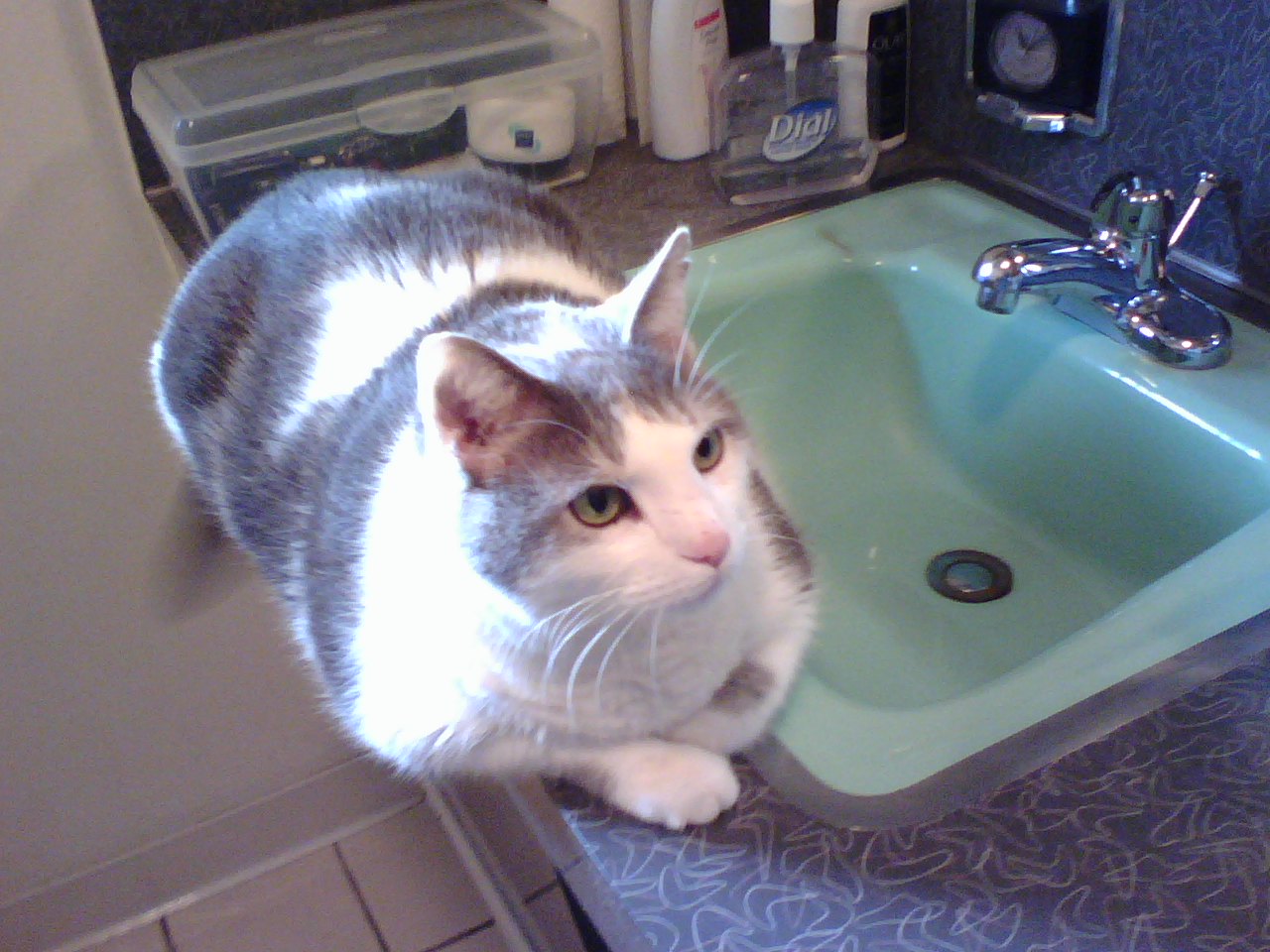
Sherlock at his water dish
Good day -
I have been flooded with one request to resume the blog kept by our beloved Sherlock and abandoned when he left this earthly plane in 2009.  He left many writings behind, as he had learned before there were LOL cats that any cat could walk on a keyboard, but using one, that was superior.  And he took his superiority seriously.

Sherlock was with us 13 years, and his death hit me hard.  It's taken three years, and the loving interventions of Sheba and Tashi, to get me to the point where I could go back and deal with this material.  I hope to be publishing more of it.  You can read this entry here or click on the link to read it on his own blog, Sherlock Here.  

From Sherlock’s Diary:


I don’t ask much.
Food in my dish.
A dripping water faucet.
The occasional morsel of salmon or tuna. Perhaps chicken.
An open window when the weather is pleasant.
A respectably clean litterbox.
A ledge to meditate on, and a way to get to it.
Everything in the same place.
All comings and goings at the same time every day.
Everyone nice and calm.
(No thunderstorms.)
No one trying to pull me around the house by the tail.
Occasional gratuitous strokes and compliments on my eyes.
Utter freedom to explore.
Full ownership of every horizontal surface.
In return for this, I vow to be myself at every moment,
for I am the Cat.
I think that’s a pretty fair deal.

Thursday, October 4, 2012

Seeing the Light


[video:  Maru sees the light.]

Understanding that we are fragile and our lives can be snatched from us any moment is a staple of Buddhist thought. Gaining that understanding is thought to be key to awakening; some monks meditate in cemetaries or worse, charnal grounds. (The link leads to an interesting Wikipedia article, but you probably don't want to know.)

During some Zen retreats a beautiful text may be intoned by a voice from the dark outside the zendo, encouraging us to to understand that the great matter is the fragility of our lives, and we should not waste one minute of our precious time on retreat.  Along this line, here's this from an article about one of the great Teachers who brought Zen to the West, and was known for a sense of humor.
Maezumi Roshi's style was warm, dynamic and direct. He lettered a sign on the zendo reading, "If you want to clarify the Great Matter of life and death you are welcome. Otherwise, better get out!"
 So I would have said I grasped this intellectually - but Zen is never satisfied with that.  Mind is only a piece of heart-mind.  And yesterday I got a body blow that took me deeper with it.

As you know if you follow this blog, we've been to four funerals in about three months - three friends, and Tom's father.  Two of these friends were way younger than me, and their deaths shocked a lot of people.

Another couple we know has had a string of frightening events.  In April the man had his first heart attack; last month the woman took a fall that fractured her pelvis, and means she is in chronic pain and has to use a walker; yesterday we learned that the man had fainted and hit his head, and is hospitalized. Why he fainted is still being investigated.  These are older (than me) people, entering their eighties but vigorous and engaged in life, who had already had to abandon a planned trip.

The woman leads the collage group I am in, and the way we work together in silence has led to a sense of intimacy in the group.  Maybe that was why the news hit me so hard.

The way it hit me was that my body feels soft, and it is as if I can see by x-ray vision my small bones and their significant deterioration. It's that sensation, and that enhanced perception of my fragility that has me reeling.  As much as I've been reminded of my age, as near as I've been to dying, first from cancer, then from kidney failure, I didn't feel it until now.  Or if I did, I'd forgotten.  Our bodies really are soft, our skin a very thin defense; we are constantly invaded by germs and viruses and cancer cells that would like to use us as a host. I knew that, but I didn't feel it.

So I find myself remembering that chant.  Here is one version. 
Let us be respectfully reminded:
Life and death are of supreme importance.
Time swiftly passes by, and with it our only chance;
each of us must strive to awaken.
Be aware! Do not squander your life.

Wednesday, October 3, 2012

Healing Gifts

Today, for the second time, I listened to a guided healing meditation by Jack Kornfield, whom I had the great good luck of sitting with just once at Spirit Rock. It was more satisfactory for me this time, though my back still hurts - there's only so much you can do about getting old.  I thought I'd share it here, though I always feel somewhat shy about sharing spiritual experience.  I don't know whether visualization can work for everyone, but it's worth a try, and Kornfield leads it well, makes it easy.

This time my mind went back to a place that felt like a healing temple to me.  This was a small art gallery we visited during a vacation in Toronto Montreal that was simple, clean, and silent.  I rested on a bench there, not examining any particular painting, just enjoying the peace of the place.

The healing presence who came to me looked quite a bit like Andrew Weil, a healer of the body and the whole self....


And also like Bernie Glassman Roshi, whose specialty is the mind, or consciousness, and ethics. 


And when I thought about it they both reminded me of someone generous I loved in childhood.........

So there you are.

You do various things during this meditation, and at two points the healing presence gives you something.  The first time I got a small jewelry box that contained a clear glass heart pendant.  I liked that.  I do a lot of heart-cat meditation with Tashi; she prefers being held against my heart to sitting on my lap.

The second gift was even better - a small white book, the cover handmade paper.  I smiled, because I knew instantly that the book was blank, and when I opened it, it was.  So, I thought, every day is a blank page.  Anything can be written on it.

And I thought I'd pass that on.

Tuesday, October 2, 2012

I'm Nobody! Who Are You?

I am reminded of this whole problem of competitiveness by reading a pleasantly negative review of Arnold Schwarzenneger's new memoir, which the reviewer said is arrogant and self-satisfied to the extreme.  But you knew that.  The one thing I like about his story is that Maria Shriver, his wife, drew the line and left him when the story of his "love child" came out.  (It's odd, we have a term for that when a man does it - "manned up" - but no equivalent verb for a woman who calls upon her strength to do something difficult.  Any suggestions?)

Vaguely along these lines, this morning I picked up a book by Ram Dass and Paul Gorman from this heap I could call my "library," titled How Can I Help?  This is the kind of book that is on paper with a cover, so it seems like a memento of times passed.  I opened it to a story I enjoyed, not for the first time, but then, a story is new every time you read it.
     One day a rabbi, in a frenzy of religious passion, fell to his knees before the ark and started beating his breast, crying, "I'm nobody!  I'm nobody!"
     The cantor of the synagogue was impressed by this spiritual humility, and joined the rabbi on his knees.  "I'm nobody!  I'm nobody."
     The shamus (custodian), had stopped cleaning the floor in the far corner to watch this. Now he felt drawn in by this shared spirituality and joined the other men, falling to his knees and calling out, "I'm nobody!  I'm nobody!"
     At this, the rabbi nudged the cantor and indicated the shamus with a gesture:  "Look who thinks he's nobody!"
Don't you love it?  Competition even in being the very least.  Ram Dass refers to this as "the problem of always having to be 'somebody.'"  There is a Zen koan that touches on this: 
With empty hands I take hold of the plow.  
I take this to mean we try to step away from our ideas of who we are and who the other is, and realize our oneness.  And let go of our desire for our actions to have a certain outcome, and just do our work.  I think that for those of us who are aging or ill and can't "work" or even do much, emptying can just be a matter of remaining open to possibilities.  When I meditate, I like to note that I am sitting in a space, that I am a space, in which anything can happen. I don't think a day goes by when I can't give a little comfort - maybe only to the birds at the feeder - or a smile.  Just connecting.

[The title of this post is from a poem by Emily Dickinson that you can find here.]