Showing posts with label Daniel Terragno. Show all posts

Tuesday, March 3, 2015

This, Too, Shall Pass


You guys can't imagine how many times I begin a post and don't finish it. Because it takes time. Energy. Thought. The confidence that you have something to say worth reading.  I don't really have any of those things these days, not on a predictable basis. Bad ups and downs - and when the ups are bad you have your truly undesirable bipolar disorder, the kind that makes headlines if you are famous.

But one can say Buddhist things about all this. Here's one: what helps me a lot is to remember ~
This too shall pass.
Daniel Terragno told me that once, in regard to a very pleasing state of mind I had encountered on a retreat.  He was sure right.

In all seriousness, when things are bad, we need to remember, oh, it's just life. And gosh, the Buddha was right about suffering. And it will pass. I honestly believe that's the best suicide counseling I could give. That and, tomorrow is another day. And oh, spring comes and the grass grows by itself. (Basho)

You're probably wondering why I have been able to post this sketchy thing. Well, by restraining myself from making a fancy sign that would say This Too Shall Pass. By staying up past my bedtime.  By not discussing whether the commas in the title are definitively better than the lack of commas in the saying in the text, and linking to the great article I just read in the New Yorker by a comma queen (copyreader). By not fact-checking the Basho quote. Like that. Being bipolar, you have to learn restraint of the many many creative ideas that won't get the humidifier cleaned....Anyway, I just saw this cartoon and wanted to share it.  A great one. Let us smile at ourselves.


Sunday, December 15, 2013

The Wholehearted Way

Henri - exemplar of the half-hearted way
I think one of the reasons people find going home for Christmas stressful is that we care what those people think of us - our parents, brothers, sisters, the clan.  On the other hand, it's good to see old friends.  One good Thanksgiving weekend home, long ago, I went with my friend Cheryl to hear a local band she liked in one of those dinky bars, the kind with wood floors.

The band was good, especially the lead singer, who was had that easy blond charm.  At one point he got to riffing on a song about going home for Thanksgiving, and sang (you have to imagine the driving rhythm)
sittin' around with the relatives drinking coffee, coffee, coffee, coffee!
Everyone laughed and cheered.  Of course, everyone was now comfortably drinking their favorite CNS depressant, while still jazzed up by all the coffee.

Looking at the singer, I thought, He doesn't have any trouble going home. He doesn't care what they think of him.  He's okay with himself, he's a performer, a confident sort of guy.  He digs seeing his cousins and sister.

Of course, you never know.  His parents probably weren't perfect.  Maybe his father said pointedly, "Your little brother got admitted to law school."  Maybe his mother asked him, "How is that . . . girl you were living with?" and they just broke up.  Maybe he read chronic criticism into these things - after all, he was "just" a starving artist, not a big name, and getting older and all they care about (he thinks) is money.  They have never appreciated his talent (he thinks).  Maybe it made him want to climb the walls.  Or pour something in his coffee.  When will they realize I'm a grown up?

His mother, on the other hand, wondered, "What do I do wrong?"  That's a good question if you're using it to stand back with some detachment and ask yourself whether you hurt someone, but sometimes it's just a way of picking on yourself.  "What did I do right" can be more useful.

Yesterday in my sitting group we started talking about the most difficult aspect of Zen - how do you act when you're not meditating.  Nancy I (we have two Nancys) pointed out the interesting distinction Dosho Port makes in his list, "Practicing the Path of Zen Like A Long-Distance Train" (you can find it here).  He quotes Katagiri Roshi:
Mindfulness is nice but practicing enlightenment is about wholeheartedness.
Later I recalled an example of wholehearted action in one of Daniel Terragno's talks (which I wish someone were videotaping or recording and transcribing).  He said, "When you get an urge for a Big Mac, and you decide to have one, don't spend the whole time saying to yourself, I shouldn't be eating this crap. This is disgusting.  Just eat it.  Enjoy it."  That's the way to eat.  Step off the mind road and dig right in.

Visiting the folks over Christmas can be done in the same spirit:  dig right in.  Be completely there.  Sing along.  Before you go, do a little ritual in which you push resentments, historical inequities, discomforts into the closet with those hungry ghosts who think Christmas is about what you get, and shut the door firmly. Enter the dance.  Give yourself.

To get you in the spirit, here is my holiday gift to you - my all-time favorite rendition of the Hallelujah Chorus.  I especially enjoy the last shot, the shy wave from the teacher who must have worked many hours to include every last sentient being in the little community in this project, including the shy kid who doesn't wave, the pilot of the puddlejumper, and those happy, useful dogs.

Thursday, April 11, 2013

Sick, and Tired of it, With Comments on the Spiritual Path

I was reminded this morning of what took me from trying out all kinds of Buddhist practice to focusing on Zen - I met a Teacher.  Then I met another one.

Both these men, Daniel Terragno and Ama Samy, come to Grailville in Ohio once a year from far places to hold retreats, and snagged me on my very first retreats.  I've also met another Zen Teacher, James Ford, a unique Unitarian minister, and corresponded with a few others.  Now I am gratefully undertaking to practice "distantly" with Dosho Port of Wild Fox Zen, who is extending himself to work with us solitary and destitute types via internet methods. 

Every single one of these people has treated me with the attention you would give to the most important person on earth.  Their attitude is not just about the calmness and general slowing-down that we gradually learn through zazen.  It's about the practice of open-heartedness.  You can think of it as treating everything and every little yellow buttercup as sacred.  Or you can think of it as kindness.

I thought about this watching one of Dosho Roshi's videos this morning, in which he explains the above.  It is not at all abstract to me.  I have been so ill for so long here (see previous posts), and it is frustrating to wait for phone calls from the nurse, the doctor, home health.  It is easy to get resentful of friends who are too busy to offer some homemade soup (see cartoon above).  It is easy to feel entitled to inflict on others the occasional crankiness natural to this situation.
That crankiness comes from animal nature, perhaps, but the Eight-fold Path asks me to refrain from expressing it in harmful ways.  And it reminds me that I am actually not the center of other people's universe.  Jeez.  That I am no more sacred than everyone else.  That we are all seeking happiness.  Even poor Tardar Sauce (above), the cat who looked grumpy from birth.  And maybe was and is, I don't know.  I love him (her?) anyway.

Tuesday, July 31, 2012

Enlightenment


Stella Doro lily doesn't know it's too late to bloom.  Note the sheltered ladybug.

Salvation, if we can talk about it at all, is the end of ambition, which is when you become completely one with your experience. Knowledge becomes one with wisdom, which is called buddhahood or the awakened state of mind. You realize that you never needed to make the journey at all . . .
Chogyam Trungpa, “The Human Realm,” in Transcending Madness: The Experience of the Six Bardos, page 258.
My main practice is Zen, but with an interest in other streams.  A year or so ago I bought "The Practice of Contemplative Photography," which includes some photographs by Trungpa Rinpoche, and that stimulated my interest in his work.  Like Shunryu Suzuki, he is more difficult to understand than his American followers, but worth the effort.

What these words remind me of is that I am perfectly what I am, what I was made to be by long and wide streams of karma, national, genetic, historical, environmental, and so on.  In Zen we talk about "the self," or "the conditioned self."  At one time I believed my task was to get rid of it.  I did, I believed that, because it was becoming clear to me that my histrionic hypersensitive over-responsible and bipolar self was the source of my suffering.  I remember Daniel Terragno asking me reasonably, "How could you do that?"  I thought we weren't communicating very well.

You cannot not be who you are. Your brain and your butt are the shape they are.  And you are okay.  But (as many teachers have added), you still need to work a little harder.  You may be OCD, but you can learn how to throw away a cereal box. You may be hypersensitive to criticism, but you can learn whose criticism to avoid or how to deflect it. It's bit by bit, inch by inch. There's always work to do

When I started a regular meditation practice, it was in a frenzy of fear that the cancer in my breast would kill me.  This was irrational; it had been discovered on a mammogram at stage one.  Nevertheless, I began doing a white light healing meditation you can find taught all over the world.  From there I somehow moved into just sitting following my breath, then a lot of other practices.  At this point in my life, I was also in torment with my alcoholic family, and they weren't the only people in my life driving me crazy.  That was how I saw life then: they drove me crazy.

There was some truth to that.  Some people are hard to take, and you should have a really good reason to spend time with them.  Over the next couple of years I was going to leave behind several people who just weren't good for me.  It was hard every single time.  Now I am amazed that I ever tolerated them.  But I didn't see the reality then.  My reality was governed by an idea that I should like everyone, tolerate rudeness, cultivate patience, and enjoy pool parties.  I mean, of course. 

You know what?  I like a genuine beach and a nice big body of water, as well as a creek and a waterfall.  I hate swimming pools, chlorine, cold water. It's a matter of personal preferences.  But I had to take swimming lessons and push push push myself to try and try harder - in the face of fibromyalgia pain - because, well, everyone said swimming was good for you.  And I thought I should learn to like it.  And certainly I had to go to my brother's pool parties because, well, he invited me.  Though another thing I really don't like is being around people who are devoting themselves to drinking all day.

One of the things Zen says is that when you are enlightened, you will taste a cup of tea and know for yourself whether the water is hot or cold.  It's a metaphor.  You learn you don't like Carol, and you're cold when you're cold, and hungry when you're hungry.  Other children of alcoholics may recognize the denial of ordinary needs that was enforced in my childhood.

I thought practice would teach me how to handle all the problems in my life back then. It has, including that some things can't be solved.  Also, I often see more clearly now where the problem lies, and how it can be handled.  This is hard for me to say, but there's actually nothing wrong with Carol, and I bet some people like her.  She is what she is.  I just - sorry, I just didn't like her.  And don't miss her.

In short, what I am gradually approaching with practice is not universal joy but being aware.  That includes, though it is not limited to, what you like and don't like, moment by moment.  It applies to many mundane things that can add up to STRESS.  It's very interesting how the little raft takes you far, but not where you thought it was going. 

[In looking up the hot and cold thing, I was led to a dharma talk I think must be by Shinge Roshi, for those who want to think more about this.]

Sunday, May 20, 2012

What Moves You?


[If the above video doesn't open for you, it is Alison Kraus singing "Down in the River to Pray," from the film Oh Brother, and is available on YouTube.]

This morning I heard from a friend who has struggled for many years to reconcile reason and spiritual experience.  Or maybe the problem was that he wanted to reconcile reason and faith - what people believe about that which cannot be captured in a laboratory (which is most of everything).  He wrote about being tremendously moved by music sung in a foreign language.

I feel that too, but also thought of how I have been moved sometimes by the captured/expressed energy of visual art.  The scene above is a lovely marriage of visual art and music, the ethereal chorus moving slowly and in harmony toward baptism.  The river, a symbol that is universal wherever people have rivers.  I was also thinking of the time I walked around a corner in The Museum of Modern Art and found myself face to face with a small painting, "The Starry Night."  Layers and layers of paint.  It hit me in the solar plexus.  It is the most famous of van Gogh's many attempts to capture "It," the divine essence in everything. If you like, you can go here and scroll down for a brief experience of it.

Daniel Terragno once said to me mildly, "Zen is not for everyone."  In fact, Zen claims that the essence, reality, the sacred is everywhere in everything.  Where is it for you?  Is that in your life?

Monday, June 13, 2011

Trying something

From Chogyam Trungpa's The Path is the Goal -instructions for beginning meditation:
So you keep just on the verge of your technique, with just 25 percent of your attention.  Another 25 percent is relaxing, a further 25 percent relates to making friends with oneself, and the last 25 percent connects with expectation - your mind is open to the possibility of something happening during this practice session.  The whole thing is synchronized completely.
Earlier he has said that we just "put 25% of our attention on the breathing or walking. The rest of our mental activities should be let loose, left open."  Reminds me of Suzuki talking about letting your cows have a wide field to roam. 

One of the important things I learned from Daniel Terragno was to just try things.  You don't have to make a big lifetime decision, even if you are, if you know what I mean.  Experiment.  See what works. I note that this attitude gives a certain release from craving to make it work, whatever it is  You don't have to make something work if it doesn't work. You can try something else.

As for this, I've practiced in the Japanese Zen tradition for many years, and it works for me, and has not stopped being good.  Now I feel like the Tibetan has something to offer.  We shall see.
[image: the endless knot, a Tibetan symbol]

Saturday, January 22, 2011

Following the pathless path

Jizo in the snow, photo by Tom Tucker
This morning I read Open Buddha's review of Footprints in the Snow, an autobiography I also like, and noted that Sheng Yen wrote a book on the Chan form of koan work.  My first response to this news was, I'd like to get that.  Next, I remembered that I have mostly lost interest in formal koan study, which was very good for me when done with Ama Samy, whose method is unique, and good for me in altogether a different way when I worked with Daniel Terragno, whose traditional method was guaranteed to arouse my striving and thus my frustration.  There's a book in that sentence.

Koan work appealed to that in me that longed for mystical, intuitive engagement with the truth.  In fact, the beginning of my work was in a dream after I got home from my first retreat with Ama Samy, one of whose books is titled after the koan, Why did Bodhidharma Come from the West?  I dreamed a deeply felt answer, woke up briefly to write it down that night, and the next day wrote to him about it.  This was in 1999.  He wrote back to me with another koan, "Who is that one?," and I carry that koan to this day, realizing more all the time that this one is compiled of a thousand thousand bits that shift constantly - the truth of no fixed limited self.

During the years that I worked with Ama Samy while on retreats, I also worked with the first book in the Japanese tradition, The Gateless Barrier.  I worked with three copies of it, in fact, by three teachers, studying each koan hard, thinking about nuances.  I embraced this study gladly, finding it much more fulfilling than the graduate studies in literary theory I had recently completed.

It made its way into Zen-flavored humor written by Sherlock, my cat, which I intended to collect as The Sound of One Paw until I got felled by one real-life koan after another.  I also read and reread John Tarrant's marvelous collection, Bring me the Rhinoceros.  In all this, each koan worked its way into my mind.  It's something Tom and I share in that intimate way of the long-married, casual references to something we both did and that we understand.

Well, this is a shorthand description of a few years of journey.  My interest in koans tapered off - I couldn't say when.  At the time, I felt like I was failing.  But now I notice that I carry all those koans, and they often pop up in response to some event.  My practice has become more flexible, is changing all the time.  I'm about to pick back up yin yoga, taking advantage of Lulu Bandha's online site, recommended by the best and most generous yoga teacher I've ever known, Kit Spahr.  I am again interested in poetry, writing my own, reading others'.  On retreat, I was very moved by the visible world, and took photographs, including a sequence of a sunrise and one of a sunset that I'd like to turn into mini-slideshows and publish.  And, well, going to the health club - I have never been attracted to exercise - is a way of recognizing the basic principle of cause and effect we call karma.  Practice is all over the place, if you think about it.

I suspect all serious practitioners think deeply at times of throwing over the householder's life and entering residence, spending more time on formal practices like meditation and calligraphy.  I don't, anymore.  I'm too bonded to Tom, my neighborhood, my home, my church.  Besides, I'd drive them crazy.

Friday, January 22, 2010

Zen and Memoir

At one time my Zen training kept showing me how I kept inventing and responding to stories thrown forth by my fertile mind. "Stories" was a word my Teacher, Daniel Terragno, seemed to favor as he tried to shake me loose from my iron grip on this passing, constructed self.

My graduate study was in narrative theory, so I theorized about this story thing. A story is a fiction; that's fundamental. It's made up. It is not what happened or what is happening right now. What does Zen say? Something like, The moment you say a word you have lost it.
It is possible to be quite lost in your story about your reality, not only dreaming during meditation but when you are up off the cushion supposedly engaged with reality. For instance, when I was 20 I had a story about what I felt entitled to: "I shouldn't have to work at a crummy clerical job." Much later I found that story was encumbered with feelings of frustration and with judgments and expectations. I felt demeaned by clerical work. I hated it. It bored me. I believed myself entitled to interesting, highly-paid work. I couldn't even stand to look at the fact that I should have stayed in college. Don't Want, in other words. Preference. Pain avoided and amplified. It's really hard to grow up.

Our stories about our past lives can get much more elaborate than that. What my mother should be like, what kind of father I deserved, how uniquely I suffered. Indeed, a lot of people have had very painful pasts, even here in the most widespread luxury any humans have ever enjoyed (and what a lesson there is in that). The American model of recovery from a painful past is often to talk about it. In 12-Step meetings, people get up and tell that story, a verbal memoir of suffering and redemption. We might also do this with our friends. I knew a woman who always got around to the thin stream of her misery. I don't see her anymore.

This is what "confessional" memoirists usually do - they invent a coherent story that uses selected pixels from the huge junkyard of their past, and knits them together into a story with a narrative arc, a beginning and an end. It will begin with their despair or dissolution and show us how they achieved redemption, or at least a peaceful wholesome life. (Won't it be interesting to see how Tiger Woods tells that story?) I understand that many psychotherapists believe that humans can't change much, that it is their job to get the patient past the crisis that brought him in, maybe give him some hope.

I benefited from therapy and was also harmed by it, so I don't speak for or against it, just to say that it's my nature not to be satisfied with small goals. I took to Zen and the idea of enlightenment with a lot of enthusiasm. I believed happiness was possible, that life could routinely include joy and satisfaction, and a sense of freedom, and security. At least, I was going to shoot for that. So I meditated. Listened to tapes, bought and read books, lots of books, studied. Went on retreats.

And I kept hearing from the Teachers that my past did not exist, my life was not a story at all. Just here, they would say. Right here. I was encouraged to notice as I sat that a story would arise from my brain like a thin twist of smoke from incense. To back off and realize it was just another story, to hold still and keep breathing, to let the story fade away.

There were years during this process when I did write memoir, telling the painful stories of family members who died unhappy during this time and left me grieving. I never published any of it. As the years go on, those people become more real and complex to me, and I realize that I didn't have "a relationship" with any one of them, but a stream of many, many encounters, some close, some frustrating. From this I learned something more true and painful than I could have ever written: they are dead. People die and then they are dead, and the opportunity to sit and listen to them is gone forever. The past is dead. Maybe memoir can be a memorial - I hadn't thought of that until now - but it won't bring them back.

Thursday, December 31, 2009

Completely full

In 2005 I wrote the first two stanzas of this poem, and sent them to Daniel Terragno, a Zen Master I was fortunate enough to work with at the time. He wrote back the few words that became the last stanza. May you sleep peacefully and awake to the new year with pleasure.

Winter blue out there.
A drip from the eaves, another.

How thin the needles of the pine
at the edge of the ravine.
No blessing anywhere, and

that no-blessing—
drip drip drip . . . pine needles . . . the ravine—
is completely full.

Thursday, October 29, 2009

Change the Energy Day

A while back I was able to train with Roshi Daniel Terragno, whose words had a way of being clear and penetrating for me. Once we were talking on the phone and I brought to him the problem I had with my work. I believed I should be sending manuscripts out, and I couldn't make myself do it. I had a sense of being an engine at the starting line, huffing and puffing, but not able to get traction and move forward.

He said (I could hear the shrug), "Why don't you just send something out - that will change the energy around it."

I loved that. I have a mystical streak a yard wide, my grandmother would have said, and have experienced energy in many contexts, enough to know it's real. Change the energy around it is a principle of feng shui, for instance. I've read the advice that to recover from a spouse's death you should immediately change the bedclothes, and if possible, the position of the bed in the room. I experience energy every week when I get acupuncture.

Yesterday this particular concept popped up for me when my friend Gini called. We usually have lunch on Wednesday, but neither of us had any ideas. "Do you want to do lunch or breakfast?" she asked.

"Breakfast!" I said. What a good idea! Get me out of the house, something different. I asked her, "White Castle or Waffle House?"A change from our usual quiet sort of place.

I swear I could see her eyes light up. "Waffle House!"

Well, we had a good time, and ate as you can there, terrifically enjoying the grits, hashbrowns smothered and covered, a full midwestern breakfast and really good service with the coffee. It turned out to be a good place to talk after a meal, too, not too busy, they don't bug you. Then, coming home we got lost, you might say, and enjoyed a leaf tour of the neighborhood we have lived in for much of our adult lives.

Different is refreshing. When we choose it, I guess. Maybe we could look at all change that way. This morning I got up to a storm of falling oak leaves. It wasn't very windy out there, but it was as if all eleven oaks out back decided it was time. My impulse was not to like it - fall is hurrying away faster, too fast. Don't like winter. I didn't like yesterday either, when I got up to black sticks. So many leaves had fallen overnight that the woods had a new aspect, was no longer about foliage but about the black lines of trunks and branches.

Not liking reality - Daniel calls that stuff "preference." I'd prefer Indian summer forever. I'd prefer to live in northern California, only not to lose the roots I have here. When the sun shines, as it is right now, I grasp at it - how do you do that? I don't know. Inside me that engine is saying Stay, stay, stay, like a child trying to make something happen through sheer intensity of wishing. I prefer sunshine. Beyond "prefer."

Tonight is Trick or Treat here, so yesterday Gini and I stopped at Giant Eagle to get some candy. Lord, they have a great candy shop. We got foil-wrapped eyeballs for the kids and authentic Reese's peanut butter cups, and various old-fashioned penny candies for ourselves. Checking out we found ourselves in the cigarette aisle and my craving peeked up. I think craving is preference with chemistry added. We both quit smoking years ago, and had to work very hard at it, too. We agreed that we would love a cigarette just then, and were going to let that impulse pass.

Wednesday, March 25, 2009

Sticky karma

[photo: a companion animal getting hemodialysis]
Monday night I was talking to Tom about some emotional issue. Maybe about calling a vascular surgeon, which I had not even put on my to-do list for a week now. Maybe about a friend who disappointed me. Maybe I was declaring that I really had to fill the prescription for a wheeled walker, which I'd put off doing for three weeks now. Whatever I was talking about, pow, this bright red ball of pain struck my upper back. I have arthritis in my spine, so I thought the worst, a slipped disc. And I thought, no, not something else right now.

This was pain, about 8 on that scale of 1 to 10, and 10 when I raised my arms to take my tee-shirt off. It disturbed my sleep, coming forward every time I changed position, and it worried Tom - could it be my heart? Women experience heart attacks wierdly. But the next day, the doctor examined me carefully, and became convinced it was a muscle spasm. The muscle relaxant he prescribed has helped. Knowing it wasn't a problem in the spine helped too. And I started to think about why it happened.

It gets obvious now and then that an abused child lives inside me, and is animated when I feel threatened. If there is a magic button you can push and get rid of the million experiences of a dark childhood, my therapists hadn't found it, though they had helped me gain some relief. Post-traumatic stress is what it is.

The walker, that's just an ordinary desire not to be so old. I'll get over that; I do want the thing so I can rest when I walk. But seeing the vascular surgeon involves a more complicated story.
That's what my Zen teacher, Daniel, would have called it, a story; a fabrication in my mind about what hemodialysis will be like, an imagination of dreadful futures.

Mental emissions. I was full of them. Getting an access installed in my arm had meaning far beyond the surgery; it would mean admitting that I really might need hemo fairly soon. And that I would actually do it. Don't want! my abused child was crying out, and I wasn't listening, so my back seized up.

She is/I am afraid of dialysis. The fear starts with being invaded, and goes on to being held down, unable to move. I haven't seen my father's monument these twelve years since he died; I am his real monument, testimony to his cruelty.

My fear extends to another echo of childhood, the possibility of getting a mean nurse. I am afraid I'll find myself in the care of Jan Davis, the nurse I had when I was on dialysis for a short while two years ago. They exist, nurses without compassion. That's who's on your shift. You are stuck with them, like you were stuck with a mother who never gave you cookies and milk after school.

Buddhism says that enough practice will liberate you from your conditioned self. That may be true for some whose childhoods weren't as damaging as mine, who started practice earlier in life. I suspect I was wrong about liberation, anyway - that it only makes you able to recognize your self and control your behavior, but doesn't wipe the past away. How could it?

I felt like taking the day off today, putting heat on the spot, doing some gentle yoga (and blessing the teacher, Kit Spahr, who taught me so generously). No to-do list today. Just random unimportant stuff. Clean out my sewing box and pack up the stuff for machine sewing to store downstairs until my daughter inherits it all. Contemplated summer courses at the local art school. E-mail offered courses sponsored by the James Cancer Center; I signed up for two. As for dialysis, I am taking Scarlett O'Hara's path today - I'll think about that tomorrow.

Wednesday, March 11, 2009

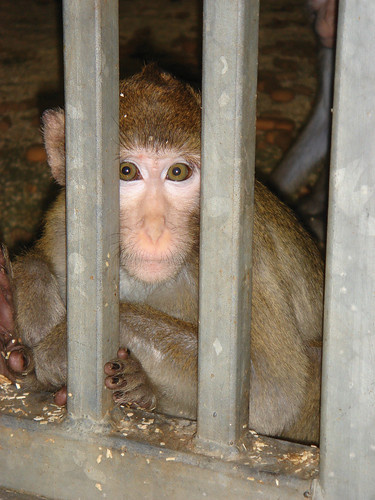
Love the monkey

I was sorry recently when our minister said in a sermon that he had tried meditation for six months, but "I couldn't stand that monkey mind." I was afraid this statement, backed by a minister's authority, might have the unhappy effect of assuring people that an unpleasant experience is enough reason to give up practice.

"Monkey mind" is a common metaphor in Buddhism - the mind as a nervous monkey, jumping from branch to branch, chattering and shrieking. No peace and quiet, not the bliss we are all hoping to find.

But the fact is, this is not just about mental activity. In itself, an active mind can be delightful. Sometimes we seek it out in scholarship and debate. Some people enjoy flashy movies with car chases and explosions and confusing plot twists, or concerts with smoke and mirrors and surprises in the aisles. The monkey mind people can't stand is something more than just excitement and sparking thoughts. And it is not Creative Monkey, brimming with ideas now that he has a little space to think, or Planning Monkey, who won't let go of the to-do list. It's worse. I'm talking about Obsessive Monkey. It's this one people can't stand. I know it intimately.

It got me right away on my first weekend retreat. Everything was wrong. The basement space we ended up in was ugly and crowded, not anyone's idea of a spiritual space, and smelled of mold. I am allergic to mold. It was hot, very hot and humid in that airless room, a thunderstorm in the offing. I was sweating. I hate to sweat. The chair I sat on was vinyl, and I was wearing shorts. Whenever I peeled my sticky, burning thighs off the chair and readjusted myself, the noise was loud. The leader cautioned me to stop doing that. I burned with embarrassment.

In a lengthy lecture on Zen etiquette, all new to me, we had been told we had to come to every sit, had to walk in a line to the dining hall holding our hands in a certain posture and looking down, and they were going to wake us up at 5:00 in the morning. I was too shy to ask if it could possibly be true there wasn't going to even be any coffee before the first sits. (Yes, it was true, proving to me that I could live through even the most extreme hardship.)

It was insane. I felt somewhat like I had been dropped into a really bad high school play written by someone with issues. And my body was giving me fits. I have fibromyalgia, and trying to sit up straight in that stupid vinyl kitchen chair made my back hurt all the way up to my neck. My head ached, my jaws ached, my shoulders seized up with pain. You weren't supposed to move, not that moving helped for very long.

I had been meditating for about two years at this time, but my method failed me now. I could only think of how incredibly miserable I was. Quickly these thoughts became an obsessive anxiety: I can't stand this heat I don't tolerate heat well Tom knows that could I get him to leave he won't leave tonight, he's like that, he always sticks things out maybe I can get him to see how much I'm suffering he could get a ride home with someone else maybe he would leave tomorrow, maybe at noon maybe we could compromise marriage is supposed to be about compromise. . . . Hot, it must be a hundred degrees in here, when is it going to storm, I can't stand this I can't stand another

Suddenly the teacher at the far end of the room shouted into the quiet, Sink into the heat! Everything in my mind crumbled and fell to the floor, as at the same time my stiff, suffering body relaxed and I exhaled. I felt -- well, there. Relaxed. I was just sitting in a chair, no longer resisting the discomfort with all my heart and soul. The monkey fell quiet.

From there on the retreat became a memorable experience, and I will always be grateful to that teacher, Daniel Terragno, for his kindness to a novice. By 9:00 Saturday night, the end of a full day of sitting, I felt clarity and peace. I recall going into our room and turning on the big floor fan, looking out the window at a field of golden grain gently waving in the twilight, and thinking I had never seen anything so beautiful. I was perfectly happy. When I told the teacher that the next morning, he smiled and said, "This too shall pass."

Thinking about this experience reminds me of the importance of having teachers whose job it is to help you cut through your stuff, to surprise you out of your obsession, to assure you your experience is normal and encourage you to stick with the ups and downs.

Lay people, even those who have teachers, meditate at home most of the time, where Obsession Monkey can catch us off guard. His chatter may be about some problem with another person, someone who hurt you, a painful memory, an anxiety, a symptom you're not attending to - in short, something you'd rather not think about. My experience is that I have to turn the volume down on the chatter and sit for just a moment with whatever feeling it is arousing. And then return to my breath. And return to my breath again. That doesn't mean I can ignore the issue.

When an obsession is loud and persistent, it's a psychological or life problem that we're being called to pay some attention to off the cushion. It isn't coming up for no reason, and it isn't irrelevant. It's coming up because meditation gives us the space, the occasion, to meet our real self. This is exactly the time not to quit practice.

In other words, love the monkey. That monkey mind is actually our friend. It is us, our own mind demanding we pay attention to our own reality. It is one of the ways a steady practice leads us toward a more peaceful and satisfying life.

Monday, March 9, 2009

Eating a Big Mac, for example

[Chad Foster, of North Huntingdon, Pa., gazes at the world's largest Big Mac sculpture (14 feet high, 12 feet wide), at the grand opening of the McDonald's Big Mac Museum Restaurant in North Huntingdon, Pa., on Wednesday, 2007. (AP Photo/McDonald's Corp., Henny Ray Abrams)]

It happened again today. I was in the shower thinking about the things I want to do today, matching them against my priorities, revising my mental schedule, when Lakein's Question came to mind:
What is the best use of my time right now?
The answer popped into my head: taking my shower. I could - just do what I was doing, take a shower. Instead, I was sending my thoughts out for a planning session. As I say, this is the second time this has happened in the last week, and it is happening the way Alan Lakein advised in his book: the answer popped spontaneously to mind, and I knew it was the right answer.

What a pleasure it is anyway - a hot shower with Caswell Massey rose soap, in your own comfortable bathroom, the electric heater turned on, the towels just the kind you like. Over and over, it's the same simple lesson - just be where you are, do what you are doing, do it all the way without sending some part of yourself somewhere else. So often that turns out to be enjoyable. In a way, it's the other face of something I write about more often, the need to let our demons in the door.

At one retreat, Daniel Terragno Roshi talked about this issue of holding parts of our experience at arm's length. "If you're going to make a mistake," he said, "do it. If you want a Big Mac and you decide to have one, enjoy it." Of course, we serious Zen students could be heard gasping in the noble silence. But here and there you could see a mischievous smile.

Thursday, December 18, 2008

Very satisfactory vices

[video: a Rhoomba and a more cooperative cat than Sherlock]
I have to accept it - I can't write while the robot is vacuuming, anymore than I ever could while a more sentient creature was cleaning my house. It isn't guilt that bothers me now, it's just that the darn thing distracts me; that is, I am so distractible. So the Roomba is shut off for the moment.

It is a tool I bought myself to make housework easier, or at least possible. I could tell you how it is that Tom and I, considering our disabilities, really should not be vacuuming. And that's true. But like so many tools, it is at least half toy. And in my world, playing tends to qualify as a vice.

For some time I have been studying with fascination a talk by an unusual Zen Master named John Tarrant. I feel connected to John because I studied for a while with one of his students, Daniel Terragno. Also, he is a poet. Here is the paragraph that interests me:
Athletes are trained to not get interrupted by their scenarios. Otherwise if someone insults you on the field, you lose your game, and what’s the use of that? Another example would be for a disabled person to say, "I am disabled so I can’t do anything, my life is over." Even though you may have plenty of data points to back it up, that is a scenario that won’t help you. Without that thought-world you might find that you can be disabled and develop plenty of very satisfactory vices and live a rich, complicated and difficult life.
from The Moon Sets at Midnight
Well, this is me he's talking to. Disabled by advanced kidney disease (not my fault!) when friends my age are still working and traveling and doing their own vacuuming. But this being a blog, I'm not going to explore the entire paragraph right now, not even the vital last words; just the surprising part I italicized. What is this? a spiritual teacher recommending vices? I looked up the word.

"Vice" is not necessarily downright evil, or social transgression of the sort vice squads and some churches deal with. The word is also used to describe an imperfection, a frailty, a practice considered immoral by your society. But it isn't society whose judgment I have to fear these days, since I am free of the workplace and its demands for respectability; it's my own. I learned as a child to consider all sorts of things weaknesses. So it was with pleasure that I read in another one of John's talks that his students often tell him he's fat, and he admits it, no problem. His photos show a man who likes to eat, and enjoys wearing a great hat.

Zen attracts a fair number of skinny, serious people who like to dress in immaculate black, and are convinced Zen will make them more perfect. I have noticed that the better teachers try in various ways to knock this form of self-imprisonment out of their students, often by just being who they are and fielding the criticism. Sylvia Boorstein drinks coffee, not tea; Bernie Glassman loves pizza; Daido Loori smokes.

Well, I got to thinking about this idea of "satisfactory vices." I am pretty old now, 66, and there's hardly a vice that could do me any harm at this stage, though I have to be careful about elements of my diet or suffer serious consequences. I used to love smoking, but I don't want to take it up again, and I've learned that I can't just smoke one. I'm not attracted to alcohol on a regular basis, or to the way people act when they're seriously drinking. The only effect of pot is to make me really hungry. Drugs to space me out would be simply redundant.

But my imagination was too limited. I already have vices, I just didn't know it. I realized that as I sat here happily in my study, surrounded by a herd of Devil Ducks, a passion I share with my grandson, watching my Rhoomba wander around the room. Yes, I have a vice, maybe the worst possible thing my parents thought could happen to me: I don't like to work. I like to play. My father called that being lazy.

When I have work to do, I work, always did, and there a certain inherited perfectionism comes in handy, if I don't let it take over. But when I don't have to work, I don't go find something useful to do. I blog . . . play on YouTube . . . watch DVDs of A Touch of Frost . . . sit around and read the Times . . . visit with friends . . . write poetry I don't bother to send out. And that somehow tempts me to end with one of my favorite poems, which makes a very good case for being lazy. Maybe it's really called "living."

Lying in a Hammock at William Duffy’s Farm in Pine Island, Minnesota
by James Wright

Over my head, I see the bronze butterfly,
Asleep on the black trunk,
Blowing like a leaf in green shadow.
Down the ravine behind the empty house,
The cowbells follow one another
Into the distances of the afternoon.
To my right,
In a field of sunlight between two pines,
The droppings of last year’s horses
Blaze up into golden stones.
I lean back, as the evening darkens and comes on.
A chicken hawk floats over, looking for home.
I have wasted my life.