Tuesday, May 29, 2012

The Fast Lane

Over the last couple of weeks I have had to face the condition of this body-mind - I don't say "my" body because it's pretty clear I'm just renting it from the universe.  I'm getting afraid of getting that final eviction notice.........
And of course, it's not just about that deteriorating spine, cervical, thoracic, lumbar, the osteoarthritis has covered every base.  It's -

Distraction.  Did it take me half an hour to figure out how to put the Google calendar gadget on my home page? then, how to add to it?  And why was I in my e-mail anyway, that caused me to see it?

Actually, that is not off the point at all.  The point is, I'm old.  I'm not just getting old - you could say I'm getting older; I'm old.  Case in point, why do I still have my regular glasses on?  I need to wear my computer glasses when I'm at the computer or I make my neck hurt trying to look through the screen at exactly the right angle.  I can't do that bifocal tilt.  Like I said.....
~~~
And now it's an hour or two later.  1:00 pm, to be exact.  Lunch at 2:00 and I haven't worked on my collage for this week, except in my mind.  It was more important to catch up with my friend Laurie, and to pack a hospital survival gift basket for Tina, who is in intensive care in the heart unit, I'm sorry to say.  She is 76, I believe, and has struggled with breathing problems for years now.  Death will be a relief from that.  She doesn't want visitors, so I'll drop the basket off.  Someday I'll write to tell you guys how to pay a hospital visit.  I do know how.  But I am not only respecting Tina's stated wishes, I also know hospitals are danger zones for me, on immunosuppressants.  So I don't insist.

And my e-mail just beeped to inform me that Sarah's funeral is next Saturday....I can't figure out how to add it to the Google calender now.  Pause to add it to my phone calendar, at least.  It will send me an alarm to remind me, too.  How does any old person get by without a smart phone?....

And got an e-mail from the museum about a lecture on Degas' dancers next week, and I have the perfect friend to go to with it - an artist and a dancer (though no longer dancing on her feet).  Left a message with her.

I was going to say, it's been very very very very hard to accept being this old, as if it happened all of a sudden, though it didn't.  The back thing has scared me, that's the truth.  MRI this Friday eve, so we will have you know, more information.  Then options.....And I think maybe this post ends up showing not only how it is to be old in your body, but also how you begin to constantly lose people you love, and that will go on until all your friends and family are dead, though I dearly hope never to lose my daughter and grandson (still, it can happen).  It's constantly acclimating to the changes in yourself, which feel right now like a snowball rolling downhill.

Sunday, May 27, 2012

How to Get Found when You're Lost

Deep Valley, Guo XI

                        Lost
                             David Wagoner

Stand still. The trees ahead and bushes beside you
Are not lost. Wherever you are is called Here,
And you must treat it as a powerful stranger,
Must ask permission to know it and be known.
The forest breathes. Listen. It answers,
I have made this place around you.
If you leave it, you may come back again, saying Here.
No two trees are the same to Raven.
No two branches are the same to Wren.
If what a tree or a bush does is lost on you,
You are surely lost. Stand still. The forest knows
Where you are. You must let it find you.


from Collected Poems 1956-1976 © Indiana University Press.

Thursday, May 24, 2012

Standing in the midst of the mall

Recently we had occasion to go to an enormous glittering mall.  We ate lunch on a mezzanine  above the crowd, watching the people.  It seemed that many use this as a place to meet, to wander.  It's like a giant party, much more mixed-race than it was 20 years ago; in fact, just recently a census showed that Caucasians are now a minority in births in America.  To get perspective on this, when I was in high school in the fifties in a very ordinary middle-class neighborhood, there were three black people in my class of 600, and no Asians.

Being in the midst of the mall made me think of something that happened in our Buddhist meditation group years ago.  We always ended by standing in a circle holding hands, and saying these words as a chant. 

Praise and blame,
gain and loss,
pleasure and sorrow
come and go like the wind.
To be happy, rest like a great tree
in the midst of them all.

           (the Buddha)

An older woman named Marie, an artist, became a constant member of the group.  After some months, something cued her to understand that the chant meant you stand in the middle of all those winds of change in the relative world.  She laughed and said that she always thought the last line was "in the midst of the mall."  I still love that.  If you are a householder in America, a layperson, it describes the challenge much better than the original.

What is it that thus comes?

The I

This morning I was led to a little story that I found here in Sweeping Zen.  This is a piece of it:
The Chan Master Nanyue  Huairang visited the Sixth Ancestor, Huineng.
Huineng asked him, “Where do you come from?”
Nanyue   said, “I come from the National Teacher An on Mt. Song.”
Huineng  said, “What is it that thus comes?”
The Master was without means [to answer].
After studying with Huineng for eight years, he finally understood the previous conversation.
Thereupon, he announced to the Ancestor, “I’ve understood what you put to me when I first came:  ‘What is it that thus comes’”
Huineng  asked, “How do you understand it?”
Nanyue   replied, “To say it’s like anything wouldn’t hit it.”
What is this "I"?  Any way you describe yourself feels woefully inadequate.

Then on I went to my collage group, where I created a vertical piece.  I'd like to show you a photo of that, but my computer is refusing to do it.  You could see it if you just picked up your monitor and rotated it so the blue patch is in the upper left. But I found I like it turned this way much more.

What we all love about creating collage together is the non-thinking.  None of us tell stories with what we do; we play with shape and color.  Knowing that art doesn't have to be representational is one of many reasons it's good to live in the modern age.  Our assignment this morning was think quilt.  I am also always reminded of Joe Brainard's earnest advice:  just glue something down.

So I began in the upper left, with that lovely piece of blue handmade paper, my intention being Patchwork.  I thought I would work from left to right, one row at a time, the way you make a patchwork quilt.  We all murmured a bit about quilts we knew as girls, when women made quilts out of old clothes, and their function was to keep you warm.  But soon we settled down and the silence became absolute. So often, art feels like a sacred practice.

It seems that the main purpose of any assignment is to give me something to rebel against.  Sure enough, I didn't get far before I felt my plan to imitate a quilt was boring, so I left it.  Then it got to be fun.  Especially when I found the letter i.  I decided the collage was about "The I" - the self, this one, and its place in the universe.  The last thing I did was put the i in what is now the lower left-hand corner.

There is always a lot of space in my collages; I remain intrigued by the space everywhere, inside and outside this body, the idea that the shape of the empty spaces is as important as the images in it. And also, as I face my often-frightening old age (my back really hurt today), I feel better remembering how small I am, how big the universe, how spacious.  Collage is a somewhat more impermanent art than carving stone.  I like that about it, too.

Tuesday, May 22, 2012

Nothing extra

Tashi contemplating tea
Last night watched the last episode of House, which ended well, he and Wilson on motorcycles going through a digitally-bright-green landscape....maybe this is the end of an 8-year episode in my life, too.

Perhaps unrelated, I decided I need to turn back to Zen, to the simple bareness.  I read some in Branching Streams Flow in the Darkness, and was struck by something Suzuki said in answering a question, Why do we shave our heads?

“We should not have anything that is not necessary.”

A mind like mine begins to parse “necessary.”  Looking it up doesn’t illuminate it.  But I remembered the sentence somewhat differently, like this -

“We should not have anything extra.”

So I began to think about how bare and simple life is on retreat:
There is my little room (no socializing, no talking, no decorating or art). 
There is my bed, that I sleep well.  Thought, must order new sheets today.
There is my food.
And water.
My body, whatever else it needs, taking a shower, taking medications, moving it, sitting in meditation. My mind needs that, too.  Body-mind.
There are clothes that are comfortable and protective and not distracting and just enough.
    (whoa, wait...earrings?  I suppose we shouldn’t stand out so much)
    (How do fun and making art and personal-clothing-art fit into that?)
So I thought, retreat strips away the unnecessary so you can be with the very simplest thing, your breathing. Being awake or asleep.  Sitting or walking. Wearing shoes, taking them off at the door. What a relief.

When you think about “nothing extra” you think about your things  (which are an ominous gray area) - and the visual clutter of your house.  Those of us who have houses and things.  I left that out -

There is your shelter.

Its actual purpose is - shelter from the elements, and safety.  Beyond those walls and doors and HVAC systems, roof, gutters, and what you sit on and cook on, beyond that everything is extra.  And 90% of what is in my kitchen goes unused most or all of the time (the Bundt cake pan).  It is not necessary, is it?

And how simple life was when all you had was a typewriter.  Oh, go back before that - van Gogh would pick reeds, sharpen them into pens, and draw with them.

If you had a camera when I was young, it was film and it took a limited number of pictures per roll, and that cost money and took time to get developed.  Now you are plagued by pictures, they are another something-extra problem in your life, how to organize them.  This is making me smile and chuckle at the ridiculousness of it all.

And let us not forget, as Suzuki once pointed out, there is the broom with which you sweep.  It should be stored upside down, so the bristles don’t wear down so fast.

And there is the cat who lives with you, her litterbox, her food, her measured probiotic, her need to play, her anxiety when you leave.  What a wonderful complication love is in your life.

Monday, May 21, 2012

Imagining Old Age

I have been meditating about another way to think about aging, a new paradigm. And my heart is stirred this morning by reading in the NY Times "Metropolitan Diary" about a woman whose sister created suicide because "she couldn't face being sixty."  How very sad.  But very American.

The way we think here is that life is a bell-shaped curve, up from being useless to becoming an energetic adult and working and being productive and active and always youthful and energetic, then aging, a steep downhill fall to being useless again.
[Here, picture that curve in red.]

We may not be aware of this picture in our minds, but we do, as a culture, think that way.  It is a way that emphasizes "productivity," in terms of earning money and other benefits, like fame and power, which are seen as good, rather than something to be avoided.

But you can imagine the course of a human life differently.  You can see life as a slow, gradual climb into wisdom and spiritual depth.
[Imagine that line as a pilgrimage, going gradually up toward light.]

You can think that at the same time as we grow in compassion and wisdom, our life unfolds into the world.
[Like so many colored strands of thread moving into the world like rivers, curling around, embracing it.]

That is a life of connecting and giving that can become richer in a peaceful old age.

Offering birds bits of yarn in a suet feeder for their nests

Sunday, May 20, 2012

What Moves You?


[If the above video doesn't open for you, it is Alison Kraus singing "Down in the River to Pray," from the film Oh Brother, and is available on YouTube.]

This morning I heard from a friend who has struggled for many years to reconcile reason and spiritual experience.  Or maybe the problem was that he wanted to reconcile reason and faith - what people believe about that which cannot be captured in a laboratory (which is most of everything).  He wrote about being tremendously moved by music sung in a foreign language.

I feel that too, but also thought of how I have been moved sometimes by the captured/expressed energy of visual art.  The scene above is a lovely marriage of visual art and music, the ethereal chorus moving slowly and in harmony toward baptism.  The river, a symbol that is universal wherever people have rivers.  I was also thinking of the time I walked around a corner in The Museum of Modern Art and found myself face to face with a small painting, "The Starry Night."  Layers and layers of paint.  It hit me in the solar plexus.  It is the most famous of van Gogh's many attempts to capture "It," the divine essence in everything. If you like, you can go here and scroll down for a brief experience of it.

Daniel Terragno once said to me mildly, "Zen is not for everyone."  In fact, Zen claims that the essence, reality, the sacred is everywhere in everything.  Where is it for you?  Is that in your life?

Wednesday, May 16, 2012

Where Feminism Failed

I consider myself a really good feminist - Not to brag, but I wrote what has been called "a classic feminist fairy tale," The Princess Who Stood on Her Own Two Feet.  I founded a chapter of NOW in my little town in the early '70s.  I spoke to the Kiwanis, on the radio, to a committee in the Ohio House about sexist language, I did seminars on sexist language.  And so on.  And overall, I'm disappointed in what it has led to.

I certainly don't mean I'm disappointed in the expanded opportunities we got for women.  When I was in school, there were no girls' or womens' sports, except gymnastics, an occasional diver. By the time my daughter was in high school, she could be and was on a mixed swim team.  There is talk now of accepting women into training that would let them lead infantry into combat, no different than men.  I think the statistics look good for a lot of things that were once taboo, and there are more women in technical and scientific fields.  Single women can have babies or adopt them, and raise them.  Without being married, ever.

But what I see around me is that in a pervasive general way, women have failed to get it.  It goes like this:  If you are cute and silly and talk with a little lisp and go around the office in 5-inch heels with cleavage showing, people are not going to give you the respect they automatically give a man.  You'll have to work twice as hard to be taken seriously.

You could blame Dr. Lisa Cuddy on House for this.  I am a great fan of House and Hugh Laurie, in particular, and I watch it.  But I never fail to shake my head and mutter at Dr. Cuddy's clothes.  Skirts that fit like a snake's skin.  Boobs falling out of her top.  Stiletto heels.  No. I don't believe it. You just don't become Dean of Medicine dressing like that. But then, a doctor can't go around looking like Gregory House, either.  A woman who had ambition would figure that out.  Her mentor would tell her.

Ladies, wake up.  If you present yourself as an eternally young and cute sex object, you will not be admired for your mind or your competency.  You can't do it both ways at once.  You can run around dressed to incite lust on the weekends, maybe, depending on how much you run across your boss.  But in the world of work, dress to be respected.  I deeply believe that women who respect themselves can still find love. I know it.

Below, how a successful doctor looks in real life. 

This is Dr. Nancy Snyderman with some guy (okay, it's Jeffrey Immelt, CEO of General Electric).  Notice that she, in fact, looks a little more professional than him, with her pearls. I guess a CEO can get away with not wearing a tie these days.  Dr. Nancy often appears on the NBC nightly news, well-spoken, knowledgeable, attractive, feminine, but not cute or sexy.

Maybe Dr. Nancy once read Dress for Success.  Following on the feminism of the 60s and 70s, there was a vogue for women wearing suits and nice blouses with bows or silk ties. I still have a couple of those ties, too nice to get rid of, though they don't go very well with yoga pants and tennis shoes - I'm old, that's different.

In closing, an illustrative example.  Some time ago a mature woman joined my church.  Right away people started dropping her name as someone who could be on the board, things like that.  As I explored it a little I found that she'd never done anything in the church.  Anything.  Why did people think she was competent?  I'm convinced it's because she always wore a suit or tailored jacket, and they were nice clothes, too.  She looked professional.  As long as she didn't open her mouth, nobody would ever suspect otherwise.

I know, the world shouldn't work that way.  Wouldn't it be nice if nobody judged each other on our looks and how we dress?  Yes.  If I ever find that utopia, I'll be sure to let you know.

Friday, May 11, 2012

Mothers and Moms

I would be crazy to say anything against the term "Mom," which is firmly fixed in our language now, as in SAHM. I will just comment that as a person trained in the ways language impacts us, that I think a Mom is different than the Mothers of our youth (mine and Tom's, your youth if you are much over fifty).

Perhaps in illustration, I recall a Sunday dinner with my high school boyfriend, whose parents were immigrants and went to the 9:00 service in German at their Lutheran church.  His older brother was there, too, with his fiancee, a really sweet, feminine girl named Ann.  Al's mother made rolls every Sunday as part of a very nice 1:00 dinner - from scratch - it was the late 1950s, and cake mixes hadn't been around that long.

There was something stiff and silent about those meals.  At one point, into the silence, Ann said, "The rolls are really wonderful, Mother Nickles."  I'd never heard anyone addressed like that before.

Al's parents were the kind of parents who expected respect. That same year, perhaps it was before Easter dinner, Al said to his father (as he reported to me), "Why can't we do some other kind of grace before dinner once in a while?"  His father knocked him across the room. Somehow, Al had not expected that.

Oh, I am not standing in defense of this kind of parenting, a pure form of patriarchy and its rigid ideas about heirarchy and how people ought to act.  But I confess to an internal sigh, when someone talks about herself as a Mom.  There is something very friendly and casual about that.  But mothering is a pretty intense occupation.

When I was growing up, our mothers were not our friends.  Though as I think of it, I was very close to my mother in my twenties, and ended up at one point in my thirties in a different role, advising her when she was going through a nervous breakdown.  What did I know?  But I told her, "You need to go to college."  She must have wanted to, because she did, and attained an Associate Degree.  Later she would say those were the best years of her life.  She was the only one of twelve kids in her family to go to college; it was my generation that got nudged into degrees and attainments.  Her generation stayed in The Mill - Youngstown Sheet and Tube. My father was the exception in his family too, went through college on the GI Bill.

This is early, but if I try to save it for Mother's Day Sunday, I am likely to forget to post it.  And it does give me a chance to say, if you don't have children yourself, you might not realize how much it means to get a Mother's Day card and gift.  It's different than any other honor I've known.

[image: a tree peony with a Polaroid effect applied.  Instant cameras were the greatest thing back then.]

Thursday, May 10, 2012

Along the Healing Path

Tibetan body mandala
I feel I'd like to write about how I feel these last few days, without a UTI or a cyclical biochemical depression. Maybe this is a place spiritual practice can put some people in full-time. Calm, clear, balanced, without anxiety, focused, unhurried, just okay. It is at least pleasant to be alive, maybe quietly joyful.

Before I began serious daily practice, I was never in this state, unless it was in yoga class. I had far too much anxiety, anxiety about everything you could name; that's the nature of the stress syndrome in a traumatized child. My father had it from his service in WWII, if not before then, and passed it right down with moment-by-moment criticism and worse personal invasions.

What does meditation have to do with that? For one thing, you are brought face to face with yourself (an odd image). You can't handle anxiety until you listen to yourself, and know when it's there, and begin to see what gooses it up and to work with it. 

The other part of feeling good is, for me, being balanced, neither depressed nor manic, fire not too low, not too high....I don't know yet whether long difficult moodswings are the heavy furniture of my mind, nailed to the floor, since I'm not dead yet.
~~~~ next day:
I am enjoying a Deepak Chopra online program, and as I lay relaxing this afternoon, I remembered something I heard him say on the radio a long time ago. It didn't take long to find it in an online ad for his healing retreats:
Consider the example of multiple personality disorder. People suffering from this severe psychiatric illness aren’t affected only at the psychological level. When they shift from one personality to another, dramatic changes can occur in their bodies. For example, one personality might have high blood pressure, while another personality within the same person may not. One personality may have diabetes, while the other personalities test normal for insulin levels.
I know blood pressure is very responsive to emotion; it was the insulin claim that struck me then.  Now I understand better the intricacies of metabolism, and of energy, and am not so automatically skeptical, so the diabetes claim sounds reasonable.  I lay there and thought of myself as a healthy person without UTIs.

Meanwhile, the universe tried to help me today by having the Humana nurse call me just to figure out if there's a way to make me less expensive.  I talked with her about the UTIs, and she said, "Drink water."  And a little talk about how it keeps the system flushed.  I recently upped my water from 3 liters a day to 4, having this in mind, and I was glad to hear it again. I like to work on all possible angles.  As they say, Trust in God, but keep your camels tied."

Tuesday, May 8, 2012

What is sane, anyway?

Scientific American is asking us to think about "what it means to be sane."  I know that, and here it is: you are sane when the people around you think you are. 

This becomes really interesting when we start to think about art.  My guess is that half of all visual artists and literary writers are not really very sane.  As a bipolar, I've been interested in research on this.  So let me ask, if your teenage boy came up with this --

 would you be alarmed?  Believe me, some people would.  They would be thinking, my God, is this how he thinks about women?  Is he a danger to society?  That boy's sick!  Some people live in a context in which many things are defined in certain conventional ways, and the boundaries may be narrow.  It is claimed that one in 20 Americans owns a painting (or reproduction) like this --

It is pretty.  The colors shine, the barn is in good repair, the scene is tranquil and includes both sky and air. There's a cow, and ducks.  I'm trying to concentrate here, and it's hard, because . . . it is, though I am impartial in that I don't want either of these in my living room.  But I want to make a point not so much about Art, as about being careful how we decide who's acceptable, what's sane. 

Does either one of these paintings represent reality?  No. You know they don't.  Each is an artist's dream, so to speak, a rendering of the way their brains image things.  The first painting, you can tell it's a woman.  It is by de Kooning, and sold for $137.5 million dollars in 2006. Now, that is insane, but the collector who bought it thought it was a good investment, and something fun to do with his extra money, perhaps.

The second painting is "realistic," you might say.  You know those are ducks, even as you know nothing really looks like this outside a Disney sound lot.  Thomas Kinkade, who painted this and many many other paintings like it, recently died wealthy, though with an estate in considerable disarray. Neither one of these artists was someone you want raising your grandchildren - both took alcoholism to its  illogical extreme. It may have killed Kincade, in fact; the autopsy results are still pending.

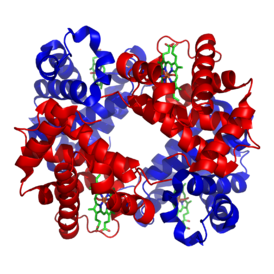
Now the image below would have been created deliberately, perhaps by a commercial art student who is staying out of trouble, but the original might be a sort of accident, like colorful shavings collecting on the print shop floor, or it might have been carefully devised.  I don't know.  There are many, many copies of this in your body; you would not be alive without them.  It would identify you as human if the issue were in doubt.  And it is just the same, I understand, in every one of us.
1GZX Haemoglobin.png

As you may know if you're a med student, it's the structure of adult human hemoglobin.

Sunday, May 6, 2012

Against the subjunctive

Why do I have to write about important things?  (Are there such things?  How do you tell important from trivial?)  So I will write about a tee-shirt that has inspired me, but first I'm going to write about when Otto went to the zoo.  Age three.

At three, many children are still enlightened, and he was one of them.  One day Cassie and I took him to the Columbus Zoo, which is very nice indeed, though it has no jumping pigs.  I think, looking back, that he was finding it all very bright and confusing.  They live in the country and at that time had two St. Bernard dogs.  Was he supposed to be impressed by a mangy-looking wolf that just laid there in the shade?  But even little kids try to please you, and he trundled around with us.

When he got home, his Dad asked him, the way grown-ups do, "What did you see at the zoo?" Otto was glad to comply.

"There was this big pile of ketchup!" he said.

Unimpressed by a herd of flamingos, bored by the elephants, what he had seen that was memorable was in The Congo Room, one of their food pavilions.  It had a big ketchup dispenser, always a thrill for a little kid anyway, and a lot of ketchup had been allowed to drip down there and form a little mountain.  You never saw anything like it, and if you were a grownup, you didn't see it, not really.  But Otto did.  Strangest damn thing he ever saw. I hope he doesn't grow up to be a food engineer or stylist or something as a result.
~~~~
These marks ~ like this ~ are called tildes.  You don't care, I don't care, though having names for things is useful, or you end up having to say, I don't want the red stuff on my hot dog, I want the yellow stuff.  And (a conjunction, pretending that this sentence is related to the one before it) the following statement is in the subjunctive, because it indicates a condition contrary to fact:
If it were easy, everyone would do it.
Because see, it's not easy.  What's not?  Sometimes I think everything's not, so it is useful to remember that nothing matters.  Well, I saw the above  motto on a tee-shirt at the health club recently, and immediately wanted to buy Cassie one like that - she once looked terrific in a Nike shirt that said in huge letters -

This was before this was morphed and marketed to death, and it struck me as a pretty good principle in life.

Now.  Back to the first motto.  I wouldn't have said it that way.  I'd have said -
If it was easy, everyone would do it.
Wouldn't you?  Well, maybe not.  I live in Ohio, USA, and learned my English the rough-tumble way.

I see these niggling distinctions as basically serving to indicate subtle divisions of class; in other words, my dislike is political.  I was happy when I learned, in a linguistics class, mind you, that there are two approaches to grammar.  There's Prescriptive, the kind we were graded on, and Descriptive - that is grammar that describes the way people actually talk.  So if I were you (which I'm not, that's why I use the subjunctive there), I'd get the second tee-shirt.  When you wear it, you will find out which of the people around you is a member of the Secret Grammar Police.  Then you can avoid them.

Saturday, May 5, 2012

The Problem of Mother

My life is flowing past me like a bad movie back in the old days, when you went to a theater to see a movie with other people, and no one was texting.  And everyone just sat there, no matter how boring the movie was, how idiotically violent, just to see what the creature from the black lagoon looked like (not much).

My morning started with an obdurate computer. Windows open, the weather is freakishly warm again, and the computer doesn't like this natural world either, the moisture perhaps.  Waiting, waiting I realized the depth of my dependence on it.

There is a natural transition here - the word dependence - to The Problem of Mother.  Yesterday we spent two hours on phone conference with Mother, Good Sister, Gentle Eldercare Attorney, me and Eldest Brother, that's Tom, all trying to convince mother that she must go into assisted living.  She has dementia, has given lots and lots of money and stuff away to the evil scammers that pop up out of the dirt where there are supposed to be bodhissatvas.  Yet, all concerned were trying to reason with her.  She is very good at pretending she hears (oh no, no hearing aid) and deflecting decisions, has been doing it successfully all her life, and she's not about to make a major life decision now.  Someone is going to have to tell her, This is what we're going to do. But I can't convince them of that.  They want to believe she is reasonable.  So not only is she crazy, so are they. 

I feel that when it comes to crazy people, I know.  And it is a special dispensation. I have been crazy (a long time ago, quick to add), and in hospitals with other crazy people.  And somehow those experiences alienated me from the delusions shared by much of the world - or maybe that's what being crazy is, come to think of it - not sharing in the general delusion.
Why do these things with mothers make us all so insane? That is, why do we not see the reality before us, that Mother is very old (90) and not able to remember to lock the door or say no to people who try to take advantage of her.  (Dad is in skilled nursing, and likely to be in it the rest of his life; and not able to be part of decisions.)  Therefore, we must take over and move her somewhere where she is not in danger.  And it will be nice.

Well, just hone in on the question:  Why do we not see the reality before us?  Because it feels better not to.

As a kid you're pretty stuck with TV and games.  As an adult you can do that feeling better-denying reality-thing a lot of ways:  Ativan, gin, running breathlessly from one social event and one responsibility to another, hey, reading and blogging and painting - What's your favorite hedge against reality?  It's the curse of these much-larger-than-necessary human brains - they can be used to evade reality in a great many complicated ways.

Now, specifically onto mothers: all this took me back ten years to going through this kind of hell with my own mother and my siblings, who simply would not see the obvious truth of our mother's impairment, which included fecal incontinence.  Why?  I did not understand - I thought it was because they were drunk.  That was true, but something else is at work in these things.  And that is that the idea of a motherless world is quite frightening.  I found that out when my mother died.  Suddenly the sky was vacant.  My mother was not a kind, nurturing person.  Yet, or because of that, her death was a huge blow to me.  Maybe it's an energetic thing, that we are included in some sphere of home.  I doubt that it's all in your mind.

But it was and is a motherless world.  If you believe in or experience a caring God or universe, I'm sure it's easier to accept this.  Even so, the only thing you can count on is that the world changes constantly, you have nothing to stand on.  No security.  No assurance.

You can't count on anyone you love being here tomorrow, as much as I also hate to think it. You can't count on having the body or mind you have at this moment.  In fact, it is all a day older and more worn down today than it was yesterday, and this is true whether or not you're paying attention.  And the problem Mother is having is that she simply will not acknowledge the reality that she is old and forgetful and impaired.  My goodness.  Just like the rest of America, which was explored by a man looking for the fountain of youth.

Many spiritual people talk about a state of enlightenment in which we just dance with the flow, in which we have a quiet, consistent joy all the time.  If I find out where that state is located, I'll let you know. I think it has to do with understanding that nobody else is enlightened, either.

Meanwhile, I was struck with this lovely white-seeding grass (not photofixed).