Thursday, August 30, 2012

Coming Out

Strawberries in their green hats


If you do not say 'good'
and you do not say 'not-good,'
then what is the nature of reality? 

I think I've written before about this koan, the first one I ever came across, not counting "What is the sound of one hand clapping?" since I didn't seriously see that as a koan until a few years ago.  The above question is in the little classic Zen Flesh, Zen Bones, which was the first such book I owned.  Maybe the first I ever saw.  I must have plucked it from a bookstore shelf because the word "Zen" signified to me a life of clean, orderly peace.  (Wrong again.)

You may react to it like I did - WTF?  Seriously, in that age before the internet and its acronyms, I wondered, But how can you not judge things and like things or dislike them?  Obviously, things are good or bad.  I wondered that every time I picked up that book and read it.  Maybe that means I was "carrying the koan," as they say; not trying to decipher it, not puzzling over it; just had it in there, not making sense.

I started to understand it when I began to do loving kindness meditation (metta), which is a structured kind of prayer or intention that includes "a neutral person."  Like many people, I discovered that I either liked or disliked practically everyone.  That slows you down, seeing that.   I was dividing the world as my alcoholic father taught me by example: either "he's okay," or "he's an a------."  I didn't think in those terms.  I just liked or disliked people, an in-law, the mail carrier, the checkout clerk.  I had to use strangers in that space.  That turned out well, but that's a story for another time.

Last Sunday morning, deeply depressed and distraught over the sparsely-attended funeral of a friend, I posted a post called "In Memory of a Wild Flower."  It ranged widely, blaming our minister, Mark, for not saying good things about her, for telling many things she had kept secret during her life; blaming others in the church who had not liked Teena or me or had let me down at one time; blaming her family for, it seemed then, not forgiving her even a little. I was ready never to go back to that church again.  I have taken this post down for now, and will repost it after I revise it in light of what has happened since.

What happened was that I heard first from Mark, and his long post was clearly compassionate.  I answered, he wrote back.  Then I ran into a woman I'd targeted in that post (though not by name), who must have heard about it, and put her arm around me and was so kind and reassuring that I burst into tears.  Meanwhile, I heard from friends who suffer as I do, some of them with serious diagnoses I had not known about, some telling me, "I'm not out of the closet on this," and thanking me for saying what they felt - that the mentally ill are stigmatized everywhere.  Thanking me for being out of the closet.  

At first, I also felt horrible, wished I hadn't posted it, wished I could have addressed the issues privately face to face. I should have known better.  But I was flailing around, drowning in hurt and outrage and, at the same time, the worst moodswings I've ever had.  Before long, though, I realized that the post had led to bonding with people whose stories I had not known, who carried around the same kind of hurt as me.  So it wasn't bad or good to have posted as I did. You can't say.

I don't regret this - displaying the kind of despair and fear we have to deal with, a depth of mental pain most people have never experienced.

I was circumspect about my bipolar disorder for decades, so I don't blame anyone for staying "in the closet."  It is analogous to the situation gays and lesbians faced last century.  But we mentally ill don't have a Stonewall Inn where we can gather, from which we could fight back and hold proud parades.  We are lonely, and we may not deal with aloneness as well as people who have not been broken.  We are paranoid because we were scapegoated or abandoned by our families.  Many of us are not able to work and not able to pass as "normal".  We may be disabled by our moods and the severe side effects of the drugs we have to take just to keep from committing suicide.  

We see stigma where it might not exist - but that doesn't mean it doesn't exist.  It does, and it is powerful, because we don't meet this society's definition of worthwhile (successful, achieving) people, and we can't always restrain our tears or anger, and we have a harder time than most people finding effective ways to stand up to the stigma.  I wonder whether this will ever be any different.

Below, the first photo of the Stonewall Riots, which were led by homeless youth that slept in a nearbye park. The Mattachine Society newsletter reported that the Inn was their only safe place, so of course they fought for it. Other than that, "they had nothing to lose."
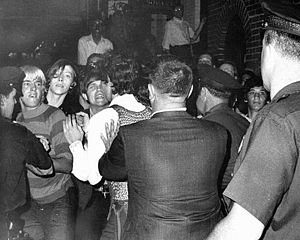
NY Daily News, June 29, 1969 - the Stonewall Riots     

Wednesday, August 29, 2012

Morning thoughts

 Facebook isn't working for me this morning, or I would post this on my Page.  It came in via my church newsletter, and was written by the Rev. Clarke Wells, who must have been a poet at heart, as well as a UU minister.  It reminds me that August is a florid month, difficult for lots of people, not just those of us with mental health diagnoses.
 
I suppose I should write something institutional or
churchly, but my heart isn't in it. Where my heart is
these days is between me and whoever it is that lays the
sun across the trees with that sudden and terrible beauty,
I've been taught all my life to believe that growing up
meant to become less vulnerable, and that getting
overwhelmed by life is what happens when you are
young.

I am here to testify to the opposite. I was driving home
yesterday afternoon on a country road, and I simply had
to stop the car near a stone fence and go into the woods
for an hour. It had nothing to do with practical matters,
or theology. It had to do with trees against the blue and
shattering light and where I am living. I report it to you
on the chance that you are as odd as I...that it all gets
more intense, no less...so that if you ever go through the
same thing, like stopping your car for an hour, you will
not feel crazy being torn apart that way.

Tuesday, August 28, 2012

In Memory of a Wild Flower

This post, originally dated August 26, 2012 has been removed for updating in light of comments I have received. 

Touching Base

[image: Thanks to Chris Hardin for suggesting this illustrated quote as a fitting homage to Teena Price, who was a wild flower.]

I have relatives who don't love me the way I wish they would, don't you?  The weather has been too hot, the air quality is so bad I have to wear a mask outside, my moods are up and down, I'm having an awful time with sleep, and I have to wear elastic on three of my four limbs, and sometimes I hate all this...... But today I am shrugging these things off (all but the depression, to be truthfull).  The universe has been giving me opportunities to see my problems in perspective.

As I wrote previously, Saturday night was a wrenching memorial service for a friend who died last Thursday.  This morning a beloved friend was at our front door to tell us that another friend died yesterday.

Greg Houston was 61 years old and seemingly in good health.  His truck went off the road for no apparent reason, and he was dead by the time the medics got there.  Greg and his wife of over 40 years are important to us, and to many, many other people, because they are lovely people who exemplify a life of compassion and generosity.  For a couple of years Greg has come over periodically to help Tom with projects around the house; it was a joy to me to hear them working together, both so polite and careful.

Yesterday Tom got an e-mail from Greg asking if he'd like help with anything.  The subject line was, as always, Touching Base.  If you want to know what it means to "lead with your heart," Greg was a fine example; Greg actually touched base; he looked at people and saw what we needed.  And he didn't just say, "Call me if you need anything."  He offered specifically to come and help with projects, and did that many times.

Many people had to be called about Greg's death, because many people love someone like that, and he was a pillar of the church.  I expect his service to attract hundreds of people, and we will all weep.

I want to say something very quietly here about the contrast with Teena's death and her service that I wrote about yesterday.  She was 76 and had been ill and uncomfortable with advancing COPD for years.  She took months to die, gasping for air.  Her death was a release from suffering, and I was glad she finally got to rest.  You feel different when someone who dies is much younger than you and vital, and it is an accident.

And it is logical that many people loved Greg and Judy.  But is it logical that so few loved Teena?  I don't know.  It's not uncommon, but it feels wrong.

I have heard from several friends who relate strongly to the post I wrote yesterday that talked about the stigma we feel if we are mentally ill or just, like Teena, unconventional.  I have thought about how many Buddhists work in prisons, often as volunteers, where they know the suffering is acute, and they might be able to offer someone a little peace.  Many others work in hospices, spending time I'm sure with people like Teena, whose own families don't want to be there, or can't.

But out in the social world there is, generally, a sharp division between the people we find easy to love and the people we avoid, or downright dislike.  Too often, people bond in groups on the basis of their mutual loathing for Sarah Palin or their mother or people with brown skin or Christians or those that have not accepted their idea of God. 

Teena was disliked for exactly the qualities that some of us liked about her:  she was open and honest, she was an original.  She said what she thought without regard for the niceties.  She was generous to me and never in my life hurt my feelings, and I never saw her say anything mean.  But she was outspoken, and had an attitude about that.

I don't know what she might have said to another woman in the church who just a few months ago told me she didn't want Teena anywhere near her private birthday celebration.  Teena had wandered into the room where it was being held, having come to church to make a payment on her pledge.  She was in a wandering condition then, liked to go spend time at Whole Foods talking to anyone who would listen, and came to church at every opportunity.  But she was not invited to that small party, not that she should have been; it was private.

I asked that friend, "You have issues with Teena?"

She said coarsely, "Doesn't everyone?"

I said, "I don't."

I didn't like that, but it didn't rankle me until Teena died.  Then I found myself furious with that woman (who has some annoying qualities of her own).  She felt entitled to hate Teena, as I gather some of Teena's children may have, too.  I was afraid that woman would show up at Teena's service, for she is another person who hangs around the church a lot.  I knew I would not contain my anger at her if she did, and I would probably regret that and it would create an uncomfortable break in our social set. But she didn't come.

I wish Rev. Mark had thought to focus Teena's service on our need to soften our hearts toward "the people we find difficult to love," a phrase he used once in a service to encourage us to say aloud or silently during the Silence the name of someone we love - or find difficult to love.  That was valuable to me.  It let me whisper, that Sunday morning, my own father's name.  My father was a shit to me, but the extent of his venomous hatred was only revealed to me after he died. When I found out that he was giving my siblings huge sums of money, and none to me because I was "mentally unstable," I was beyond hurt and angry.  I was the only kid who drove to Zanesville to visit him a few months before his death on Father's Day.  We took him and my mother out to eat.  He gave every appearance of loving our company that day.  There you are.  Life with alcoholics.  They hate you behind your back.

But saying his name in church let me open my heart that little bit and begin the long, long journey of learning not to hate him (and the rest of them, in fact).  Speaking his name with a wish that he rest peacefully let me begin the work of adjusting to that painful reality.

Some of us who are wounded have to work to open our hearts at all, for anyone.  Almost everyone needs to work on opening it all the way, to a cheating spouse, to a neglectful mother or a father who raped you or the man who killed your son in a fight.  Maybe cultivating this willingness to love is actually the fundamental practice.  Jesus thought so.  If enough of us did it, there would be no more war.  Because there would be no more concept of "enemy."  Maybe there would be no more unhappiness.  Because anger and hatred, that's hell, you know it is.

Friday, August 24, 2012

What I am really tired of (as if you cared)

I am really really tired of people who insist, in person and on Facebook and their blogs, how they don't get enough respect.  How nobody appreciates how hard their job is.  All kinds of people bitch like this, from police to lawyers to career military to chefs, and your brother-in-law.  But I'll use the example of a firefighter I once had to work on a book with (who thought, BTW, that no one should edit him). 

Ron was profoundly convinced that nobody, NObody appreciated the danger of his job, which largely entailed sitting around the firehouse and running the squad to pick up seniors with breathing problems.  He believed that those seniors and the rest of the world, the non-firefighters, were stupid people who had no idea that he could die because of their stupidity.  I was not in a position to talk frankly with him, so I'd like to do that now:  He was so proud of being anti-intellectual that it's a pretty good guess he'll never read this.  Still, I'll change the name.

Don - you.  Don't.  Have to.  Be.  A firefighter.  You volunteered for this job which has great job security, good hours, paid vacations and a terrific pension program.  If you don't want to risk your life for stupid, unappreciative people, you can quit and go to work for the Wall-of-Evil, where you like to buy things from China at good prices while you complain about people who drive Japanese cars.  WalMart or MacDonald's will pay you minimum wage and not give you full-time work.  You will have no labor union or medical plan, no job security, no pension, and no respect.  You will work on your feet and with your back until they give out.

You say you can't do that, you have a family to support.  Well, your wife could go to work too, duh, instead of sitting around painting her nails and complaining about being a housewife.  You could live like a great many people do, here and around the world, hand to mouth, paycheck to paycheck.  You wouldn't have that nice house your wife hates to clean and that yard you hate to mow.  You wouldn't have to bother having your nice new SUV detailed by stupid people who don't do it right because you wouldn't have a nice new car.  You would drive something held together with duct tape and baling wire.

And you know what - those unappreciative kids of yours who don't know how lucky they are and how wonderful you are?  You don't have to stick with them.  You can foist them off on your mother or just walk away and let Children's Services take care of it.  Drive away.  It's your choice every day of your life.

In other words, you are CHOOSING to do your job because you like the benefits of working on taxpayer's money.  And in fact, you were attracted to the danger, and still are, and to the idea of thinking of yourself as a superhero, the nation's savior.  And in fact, many many people - and I am one of them - deeply appreciate the fact that people like you are willing to do this.  (And also that not every firefighter has your attitude.)

So here's my suggestion:  learn to appreciate what you've got.  And suck it up.