Showing posts with label Parker Palmer. Show all posts

Sunday, December 13, 2015

So you think you know what bipolar disorder is

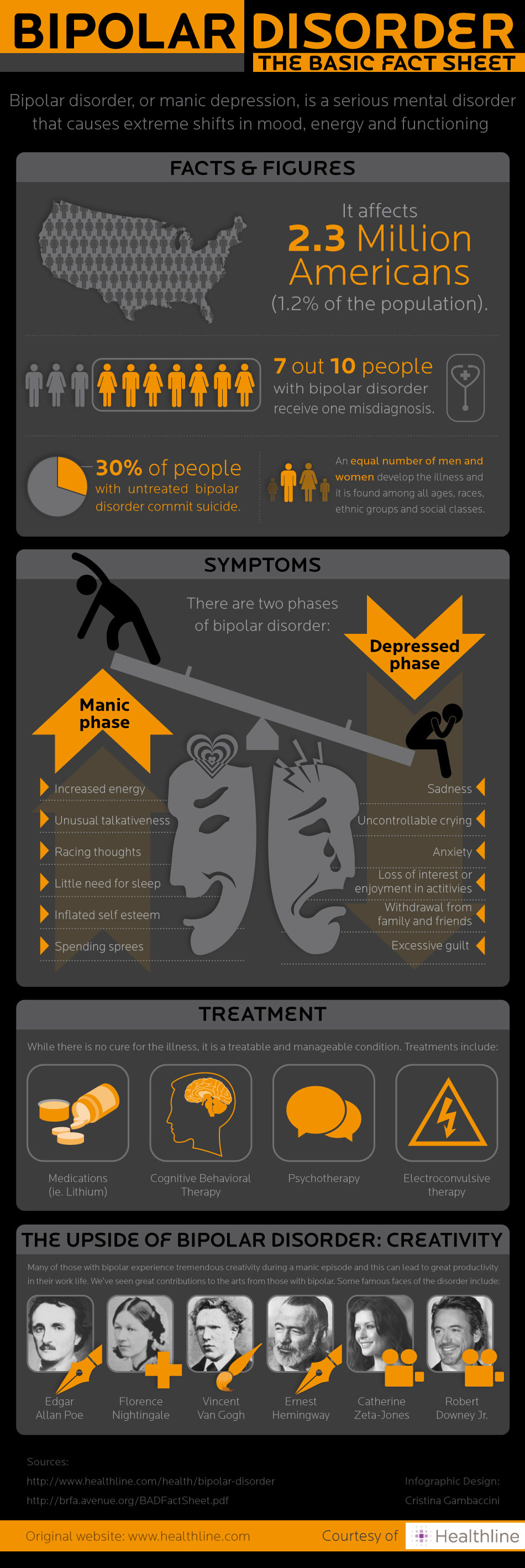
Have a look at this.

Note that bipolar is a dangerous illness, so painful that 30% of us kill ourselves before getting a correct diagnosis and treatment.  This can be hard to believe when someone is manic.  Mania is disturbing, and can read as arrogance and deliberate recklessness.  Families and friends often judge and discard us.

Note that our depression is not like yours. If you are a normie, you've known depression.  You probably managed to function and get through it. Ours is in a different category. Our relatives read it as not trying, whining, laziness. No one wants to be around it. Parker Palmer writes about a friend who came by every day and massaged his feet in silence.  Do you have a friend like that?  I certainly don't.

Note that something is missing here, and that's okay, a fact sheet can't do everything.  What's missing is that it's very difficult to find a comfortable treatment; side effects can be a bitch, like a lot of weight gain, or a sense of removal from life. Almost never does treatment work to restore a person to a mood-free state.  We are treading water all the time.  Worst, treatment can stifle the wonderful creativity that often accompanies bipolar.

Van Gogh is my favorite fellow sufferer.  His religiosity (seen today as "a symptom") gave him a restless drive to paint the essence in nature.  His family found him a trial and a disappointment.  Thank God he had a good brother who kept him supplied with paint and canvas.  Many of us don't have that relative. It's a difficult life.  Note that.


Bipolar Disorder
Bipolar Disorder Infographic — Healthline

Tuesday, December 16, 2014

Imperfectly Zen

Recently a friend asked me how I've dealt with the 48-hour-cycle of depression I've had for some time now ~ good day/bad day.  I had to tell her I haven't conquered it, though it went to rest during these last two months that included two cataract surgeries, a heart cath (without anesthetic), and frightening shortness of breath caused (it turned out) by a major UTI, which entailed a six-day hospital stay.

The hospital stay in the nice new Heart Hospital was actually the nearest thing to a vacation I've had in a long time; I just put it in there to impress you. The cycling depression didn't bother me much during that busy time.  Inbetween being tested this way and that I enjoyed sitting at the window and watching the Life Flight helicopters come in.  I thought a lot about sudden death. I also thought about depression as a spiritual ailment.

My first inkling of this idea was from Parker Palmer many years ago, his little book, Listen to Your Life,which has become a classic. There he talks about his own disabling major depression, how he learned through it that the way he was living and working was not the life for him.  He had not found his own life and work.
The black cat of depression
I think the word "work" there is important.  It can be hard to do any kind of work when you're really depressed. But we all need to feel useful, even when it's all we can do to stay alive. The women's sitting group that meets in my home has given me work to do, in the sense that there is something I do for other people on schedule.  It was frightening to undertake it.  It has helped to understand that leading the group is not about me.  I'm not giving a performance, I don't have to shine. It's about them - giving them a chance to meditate with friends, to hear the dharma, to talk about their own spiritual lives.  In Zen terms, I took my ego out of it.

I've found that the best way to put aside the dark thoughts and feelings that come unbidden to people with depressive disorders is always just to do the job in front of me (though sometimes intellectual tasks are beyond me).  One of the women talked about this last week, how she moves through her own unwelcome thoughts when she's cooking by putting her mind back on the task.  I've found this is a really good idea when I'm trying to chop carrots - not my fingers.


For me, another key to doing anything is that I don't do it perfectly.  My house is never perfectly clean (oh, I hear my Mother turning over in her grave).  When my group meets, I sometimes forget to put the tea water on. Last time I forgot about the chants altogether until after we got our tea, and so had the wonderful woman who helps me set up.  So we did a chant at the end.  Call it Imperfect Zen.

It happens that leading and teaching on this small scale are part of my way, and they are not for most people, depressed or not.  But there are opportunities to give to and serve the world in every single life. They are there even when we are crippled by depression. When you go to the grocery store, you can smile at the older child who isn't getting the attention the baby gets.  You can let someone cut in ahead of you on your way home. You can give yourself time to walk around the block, a change of air.  You can share a funny dog video on Facebook.  At your worst, you can "like" a friend's post.

It's the holiday season - you can wear a Christmas sweater - you can't possibly look as bad in it as that poor cat.  You can call someone and not talk about how bad you feel, but instead ask how she's doing.  If you're on the phone, not on Skype, you don't need to wear a Christmas sweater, but can stay in your gloomiest bathrobe.  Nobody needs to know.  No matter how the call feels, congratulate yourself after you hang up. You're a nice person.  It was good of you to try.

Saturday, January 31, 2009

Hanging in your Dilemma

A little while ago I decided to read through The Gateless Barrier - a basic collection of Zen stories and talks. I had pieced around in it the first time, and worked some of the koans with teachers, but Robert Aitken suggests you then read it right through, because his comments build on one another. And I was supposed to be off my feet this week, healing an arthritic flareup.

The last koan I expected to get interested in was "Kyogen's Man up a Tree." I never did like that koan. The basic idea is, You are hanging from a tree by your mouth. You can't reach a branch with your hands or feet. Someone comes by and asks you to tell him about Zen. You have a dilemma: if you speak, you fall and die. If you don't, you are abandoning your responsibility to others. What do you do?

Since I am a language person, I am sometimes struck by a certain word. And my experience is that Zen masters take care to be accurate. I have three translations of this collection, and Aitken is the only one who introduces the word dilemma. I recognized that prefix, di (two, as in dualism) and thought, There's a clue in this, so I looked it up.

In a dilemma, you have two choices, and neither one is good. That applied to the little puzzle. Then Aitken helped me out by telling us straightforwardly that what we have to truly hang there in that dilemma, be with it all the way. This is not so natural, is it? Can't you picture yourself writhing around, trying to make your way down the branch, kicking out, making throaty protests (without letting go the clamp on the branch that is definitely hard on the TMJs)? That is in fact what we do with our dilemmas. Sometimes it's not obvious; we may feel we are in despair over some event, a chronic illness or a lost love, but are in fact trekking from one healer to another or one bar to another, trying to find someone who can get us out of our fix. And there are always lots of people who think they can. They are even more deluded than the weary seeker, and they end up burnt out.

The first time I encountered the idea of giving over to your unhappiness or depression was in Parker Palmer's little book, Let Your Life Speak. There he recounted his own long clinical depression, and how he sank into a virtually immobile state, and slowly came to realize that he had a spiritual problem called despair, that his life was telling him, What you're doing is not working for you. He had been refusing to listen. He published this article before the recent vogue in confessional memoirs; it was a courageous act, and he has survived the stigma of mental illness to be an admired teacher and speaker.

What you do with a koan is just carry it, and I wasn't inspired enough by this one to get caught up in figuring it out. But I knew the koan was working on me this morning when I woke up to the thought, I've got to get more facts about kidney transplant. I've been on a waiting list for a year, grateful every single day that I haven't declined to the point of needing dialysis again. It's no picnic. Neither is transplant. Both carry all sorts of medical risks and uncertainty. But I hadn't been really hanging with the decision, but in the land of hope - hoping my kidneys would keep holding on until something else killed me, that I would never have to answer that phone call Yes or No (you have one hour to respond). In other words, I was really avoiding my dilemma with the mental tricks that we are best at. Maybe I'll never have to decide. (Maybe I'll win the lottery.) We are lucky when something or someone nudges us out of a delusion like that. Life is much easier when we open our eyes.