Showing posts with label Christmas. Show all posts

Monday, November 26, 2012

How to Accept a Gift

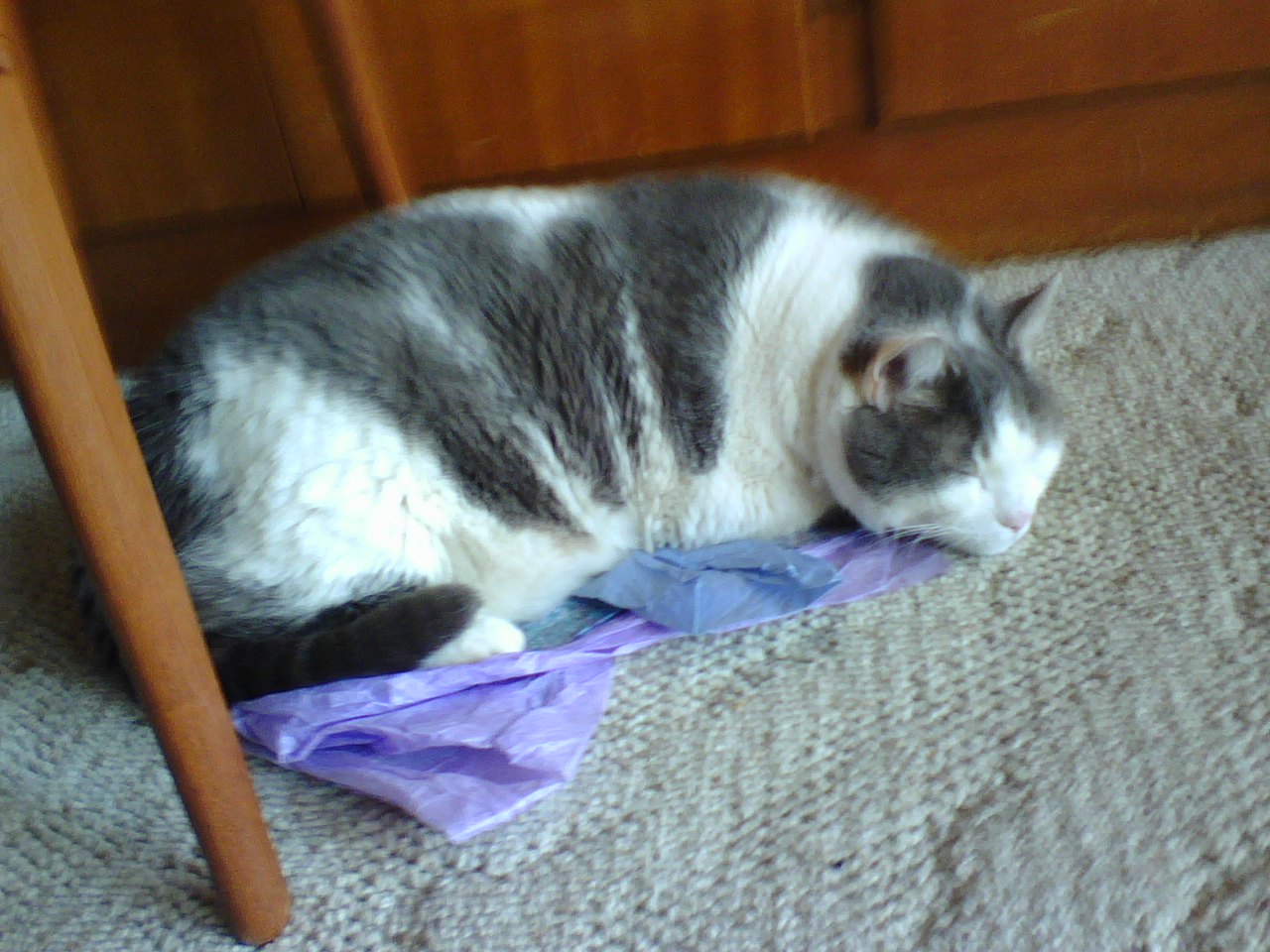
Sherlock always appreciated the Christmas bounty of tissue paper

Now, I am not going into general Buddhist wisdom of the day, which talks about accepting every [obscenity] thing that happens to you as a great blessing that gives you plenty to work with and become wise.  I am really tired of hearing that, and am pretty sure it doesn't apply to my bipolar brain, which has often been given acute depression just because my happy/sad switches are genetically broken.  It's some logical fallacy, I think, to suggest that a depressed mind can be glad to be depressed; clinical depression is a neurochemical disaster one simply endures by eating potato chips and watching old episodes of Gray's Anatomy, and you are not grateful for those things, either.

No, I am not talking about cultivating that dance-with-the-demons wisdom.  I am talking about actual giving and receiving stuff as our biggest consumer holiday is barreling toward us here in America:  Christmas. Which has nothing to do with religion for most Americans today.  My subject is not giving, but receiving gifts with a generous heart.

We get out of the starting gate wrong as middle-class children in America, who are asked by Santa what they want.  Who are encouraged to write to Santa, detailing the list.  Who have seen enough TV commercials to internalize acute desire for some particular toy and begin nagging for it on Black Friday.  Thus is formed the habit of seeing Christmas as the time when you hope to get your heart's desire.  So it has nothing to do with generosity or gratitude; it's a kind of payday in the consumer culture. Though it never works for long.


As for you, a grownup, your heart's desire certainly isn't a hairy angora scarf knitted by Aunt Melba that will shed all over your new mulberry pea coat.  It's so weird, and so huge, this scarf, that at first you didn't even know what it was.  (Sometime, drinking wine with friends, you'll make a sort of funny-ironic story out of this.) It is totally not the right thing for that coat.  And you're allergic to wool, and isn't angora wool? Doesn't she know that? You resent that failure of knowing your needs and taste. You don't wear scarves like that.  It's ugly, it doesn't express your style.  So you say, "Thanks," and toss it aside and let's get on with things.

Now let's turn to the other party in this transaction.

Aunt Melba made this scarf especially for you, with loving memories of you as a child.  It took many hours, something you don't know, since you don't knit, and knitting always looks easy.  She had to work in fits and starts because now knitting makes her arthritic hands ache.  Sometimes she had to tear out rows, and figure out how to get it going right again; her mind isn't as quick as it used to be.  She had to be very dedicated to get it done in time.

She'd been looking forward to this annual visit.  She spent a happy hour picking out a yarn she thought was beautiful and would be warming and remind you of her love for you.  Yarn is not cheap; this yarn probably cost more than the designer scarf that would have pleased you.  And the scarf turned out just perfect, she thought. Your microexpression (a tiny frown of resentment at how wrong this gift is, it will go to the thrift store) does not escape her.  If you were paying attention, her expression would suggest that her heart sank.

Not all gifts are this important.  Suppose you meet with a girlfriend you only lunch with a couple of times a year, though it's an old friendship going way back, and you like each other.  Last summer you picked up a very special beeswax candle at the Farmer's Market, thinking it was just perfect for her; beeswax burns bright and long and has its own delicate natural fragrance. You know she likes to take baths by candlelight. You went to some trouble to wrap it in a nice box with tissue and ribbons. 

She says "Thanks" in an offhanded way.  Okay.  That didn't seem to work.  Then we are on to your gift from her, some bath oil.  Has she forgotten you can't take baths? a deprivation certain health problems brought about.  You thought you complained about it often enough that everybody knew this little bit of hard  luck.  The bath oil seems impersonal, like she was just getting one more gift out of the way.  In fact, is it possible she is just regifting what you gave her last year?  Maybe. You're afraid so.

Now, what do you say, dear?

You say, "Thank you.  This is beautiful."  You look at it.  In even the wrongest gift there is something to appreciate - the color, the packaging, the daintiness of it.  You say so. And lavender, my favorite scent.  

Because, like you, she wants her gift to be appreciated.  The fact that you can't use it has nothing to do with it.  This is not about you getting what you want; this is about the ritual of receiving with gratitude, even if the gift it is a child's wilted bouquet of dandelions.  It is about receiving with the understanding that the gifts you are given have nothing to do with your dreams being fulfilled.  It is ancient ritual, the full circle of giving and receiving.  For that to work, the receiver has to genuinely receive, and be nice.

If you see some Buddhist wisdom sneaking into that, okay, it can't be helped.

Thursday, December 22, 2011

God Hates the Mayan Calendar

I stole the title from a satiric news item issued by a UU friend, Bob Parks, who is a pleasure to be on Facebook with.  Now, I could have said "with whom it is a pleasure . . ." but I have never used the word whom knowingly in my life.  I was an English major, so there is some weight and knowledge behind this preference of mine.  Long ago I learned there are roughly two kinds of grammar - prescriptive and descriptive.  Prescriptive is what grownups told you, like "Don't say ain't."  It is often a way to distinguish class. Descriptive grammar - it's obvious what it means - it tells us how we actually talk.  It is not about should, a mean jaggy acid-green word, but rather about is, a pleasant little earth-brown word.

Where was I?  At first I thought Bob was reprinting an actual news item titled "Christian Objects to Mayan Calendar."  Then the satire got obvious.  Point being, it is very difficult to satirize some things because they are already bending reality quite a bit.  I would be surprised if you could not find somewhere a fundamentalist who is denouncing the belief in the Mayan Calendar as unGodly.  And yeah, it is.  Here's news:  most of the people in the world do not hold to your particular belief system.

As someone who is always on the outskirts of things, practicing the steps my own way, I am fascinated by the amount of in-group stuff I see.  In the fundamentalist Buddhist community, furious discussion about whether we can prove the Buddha existed, some of it from people who clearly have no interest in working on Right Speech (well, if there's no Buddha, there are not precepts - maybe that's the point).  From fundamental Christian friends, Boycott Target because the store is using Happy Holidays instead of Merry Christmas.  So as I get it, when you are spending hundreds of dollars on toys for the kids to umm, celebrate the sacred birth, you want it to be from a retailer who does not hesitate to offend Jewish, Buddhist, Muslim etc. customers by focusing on Christians.

What is this?  Can't you people just enjoy your cookies without making the point that you are superior to the rest of the world?  Isn't the larger point of all these celebrations this time of year that the sun also rises, that the days will be longer now, that there is a miraculous birth over and over?  That we can feast?

Well, maybe it's their version of the holiday blues.  Some people fight depression with anger.  I know how it is.  You're not lonely, you're special.  Like that.  Myself, I like festivities that do not center around gorging yourself or drinking and making loud noises or drinking and marching through city streets and dying the river green.  This is it - a time of year when we think about giving and being connected, as in fact, we are.

Sunday, December 18, 2011

A Love Story


I've been more aware of the power of love since I read that being in love creates oxytoxcin in the brain - that is the feel-good chemical that makes the sad and unsuspecting pay a lot for oxycodone on the streets.  That got me thinking about the Buddhist practice of metta, which involves Lovingkindness Meditation, a method or prayer or chant taught especially in America by Sharon Salzberg, though I know Pema Chodron teaches it in the Tibetan tradition, too.  Loving is a good way to do no harm.

American Street Cat was founded by a woman whose heart went out to the feral cats in her local colony in Brooklyn - her story is at the above link.  I don't live in New York City, you probably don't either, but it's a nice love story, an example of how our lives can form around some one we love.  Like me and many of my friends, she loves cats and didn't want to see them suffer.  She didn't invent Trap-Neuter-Release; Olwen Firestone, a lovely woman at my church who lives a life of service, went to a lot of trouble and expense to do it for the feral cats she fed on her back porch. They would not be touched, but used to follow her every morning when she walked.

The video above goes on to show pictures of many feral cats someone decided to love, and gave a name to, reminding me of The Little Prince.  (If you haven't read that classic, you can give yourself a copy for Christmas.)

Saturday, December 17, 2011

If the people are buying dreams . . .


This morning, on the heels of writing about Oprah last night, I am remembering a song I loved, by Melanie. This kind of protest music was what was so good about the seventies.  Note the line "If the people are buying dreams, I'll be rich someday." 

We do buy dreams.  God knows I like the controlled dreams we call fictions; I like them on the page and all my screens - Kindle, TV, Droid.  I like to play the dreams like Spirit in which you try to beat back those forces of death - very realistic, because you can never win. But you get your adrenalin up trying. And it diverts you from your pain.

I don't like the dreams that are sold to us constantly on these screens.  Just watch commercial TV for an hour, or make note of the ads that come to you in an hour online, in your inbox, on Facebook, on YouTube, almost everywhere you go except here and Wikipedia (that's why I contribute to it).  For men, poor guys, the dream of a car or truck that is so masculine it can do anything, speed, drag out stumps.  For women, the feminine dream of youth, beauty, desirability.  For kids, the dream of winning.  Gender-free, the dream of Something for Nothing.  Damn.

You can't stop this sludgy flow like a river through your life unless you live off the grid in Montana.  Even there I suppose a blimp could fly over, or a plane towing a banner.  What you have to do is distinguish dream from your reality.  The news is telling me a lot of people are doing that right now, returning Christmas gifts they bought in the fever of Black Friday, and apparently got home and realized they'd been out of their minds, and couldn't afford these things they bought on credit, and are now returning them.  (That's why paying actual cash dollars is so helpful - you know when you run out of cash.)

So, this Christmas, also be careful of the dreams of perfect family, of drastically re-forming yourself with resolutions, of gaining eternal life through exercise or herbs, of giving or receiving the perfect gift.  Just take it as it comes, good old reality.  In a way, it never lets you down.

Saturday, December 10, 2011

Where You Shop the Wide World Knows

When I was little, we chanted a rhyme picked up from radio and TV's Amateur Hour, which we accompanied with twirling like Dervishes and falling limp to the ground:
Round and round and round she goes.
Where she stops, nobody knows.
That has nothing to do with my subject today, which is actually Christmas shopping.  I want to say, Where you shop, somebody knows, and to comment further that changing habits is hard.

I have been a major user of Amazon these last couple of years, especially since I got my Kindle and my transplant, and was often too ill to go to the library, but could buy e-books, and did.  Then recently I saw a headline in The Economist - Amazon:  The Walmart of the Web. You don't have to read it to get the idea, do you?

It struck a chord in me, for I am a person who decided a long time ago never to step foot in a Walmart. I was attuned to how the appearance of one of these big-box stores means the death of a small-town pharmacy, hardware, and grocery store.  I resonate to the idea of neighborhoods, small towns, mom-and-pop businesses.  If you think about it, that's the American Dream, not that anyone can become a dot-com millionaire overnight, but that anyone can set out to make a living as an entrepreneur. 

Stepping foot in a Walmart has not been hard to avoid.  But Amazon?  That's another story.  They lure you with their service, the guarantee, one-click purchasing, consistent shipping.  With some trepidation I went looking today for someone else to sell me the book I wanted to get for Tom for Christmas (which is, of course, a book I am dying to read myself).  Ebay led me to Powell's Books.  And there I actually got a better deal, free shipping.  Done.

I am in a sensitive, open place today, having watched last night (Netflix streaming) a beautiful documentary-concert on Leonard Cohen titled I'm Your Man.  Woke up humming Hallelujah.  So I noticed the feeling in my stomach as I left the security of Amazon for a new seller.  Not really rational, Powell's is long-established, nothing to fear.  Just change.  A different path.

Now there you have the fruit of years of Zen, that little sensitivity to a feeling in your stomach, to what's happening inside you, as well as outside.  If you don't have that sensitivity, the small sensation translates to anxiety, which can lead to an instant thought-trail that justifies buying on Amazon, and Walmart, because, after all . . .

So that's a little commercial, not for Powell's particularly, but for keeping up practice, and also for shopping with an eye to karma.  And by the way, Cohen long ago became a student of Zen and a monk.  I don't know whether he wrote "Hallelujah" before that time - I don't think so.  I hope you enjoy it.  A nice break from "The Hallelujah Chorus" this time of year.

Thursday, December 9, 2010

Another Blue Christmas

A triumph over self today in the grocery store - I did not buy a poinsettia.  I did not even want a poinsettia.  This is not because I have already had three days of horrible pop-Christmas songs running in my head ("A holly jolly Christmas") or, worse, pop renditions of religious songs that once brought tears to my eyes.  It is not because for a long time I have found Christmas disappointing.  Sad.  That's another story, and I am not very inclined to memoir that doesn't help anyone, and just fixes things more clearly in my head.  But, poinsettias.

They were not a feature of my childhood home, but they were of my liberal Christian home church, which was then Congregational - I think that, too, has passed, and Congregational merged with another denomination.  You can go home again, but you will be disappointed.

This big old stone church had a circular sanctuary, it was called - sanctuary - a safe place where they didn't pick on you.  The balcony, where we always sat, wrapped most of the way around, but the front of the church was given to the altar, choir loft, and pipe organ.  Every Christmas the altar was banked with dozens of large red poinsettias, paid for by congregants and then taken to the homes of elders and the sick. They were the color in this serious place, along with the stained-glass windows and, on Christmas Eve, red carnations on the ushers' lapels.

Another good memory of poinsettias:  the year my mother died, I was sitting at my kitchen table feeling sad when I saw come up the walk Marcia, from my meditation group, half-hidden behind the biggest poinsettia I'd ever seen.  It was a newer variety, smaller bracts, almost shaped like roses, entirely unexpected and badly needed.

Where is that beautiful plant today?  Gone, along with forty or fifty others, no matter how valiantly I tried to save them.  That's the problem.  Theoretically, you can save a poinsettia, and I have known a woman who did, an aged Greek immigrant who had a touch with plants.

But I, as much as I love the idea of gardening, am not an earth person, and my attempts to help the plants live on never work. They begin dropping leaves as soon as I bring them in, and soon look naked and unloved.  We probably don't have enough sun for them here in the midwest.  And I used to over-water them.  Then I learned not to do that, and began neglecting them instead, but that didn't work either.

I am very fond of plants, and a great many have died in my care, so many that I now have ten or twelve houseplants that do live for me - the two African violets even blossom (watered only from the bottom).  This fondness makes me want to keep potted plants alive.  In theory, you can buy a poinsettia and on January 1, discard it.  In practice, I never have.  I nurse it along until spring, when it may have only a little umbrella of leaves on a naked stem.  Then I put it outside in the sunniest spot, where I do forget to water it, and the outdoor cats knock it over.  Then I throw it away.

So today, commenting that the little poinsettias in Kroger's were overpriced at $5.99, I shook my head and told Tom, "I am not buying a poinsettia this year. I'm not going through that."

"We'll see about that," he said mildly.

"Not an amaryllis, either," I said.

But that's another story.

[image:  Yellow leaf. Neither red nor green.]

Thursday, December 25, 2008

Christmas Thaw

Mild moisture against your cheeks.
December, gassing up for the trip,
coat open, without gloves,
enveloped in gray sky.

The past is entirely present
in the smell of gas,
the spot of rain on your glasses,
no rushing, only standing
in this tranquil windless day,
preparing, in no hurry.

You have told this rosary
years without end, countless beads
slipped through the hand,
memories melted
in Decembers' warmest days,
in a scatter of drops
from a nothing-special sky,
the high stars invisible
in the even morning light.

Jeanne Desy, 1999

Wednesday, December 17, 2008

Men, women, and giving

I often think of the real (though, of course, general) differences between men and women, and of how urgently we need to elevate the qualities of the feminine. One of those is not making war. Another is nurturing, feeding others, which I think is a feminine quality that goes deeper than socially conditioned roles. Today, a little story in The Urban Dharma Newsletter in my mailbox struck me as almost amusing, because it illustrates the difference, though not to say anything about the sexes. It is making a larger point about how scrupulous piety is no substitute for authentic compassion. Here it is, in my words.

The Bhagavata Purana tells of a time when Krishna's hungry friends ask him to feed them. Krishna tells them, "Go to the nearby temple, where the learned Brahmins are performing an elaborate ritual to attain heaven. Tell them I sent you, and ask them for some cooked rice."

The young men go, bow deeply to the priests and say, "Venerable saints, we are the servants of Lord Krishna. He is hungry and has asked us to seek food from you."

The Brahmins are busy. This is like interrupting Sunday morning service in the middle of the sermon. It isn't done.

Anyway, they are important people, and their lives are scheduled, meditation at certain hours, study at other times, purification rituals. They brush the young followers off. Maybe one of them says, "Come back when we're open. We only do food between the hours of 6:00 and 8:00 a.m. And go around to the back door." Something like that. I don't know whether these young men are homeless, but if they're hungry, they clearly aren't of the same class.

They go back and tell Krishna what happened. He is not surprised. This whole thing is meant to be instructive. He tells them, "Now go to the same men's wives and ask them."

Maybe the young followers are somewhat dubious by now, but you do what the boss tells you. They go to the women. This time their story is, "Lord Krishna is in the neighborhood, and he told us to ask you for food for our hungry group." [So it's like I'm raising money for my high school band.]

When they hear this, the women drop everything, gather huge bowlfuls of the best food in the house, and rush "like rivers towards the ocean" to Krishna, glad to have a chance to give, their hearts full.

Here ends this part of the story. Now, don't anybody call me a femininazi. I didn't make it up. And in any case, bless Christmas. Whatever else is wrong with our holidays, in this season we are sometimes moved to give from a genuine surge of generosity and compassion.

Sunday, December 14, 2008

Who is that?

[Strasse-tiara (rhinestones), from Wikipedia]
This morning I made myself late for church (well, for coffee hour) trying to dress well for a change. Who was that in the mirror, in a sweater that fit, velour pants, a red abstract silk scarf, and mascara, with rhinestone Christmas trees dangling from her ears? I didn’t quite recognize myself. As I coaxed my hair into a barrette and sprayed it, I thought of the ease with which Zen monks get dressed: put on same old robe, shave head twice a week, or not.

What got into me? The Christmas spirit, which peaked yesterday when I learned Devil Ducky Depot had shipped my order, and which led to getting out my Christmas jewelry. It’s wear it now or forget it until next year.

I don’t remember Christmas jewelry from my youth. I have too much of it, though so far I don't have a clever appliqued sweatshirt. The jewelry is something I tend to pick up during brief moments of holiday spirit; you don’t have to try it on. Mine includes a clever handmade cloth elf that hangs on my coat; two small multicolored rhinestone bows, pins; earrings that are red enamel bells with rhinestone tongues; small candle ear studs that tend to turn upside down, making them unrecognizable; and, ah yes, the rhinestone Christmas trees.

They are striking and glamorous, not my usual style. That made them the inevitable conversation opener in Fellowship Hall. When people realized they were staring, they'd quickly say, "Like your earrings."

I found myself replying with a throwaway line: “These are bling from the old economy.” That seemed to remind people what a horribly depressing year this is, yet I kept saying it. The earrings had taken me over, like some scifi horror movie, and were scripting my conversations.

I got to wishing I had worn the red-and-green flannel shirt I found stored in the guest room closet. I paid a lordly $5 for it several years ago, which is a lot of money for a thrift store shirt. It is a very soft, smooth flannel, a Ralph Lauren, which is why it was priced so high. But the little polo pony logo doesn’t seem to bother anyone, and you can have a normal conversation while wearing it. I’m not sure my friends know Ralph Lauren; we tend to be old hippies who ended up in the middle class looking normal, but we really aren’t, inside. Who you really are - that’s always good to know.

Sunday, December 7, 2008

A handmade Christmas

The alert reader might notice that I changed the subtitle of this blog today, back to what it used to be. "The 10,000 Things" is one way Buddhists refer to this reality of forms. "The myriad things" is another phrase. Today, putting out our Christmas decorations, I find myself responding to, loving, things.

First was the little fiber-optic Christmas tree that changes colors in a wonderful way. We bought that after we bought this house, but before we were in it, when fiber-optics were pretty new. I remember so clearly that little store in a mall, the $29 impulse purchase - too much, but we were so happy to have found our dream house.

But the real memory trip came when I finally opened the small box inside the big Christmas storage box.

Over the years I have weeded out the things we no longer used, now that we don't put up a live tree anymore. So almost everything in the big box is something we like. On top, not packed very carefully, but unscratched, were three beautiful chrome candleholders in the shape of different snowflakes, another impulse purchase I don't regret. Like other lucky Americans our age, we have any number of things we like that are always out on shelves and tables, but you grow used to them. These, though, I had forgotten about, and finding them was a thrill.

But the little box was another story. Every ornament in it is handmade, except the sterling silver collectible ornaments my mother gave each kid every Christmas when she worked in the jewelry store. Here was a hanging door decoration that says Noel, green and gold. My mother's best friend, Eileen, whom I thought of as an aunt, gave it to me one year. This would have been in the early sixties, when I was a young mother.

Eileen's life was hard even then, long before two of the kids killed themselves, before she suffered a catastrophic brain injury in a fall: five kids, not enough money, a husband who traveled extensively, an alcoholic family. It occurs to me that I don't know whether she'd ever had any aspirations beyond being a wife and mother. She was a petite and cheerful woman who cherished her Irish ancestry, and did fulfill a dream of taking her father back to Ireland. There she bought a charming traditional costume, which she wore to the Sons of Ireland every St. Patrick's Day. She could do a little easy soft shoe while the band sang "Harrigan" and we all sang along, full of the enthusiasm of green beer.

Eileen found joy in her life where she could. I think now about her sitting those lonely evenings after getting the kids in bed and crocheting afghans, and making this pretty door hanger. Joy and sorrow intertwined.

There are other felt ornaments in that box. One of the happiest years, Eileen, my mother, and I gathered at my apartment to make those. Cassie was three. Her contribution was a mass of felt scraps glued together and placed in a copper scrubber: nestlings, baby birds in a nest.

So many women came to me out of that box. Here are starched cotton snowflakes crocheted by Helga, whom I knew in a cancer support group. Here is a beautifully tatted ornament given to me by a woman in the next office one drab year when I didn't have much Christmas. Here, thirty years later, is a construction-paper Christmas tree with a puffball star on top, signed Otto on the back.

There was something about this, and getting out the bayberry candles and the four different Christmas coffee mugs picked up at various garage sales back when I could still run around on nice summer days searching for wonderful finds. That was a lot of fun, and I'm glad I was foolish when I could be. . . . I started to say, pulling out this box and its decades of memories was somehow stabilizing and grounding. It has been hard to find some shelter from the general anxiety these days. But the box reminded me of all these connecting threads, how we pause for Christmas every year, and how people I loved return through their gifts, friendly ghosts to sit with me for a while by the fire.

Wednesday, December 3, 2008

Christmas in Rehab

It occurs to me this morning that what happened to "the consumer economy" was that everyone sobered up and realized we've made an awful mess of our lives. The economy is looking like a holding tank for drunks. Continuing with the analogy, I wondered whether thinking about the present task as a recovery program can help us get somewhere with this mess.

Recovery from any addiction starts with that glimpse of stark reality known as "hitting bottom." I like Dante's description in The Inferno of waking up to find yourself in a dark wood. Recovery programs often help reinforce this realization by encouraging people to testify graphically to just exactly how awful they were. How awful were we as a nation? Consider Christmas.

What a burden it had become! Long shopping lists, waiting impatiently for other people to do the wrapping that was once fun. Obligatory parties. Pre-decorated artificial trees. Disappointment. Something had happened to a holiday that once featured hand-signed cards and cookies made from scratch, and handmade gifts and cherished traditional ornaments. All those things were now purchased by people who also bought storage containers and closet organizers, because we already had more stuff than we could handle.

One horrible Christmas years ago (before I sobered up on this matter) I sat with relatives and watched a little girl literally stagger with tiredness, opening hundreds of dollars worth of Barbie paraphernalia, all bought on credit by grandparents who were going to declare bankruptcy after the holidays. A favored first grandchild, she had been opening gifts all day long, and the evening before. She was only three, but she knew she was supposed to be pleased with every pink outfit that emerged from the recklessly torn paper. She kept trying to smile and do what people told her: here's the remote, you can run the convertible! Blindly, she punched the buttons. Put Barbie in the car! She tried.

Tomorrow the bad news about retail is going to be official; people did shop on Black Friday, violently in fact, but they bought only bargains. That wasn't the idea. Retailers can't afford to have people shop like that. The idea was to lure you into the store with a loss leader (something reasonably priced) and have you exultently fill your cart with other, high-priced stuff. It's looking like the November retail figures will be more sobering news as far as the stock market is concerned, but maybe it's good pain, really.

I notice that my neighborhood is far less illuminated this year than in the past. We ourselves used to string old-fashioned colored lights on one of the pines at the edge of the ravine, but that tree is almost dead, with the climate change. And we figured out that those lights were real energy hogs.

It's okay. The ravine is beautiful as it stands. Maybe Christmas can be beautiful too, can be about peace on earth. What we were doing was beginning to seem garish, inappropriate, tiring and, like getting drunk, not really much fun the morning after.