Showing posts with label meditation practice. Show all posts

Thursday, July 19, 2012

Zen and Bipolar: What to do When You're Going High, Part 1

This morning I'm having fun with a three-month-old list I made titled 100 Cool and Stupid Things to Do.  It is gratifying to see that though I closed that file and forgot about it, I got a lot of those things done.  (And am reminded to do others.)

One thing on that list was the suggestion to write this post, as part of a larger project about Zen for Bipolars.  I'm neither low nor high today, just in that nice balanced space between waves, so I'll take advantage of that and begin.

Starting up on a manic moodswing is similar to being pleasantly excited for a normie (I don't like that word, we're not abnormal, but what else can I call people-who-don't-have-moodswings?  Maybe "ordinary people"?)  But it includes the allure of a mental shapness and confidence.  And it will not naturally subside.  That's my experience, and I was just ordinary until I was 33, so I know the difference.  This difference highlights the crucial fact that bipolar is a neurochemical dis-order.  That's why chemicals are often useful in the treatment.

Science is telling us these days about brain plasticity, that is, how we can change our brains even into old age.  There's a lot of further research on the specific effects of meditation on the brain. My own experience is that nothing will calm you down better when you're too excited than meditation, which has been briefly described like this: 
Sit down.
Shut up.
Breathe.
Teachers of young children call this a time-out.  It works.  Even little ones can follow those directions for a few minutes.  For kids with temper or panic attacks, a one-minute meditation of three deep breaths, exhaling all the way, can work magic.

But the little ones have an advantage over us; someone is making them do it.  (Most elementary school is a formidable training in doing what an authority tells you to do.)  As a grown-up, you have to exert this control over yourself, unless a manic episode gets so bad that you are hospitalized.  Then you will be medicated.  If  you are really bothering people, you will sometimes be shut in a 'quiet room" for a time.  Interestingly, a quiet room is rather like a Zen meditation hall:  empty, clean, quiet.  No screens, no one to talk to, no stimulation, nothing but a mattress on the floor. But we can actually arrange our own quiet times.
They can have the same calming effect as contemplating nature.  That doesn't mean hiking, climbing, caving, making a big effort to accomplish something.  Contemplation is simply walking or wandering alone in a park or woods, just for the sake of experiencing nature.  I love doing that on retreat.  (Caution: it is  stimulating to be exposed to sun, heat, and light.)

To the left is a photo I took at Grailville in 2010, a month before my scheduled transplant, when I was very sick and very frightened.  It was a good retreat for me, given that. Perhaps you can see how calming it was.

I like the subtle colors and shadows in the photo, which is of the hedge that separates Grailville from a meadow; if you look, you might be able to make out the wire fence in the late-morning shadows.  I took photos that year for the first time; it became a contemplative activity for me, and neither the teacher nor anyone else chastised me.  Ama Samy's retreats are relaxed and kind in the way I understand retreats are at Springwater Center, founded by Toni Packer.

[If you know someone who is bipolar, or close to a bipolar, feel free to share this post on Facebook or elsewhere.  You can use the little icons below.]

Thursday, April 14, 2011

A good habit

I have spent much of my life breaking bad habits - smoking comes to mind. 

I suppose other people have bad habits too, things they wish they wouldn't keep doing.  But we have good habits too.  Say getting to work on time - some people never do.  Or working itself, though that is often a bad habit, too.

I found myself thinking this morning that it is time to make a firm decision - resolve - intention to meditate every morning.  I can pin it to taking my 8:00 a.m. meds, which also means feeding Tashi, and she knows that - cats love nothing so much as routine.  Everything going regular.  We can learn from them.

A couple of years ago Tom and I decided to just go to church every Sunday, to stop getting up and sitting around with the paper undecidedly, maybe feeling like going, maybe not.  How good this has been I can't even tell you.  I got my new kidney from a woman I knew from that church.  And much more.  Even if it bores me or I am restless, overall, church is a good habit.  My church anyway.  I like the people there, I have stopped wandering. Very settling to make these decisions and have it done with.

Meditating is another very good thing for me to do, just do, every day before the day gets rolling faster.  I have found that forming a good habit is easier than dissolving a bad habit.  It's a thought.

Now to do it.

Saturday, October 24, 2009

How to Meditate when you just can't

Today I found myself feeling sorry about a woman who left my meditation group years ago because she just couldn't stand that monkey mind. She was in a sobriety program, which she also dropped later. I don't doubt that mind was whispering or shouting things about her life, present and past, that were hard for her to hear, and she didn't have the skills to work with that. Now I wish I had told her, You don't have to sit still in this group and meditate for twenty minutes at a time. You can meditate standing up for five minutes. You can meditate walking alone outside. Or flat on your back, as I was doing this morning when this thought train pulled out.

I was very tired this morning. It's not much good guessing why; I just easily go into this exhaustion. So this morning Tom and I did one of my favorite things, running around doing Saturday morning errands, him driving the Odyssey (nice metaphor), me enjoying the saturated colors of this hazy day following a day of rain. First, to White Castle for breakfast sandwiches and coffee, then to the farmer's market to pick up some unpasteurized cider and our CSA vegetables (more squash!), then to the post office to mail CD's of our teacher's talks to people who had ordered them, then to the local gourmet market to buy a pot roast for tonight. It is hard to imagine a more luxurious life, and my part was pretty easy, but I started our tired and got tireder.

So when we got home I took off my shoes, unrolled my yoga mat, got the timer, put the sign on my study door, and lay down for twenty measured minutes. Right away I found myself thinking, of course, and it went like this: Am I meditating or resting? I recalled how Daniel once mentioned something called "resting in the breath." Sort of like resting in emptiness, I supposed. I tried to let go small mind, the individual Wun that started thinking about blogging on this subject, but that wasn't very successful. I thought, Maybe I'm too tired to meditate.

So I did rest. I don't even do that well, for like many people in whom the element of Air is dominant, I wiggle my toes, rearrange my hands, move my neck into better alignment. No use trying to do it well, no need, no teacher watching over me. I thought about Issan Dorsey, the monk whose death in the hospice he started is recorded in a book about him. Toward the end, he stopped going down to the Zendo to meditate, I gather stopped meditating altogether. It's too hard, he is reported to have said.

Meditation is work. That's why it usually goes better first thing in the morning, when you're fresh. And I had the time last year when infections and low hemoglobin had me too tired to meditate. I thought of Issan then, too, with gratitude.

Maybe he was too hard on himself. Maybe there are ways to meditate lightly, to do what you can, still maintaining the essentials. What are those? The intention, I think. It has to move from being the hope to feel peaceful or to rest to being something more, like the hope to be fully human, to be entirely with it for this moment.

Then what? Everyone would like you to have a nice straight spine uniting sky and earth in your body - but if you can't sit up, you can meditate lying flat on your back. It's just easier to fall asleep. The same goes for the general advice (in the school I've trained in) to have the eyes half-open, the gaze down, soft, unseeing. That, too, helps keep you from drifting away in dreams. And from having restless eyes, always looking for stimulation. Try it, I'd say.

How long to meditate? Everyone's got ideas on that, too - who is this Everyone, anyway? Some people recommend an hour, some several hours a day. You can bounce from one teacher to another and always feel incapable of living up to the thing. I recommend not doing that. Really. The answer is not out there.

An interesting point is that teachers almost never descrube their own practice. Why? Because what's good for them is not good for you. And you should not be imitating anyone, no matter how you admire them, but finding your own way. Maybe that's meditating on the bus on the way to work. And here's a link to someone who describes doing exactly that. p.s. More on getting organized to come. I'm still processing how it has worked for me.
[image: Foliage from poet Karin Gottshall's blog]

Tuesday, September 8, 2009

Urgently Meditating

[yes, that lower picture is a web built by a spider on caffeine)

It is something a Zen retreat tries to tell us with The Evening Gatha - You could die any minute. You don’t have forever to get with your life. You can’t be waiting for It to happen. Teachers say it in their dharma talks. You begin to get it.

I got it big in the early seventies. I have written before about how a book helped me think closely about what really mattered to me. I came up with the understanding that I urgently needed "to learn to relax." Well, that's a long story of not understanding what it would take, how I needed to change my life down to the very foundations. I'd rather do a bit of memoir on the arrythmia I experienced last month. It was called "a heart event."

Don't you like the term, an "event"? It was not a heart attack, nor was my heart damaged. I didn't have a blockage - I went out of rhythm. I find that evocative, because I did have the feeling in the weeks before that that I was too speeded up. It was a fact that my heart rate was higher than usual. It was a sort of too-much-caffeine feeling, though I never drank coffee after noon. (In the hospital I got off caffeine against my will, but have stayed off.)

The event . . . my heart began thumping, like an engine that's missing, and then felt like it was bounding around in all directions, racing faster, so that I got shorter of breath. When it peaked I realized I could be dying right now right here on this couch with no warning I could die!

This was the second time in my adult life that I knew that - nothing about dying from fear or grief, it was the genuine thing, the body. (The first time was the cancer diagnosis in 1997, which caused me to begin meditating.) Facing death is much harder if you think it is the very end of you, that there is nothing beyond. And since our beloved cat Sherlock died four months ago, I have been convinced that the death of the body is the end, for in no way has he come back to give me a sign. Our bond with that animal was so deep that I believe if such a thing were possible, he would have done it.

Dying, I felt, was just going to be descending into blackness. Gone. I haven't even recorded myself singing Keep Me in Your Heart for a While (but here is a lovely version).

Well, there is so much time in the heart hospital, time when you are awakened at 3:00 a.m. by someone taking your vitals or drawing your blood, and can't get back to sleep. No laptop, nothing much to do but think. Sense how worn out you are from that "event," how it battered your heart. Think about how you had been sliding on your meditation practice. Skipping days, doing it lightly, just ten minutes maybe, or just sitting outside in a lawn chair letting the universe be with me, contemplating. But not meditating.

Meditation is hard work. Seung Sahn said Americans won't do it because it is boring, and he laughed. Maybe the truth is right there - that America is a culture of Getting Somewhere, Getting Some Thing, you know, fame, money, status, going for it, just doing it, accomplishing. It is our heredity, and it surrounds us everywhere. This is why there needs to be an American form of Zen that truly takes this psychology into account. In my opinion, such an approach to Buddhism will keep before us the issues of our yang. How, for instance, being aggressive increases testoserone, which makes an individual tend toward aggression.

I got it during that event - I could die. If it hadn't calmed down, I would have. In my three days in the lovely private room in the privileged heart hospital I began meditating again. Out of bed, sit in a chair, do the posture as well as you can.

Home I didn't have to take a vow - I just started my morning practice again, sitting upright now with the incense I get from Zen Mountain Monastery, and a tea candle in a rose quartz holder. Started inching my time up from 20 minutes in case I decide to go to the Ama Samy retreat later this month, where the sits are 25 minutes. A retreat costs a lot, takes me away from my doctors and all my comforts and protections, most of all, asks a great deal of me. Follow the schedule. Meditate all day. No distracting. Some people call it "facing the wall." I think about that, how it is a metaphor. What is the wall you face? Is death a wall?

A retreat always stimulates my practice. What else would make me stay with it? besides this motivation, this urgent feeling that I could die, which is coupled with the conviction that meditation does destress me, and gives me a space to touch down on my true self, to be myself before I die. That's a good question, so I'll end with it.

Tuesday, August 18, 2009

Happy End of Day

[image: End of Day glass]
I certainly prefer birth over death, beginnings over endings. A baby is fresh and new, a delight of potential and surprise. Old age, sickness, and death are so sobering. Yet, many Buddhists work with that. I believe it was Issan, a Buddhist abbott, who started the first hospice, when the AIDs epidemic hit California, and no one knew what to do. Buddhists find hospice work fulfilling, as do many people once they have served as caregivers for a spouse or parent. Facing death, we are more sincere, we are leveled.

In my church, memorial services often glide over the hard part and emphasize the joys of the person's life, before he got so sick, that is. It is a celebration. Yet I remember one service in which people spoke about the dead woman, Lisa, her eternal youthfulness, and at last one man got up and said, "She did not remain herself to the end. That was the tragedy." I knew that, too. I had visited her in her locked dementia ward. She had been dressed well, and sat on an absorbent pad on the bed, smiling, pretending to know us. She was not herself anymore. I appreciated that man's honesty. He loved her.

As I understand it, it was encountering the realities of end-of-life that led the Buddha to leave his home and search for some consolation. It took him a while, years of traveling from one esteemed teacher to another, learning what they had to teach, meditating, doing all sorts of rigorous spiritual practices. What he came up with was - Life is hard. Very unsatisfactory, say. Because in every single birth, death is implicit. All living things mature and die. Our problem, the Buddha said, is our endless thirst. Our craving to not have life be the way it is.

You sure know about this when you end up like me, limited by a mortal illness our medical system tries hard to defeat. Beyond "lifestyle" treatments, kidney failure can be addressed only by dialysis and transplant. Both are crude, painful, elaborate and expensive treatments, but dialysis is worse, and is usually low yield in terms of restoring health. So we thirst for that magical transplant.

I had to stop there the other day and examine that. This is one reason we meditate, to go deeper with ourselves, until we face the strength of our cravings and our unrealistic delusions. Transplant is not in fact so magic as all that; the real story with Cinderella is that you might marry the Prince, but you will still have to sweep up the ashes of life, metaphorically speaking. Our lives don't stop at the beautiful waltz of the beginning.

Going deeper with myself these days I realize how I crave healing, how I want to believe there is - or will soon be - a treatment that will give me back my life - the energy of middle age. Or at least, more years with more good days. I have an alternate craving: to forget the whole thing and just accept quietly dying; that is a choice a kidney patient can make.

Lousy alternatives. Realizing this yesterday, I went about doing my laundry yelling fervently, "Don't want!" That assertion was one of the first things my grandson learned to say, and as a toddler he could say it ferociously. "Don't want!" Of course, Don't Want is as much a craving as Want.

I came back from a Memorial Service the other day with an index card on which I had written,
There is no happy ending
to an individual life.
So, what is going to console us?
Zen says the answer is to sink deep into that truth. Accept it. I guess that is the Right Understanding piece of the way of life the Buddha recommended as our consolation, what is called The Noble Eightfold Path. Ah, so, I hear my sister-in-law say. It comes down to that after all. Where is the consolation of right livelihood, of not taking what is not yours, of kind speech? This hardly seems appealing compared to a party, or a transplant.

The image I put up today is End of Day glass. If you click on that phrase, it will take you to a site that describes this accidental art, which makes beauty is made out of the leftover scraps. That seems a very nice idea to me. Consoling, in fact.

Saturday, August 1, 2009

Why Wun Meditates

In a sense, Wun doesn't meditate because they "like to," Wun meaning me, but universalizing. Do you like cleaning your teeth thoroughly before bed? Sometimes not. You're tired. And as we age, by the way, it just gets more time-consuming, involving luxury products like a Rotabrush and floss, maybe a Waterpik. I was quite impatient with all this when I had to begin doing it fifteen or twenty years ago. Meditation is like that, too. A rebellious child within Wun thinks, I shouldn't have to do this. It isn't fun.

But Wun does it. I hesitate to say, Here's what I gain from meditation, as it is fatal to do a spiritual practice in order to gain something, such as EnLightenment or the best tree pose in the class. (You could read Chogyam Trungpa's Spiritual Materialism on this subject.) But I do meditate because in the long run, I gain from it, the same way I gain something from cleaning my teeth and sweeping the kitchen. It isn't a totally bad comparison; meditation is a kind of sweeping clean.

A story. When I sit, I usually use a small elegant Pyrex timer, the kind you buy where cooking utensils are sold. It beeps twice when there are ten minutes left, and again, when there are five minutes left - very useful for calling Wun back to the task.

Today the beep surprised me. Perhaps I had missed the ten-minute beep, I wasn't sure. This thought led to an impulse to turn my head and look at the timer. It's easy to do something like that when you're practicing alone. When practicing in a group, you hesitate even to raise your eyes to look at a clock, because everyone knows we are supposed to stay quite still. Peer pressure. And then, stillness leads to better meditation. This was explained to me initially as "The stiller the body, the stiller the mind."

But today I caught myself, and didn't look. I held still, while my mind registered the thought that not following that impulse was good for me. Practice in not following every little impulse.

You never know what a specific action will lead to; this might be one reason long-time meditators are often quieter than most people, say less, maybe do less. May be slow to leap into sub-prime mortgages or new clothes.

Thinking before you act can at least save you from trying meth. It might lead you to speak out when your impulse is to protect yourself; or not to speak out, say at the family reunion, when political argument is likely to lead to a fistfight. (This actually happened in my mother's family, a vivid argument between brothers about electing a Catholic to the presidency. I missed it.)

Meditation is far from the only way to stand back a little from your impulses. At one time in my life, during the hectic eighties, I took to carrying a little notebook in which I would write down everything I wanted to buy (groceries and gas excluded), and wait three days before buying it. This worked to stifle pretty much all my consumerist desires. They just drifted away down the stream of time, to be replaced by other drifting desires.

Impulse control. You can't buy it at Wal-Mart. On the other hand, stop and think what follows from shopping at Wal-Mart.

Wednesday, July 8, 2009

Organizing the mind

[photo: The beloved critic John Leonard showing us what a working study looks like.]
This morning I knew I had to get back to my usual meditation. I felt scattered, full of ideas and reactivity. Specifically, I reacted when Tom suggested we move some wire shelving he built into my toy closet.

This closet is one of the luxuries of my life I take for granted. I don't take them all for granted. Not a day goes by that I don't thank whatever God may be that I do not have to work anymore - how did I ever survive it? I sweet-talk the robot vacuum cleaner, and load the dishwasher with gratitude. But closets? I'm used to them. My study, for instance, has a whole wall of closet. I like to think the doctor who built this house put this in for his wife, who I like to think had a lot of clothes. It was the fifties, after all. What we did was buy clothes.

I don't have a lot of clothes, so one half of this closet houses my toys - drums, paints, drawing pads, unfinished crewel embroidery, drawings and paintings and photographs, seeds collected at Grailville . . . you get the idea. The kind of toys we enjoy as grown-ups.

Over coffee this morning Tom brought up the fact of this shelving, which sits in the guest room awaiting my command. The idea is to put it in my toy closet and make everything much more accessible - there are boxes under boxes put there when we moved in, boxes that are a mystery to me. He had a friend coming by who could do the heavy lifting.

Immediately Don't want! sprang full-blown into my head the idea of the Right Way to Do This. It was muddled in with a sense of embarrassment - surely I couldn't let Greg see this mess! I would need to at least get in there and remove the little boxes before he came, and where would I put them? What I should do is buy a bunch of organizing stuff at The Container Store . . .

Now wait, I said to myself, what's all this about? Isn't this actually just what closets look like? I realized I don't actually know. I don't get much chance to look in other people's closets. But I bet hardly anyone has every single thing stacked and labeled like . . . ah-ha, like my parents did, compulsive workers. Then I wondered whether my reaction had something to do with always wanting A's? A in everything and, as my father once said, "Why aren't they A pluses?"

I could see that the whole thing was one of those half-thought constructions brought up by a knee-jerk No, a slight aversion, a sense of threat. And fifteen years ago it would have ended there, with my refusal, I'm too busy right now. This time I caught myself and marveled. Because moving the shelving is not about how good a person I am, or what someone thinks of me. It is about nothing but hey, moving the shelving. My kneejerk reaction was the kind of mysterious weirdness we can see in our friends and spouses, but usually not in ourselves. Unless we meditate.

I am not talking about destressing with a mantra, or doing a visualization, or the practice of lovingkindness meditation, all good things. What I'm talking about is plain old ordinary sitting meditation. It is taught in all the Buddhist traditions, this sitting still and following the breath, watching our thoughts, desires, fears rise and letting them pass like clouds in the sky. Practicing not grasping. Practicing just being here with ourselves and whatever arises in us.

I am not at all sure about the division often made between the psychological and the spiritual. I am just one person, with these things muddled in my mind and gut. I have found that meditation leads me time and again to what you would call psychological insight, as in this case. Then again, once I see the snafluffle I have built in my mind, and let it fall away, something spacious and relaxed appears. That feels spiritual. It is very nice when it happens.

Yesterday I wrote about some of the ways women nourish themselves spiritually. And certainly none of us should beat ourselves up for falling away from our practice. That's not productive. But I woke up this morning wanting to correct myself, afraid that I seemed to equate meditation with a number of other practices. That hasn't been true for me.

Friday, March 27, 2009

The Lone Mountain Path


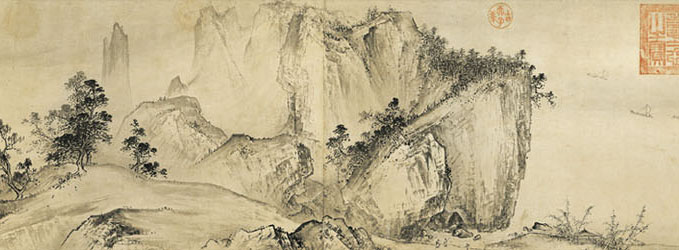
[Pure and Remote Views of Streams and Mountains, Xia Gui]
I don't want to do much typing today - trying to rest my back, which is improving. I came across this in an essay by Kobai Scott Whitney about a very imperfect Zen Teacher, and found it refreshing.
Meditation practice, at least in the Zen tradition of Dogen, is about mind and body dropping away. Small, lively, individual mind and grasping, needful, individual body can recede, if only temporarily, into the background of experience.

Monday, March 16, 2009

"Slow down, you crazy child . . . "

Several years ago I learned that tai chi Masters never use more than 75% of their energy at one time. The idea of slowing down and using the minimum required energy for any task fascinated me.

At that time, I was in the early years of daily meditation practice, and pain from my fibromyalgia was announcing itself more insistently. That sort of thing can happen as you begin to pay attention. If I sat still, my neck began to hurt in about 90 seconds, and I had to stretch it a little. Then it would begin to hurt again 90 seconds later. I had long ago been diagnosed with fibromyalgia. Now I was more aware of my chronic pain, more troubled by it.

I tackled the problem with my usual vigor, began tai chi classes (adding two classes a week to my full schedule), and bought a book on fibromyalgia. There I read that it was essential to slow down. The book suggested that those of us with this pain disorder were too intense. I thought, They’re writing about me.

The authors said fibros should take a ten-minute break every hour. Stretch, relax, walk around, do something different. I found that almost inconceivable. Waste ten minutes every hour? How could I? I had so much to do! Homemaker, cook, caregiver to my mother, whose dementia was advancing, and to my husband, whose post-polio syndrome meant he couldn't do much else but work. I was learning to write poetry, and really wanted to steal hours every day for that. (I still do.) And I loved gardening and had kept adding gardens until it was all much too much for me. Then there was church work. And spending a day a week babysitting my new grandson so my daughter could have some time off.

It was all really important, and it all demanded to be done right now. I have to make a point of having compassion for that past self when I recall this crazy-busy time.

This particular period of addiction to all kinds of work crashed, as things will, when, tired and distracted, I ran a red light one day. The accident totaled my pretty little Acura and hurt my back, and the driver of the car I ran into threw a tantrum at me, so that I began crying and cried for 24 hours. Then I became afraid to drive, afraid for a while to even get in a car.

I had been running on empty. Now I had sailed off the cliff, so to speak, and mid-air I had a chance at a fresh start. Sometimes, lying on the floor with my legs on a chair to rest my back, I would listen to Billy Joel's Vienna. It is a beautiful song, and wiser than I knew.

Obviously, I recovered, with somewhat shuffled priorities, slowly overcame my driving phobia and finally bought a new car, a 2000 Honda Civic. It's not as sporty as the Acura was, but that's okay. I am a more cautious driver now.