Showing posts with label koans. Show all posts

Saturday, December 22, 2012

How to Have Happy Holidays in Spite of it All

With empty hands, I take hold of the plow
The last couple of days have been hard for me, with a major weather system blowing me away yesterday, as it can fibromyalgics.  Three days ago, Wednesday, I came home from collage to find Tom at the kitchen table looking stressed, with a bloody gauze pad on his forehead.  He had fallen and hit his head on a corner of the hutch.  He may have been saved from being blinded in that eye by the fact that his glasses initially took the blow.  We are so close that I "lose it" when I am frightened for him.  Lose my equanimity and become all a-tremble.

I was already shaken.  My beloved women friends and I had been sharing the general pain of the Sandy Hook shootings here in America - 20 schoolchildren, six teachers, and two mentally ill people all died.  The mentally ill people were Nancy Lantz and her son, Adam.  Nancy owned at least five weapons, including the semi-automatics that can kill a lot of kindergartners in a minute, whether you can aim or not.  But Adam knew how to aim -she'd taken him target shooting.  And he knew where to get his hands on guns.  Nancy was a brand of everyday walking-around paranoia, a survivalist, who'd stocked up on food and water and guns. 

A lot has already been accomplished.  I read this morning that various of the United States, including my own Ohio, have passed funding for the treatment of autism. So many of us have petitioned the White House that President Obama has replied via a video.  People are turning in guns in Connecticut, where they understand now that people with guns kill people.  But the work is far from done.

It is our work as people of good will, Christians, Buddhists, atheists, all citizens, to stay with this work, but not to let it destroy us.  I awoke this morning realizing that I need to bring myself back emotionally from too much empathy and emotion.  It is a very good motivator, but the work of change needs a clear head.  So there's a Zen koan, "With empty hands I take hold of the plow."  I can actually visualize this, hands relaxed on the plow.  (The painting above is one of several van Gogh made of ploughmen.) 

The empty hands mean we work from our understanding of the universal, of all the dynamic and potential of life.  So we need to be refreshed by spiritual practice and by celebration, by love and friendship and our understanding of the constant miracle of birth.
Botticelli, The Birth of Christ (attended by the animals)

Thursday, August 30, 2012

Coming Out

Strawberries in their green hats


If you do not say 'good'
and you do not say 'not-good,'
then what is the nature of reality? 

I think I've written before about this koan, the first one I ever came across, not counting "What is the sound of one hand clapping?" since I didn't seriously see that as a koan until a few years ago.  The above question is in the little classic Zen Flesh, Zen Bones, which was the first such book I owned.  Maybe the first I ever saw.  I must have plucked it from a bookstore shelf because the word "Zen" signified to me a life of clean, orderly peace.  (Wrong again.)

You may react to it like I did - WTF?  Seriously, in that age before the internet and its acronyms, I wondered, But how can you not judge things and like things or dislike them?  Obviously, things are good or bad.  I wondered that every time I picked up that book and read it.  Maybe that means I was "carrying the koan," as they say; not trying to decipher it, not puzzling over it; just had it in there, not making sense.

I started to understand it when I began to do loving kindness meditation (metta), which is a structured kind of prayer or intention that includes "a neutral person."  Like many people, I discovered that I either liked or disliked practically everyone.  That slows you down, seeing that.   I was dividing the world as my alcoholic father taught me by example: either "he's okay," or "he's an a------."  I didn't think in those terms.  I just liked or disliked people, an in-law, the mail carrier, the checkout clerk.  I had to use strangers in that space.  That turned out well, but that's a story for another time.

Last Sunday morning, deeply depressed and distraught over the sparsely-attended funeral of a friend, I posted a post called "In Memory of a Wild Flower."  It ranged widely, blaming our minister, Mark, for not saying good things about her, for telling many things she had kept secret during her life; blaming others in the church who had not liked Teena or me or had let me down at one time; blaming her family for, it seemed then, not forgiving her even a little. I was ready never to go back to that church again.  I have taken this post down for now, and will repost it after I revise it in light of what has happened since.

What happened was that I heard first from Mark, and his long post was clearly compassionate.  I answered, he wrote back.  Then I ran into a woman I'd targeted in that post (though not by name), who must have heard about it, and put her arm around me and was so kind and reassuring that I burst into tears.  Meanwhile, I heard from friends who suffer as I do, some of them with serious diagnoses I had not known about, some telling me, "I'm not out of the closet on this," and thanking me for saying what they felt - that the mentally ill are stigmatized everywhere.  Thanking me for being out of the closet.  

At first, I also felt horrible, wished I hadn't posted it, wished I could have addressed the issues privately face to face. I should have known better.  But I was flailing around, drowning in hurt and outrage and, at the same time, the worst moodswings I've ever had.  Before long, though, I realized that the post had led to bonding with people whose stories I had not known, who carried around the same kind of hurt as me.  So it wasn't bad or good to have posted as I did. You can't say.

I don't regret this - displaying the kind of despair and fear we have to deal with, a depth of mental pain most people have never experienced.

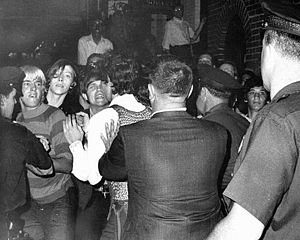
I was circumspect about my bipolar disorder for decades, so I don't blame anyone for staying "in the closet."  It is analogous to the situation gays and lesbians faced last century.  But we mentally ill don't have a Stonewall Inn where we can gather, from which we could fight back and hold proud parades.  We are lonely, and we may not deal with aloneness as well as people who have not been broken.  We are paranoid because we were scapegoated or abandoned by our families.  Many of us are not able to work and not able to pass as "normal".  We may be disabled by our moods and the severe side effects of the drugs we have to take just to keep from committing suicide.  

We see stigma where it might not exist - but that doesn't mean it doesn't exist.  It does, and it is powerful, because we don't meet this society's definition of worthwhile (successful, achieving) people, and we can't always restrain our tears or anger, and we have a harder time than most people finding effective ways to stand up to the stigma.  I wonder whether this will ever be any different.

Below, the first photo of the Stonewall Riots, which were led by homeless youth that slept in a nearbye park. The Mattachine Society newsletter reported that the Inn was their only safe place, so of course they fought for it. Other than that, "they had nothing to lose."
NY Daily News, June 29, 1969 - the Stonewall Riots     

Tuesday, June 12, 2012

The Whole World is Medicine

Our house in spring, star magnolia in bloom
I'll start with the story.  I was in the Internet Cafe (TV room) at Manor Care, where Tom's father is now resident, fixing myself a cup of coffee.  The little refrigerator was empty, but there were packets of that creamer mysteriously made from corn syrup.  Well, it was still sort of cream, and would soften the gastric hit of the coffee.  As I tore open the package, looking at it for collage possibilities, I thought of Yunmen's koan, which I learned as, "The whole world is medicine. What is the illness?"  (There is a different version by John Tarrant here.)

Students of Zen just finished that thought, I imagine.  It is a famous statement that is considered a koan.  The one everybody knows is "What is the sound of one hand clapping?"  (I know the answer to that one. :)  [by the way, smileys are addictive, especially useful in texting, which is economical]) 

later -
This morning's NY Times has an article on the discovery of the microbe that gave us streptomyacin, how a lowly lab assistant was finally given credit.  I loved this quote, though, from his journals: the microbes were found in "leaf compost, straw compost and stable manure" on a farm near their lab. I said, "The whole world is medicine."  Tom told me then that his BP medicine is based on snake venom, which kills you by reducing your BP to zero.

But that's not the deepest point of the koan, which goes like this:
Unmen said, "The whole world is medicine.  What is the illness?"
My response is, the illness is not perceiving the world. The illness is living in and grasping at your delusions.

And here's my example.  Tom and I are respectivily 63 and 69 years old, but sort of older, really; he has  post-polio syndrome, and I am, you all know, a sort of musculo-skeletal wreck, and on meds for kidney transplant, BP, arrythmia.....the usual.  Body wearing out, sooner than some people's.

His parents are 90 and 93.  His father is in nursing care, went there two months ago septic with untreated infections and long ago mentally disabled by stroke.  His mother is now living with brother Dave and his wife, but constantly trying to go back to her house.  She is bent with arthritis and can barely walk with a cane, but wants to drive.  Tom and his siblings and grandson are trying to straighten out a really horrible mess of their estate, much of which has disappeared into the hands of scam artists while they clung to their idea of staying in their own "home," the house they bought fifty years ago and have not maintained.

What is the illness?  Clinging to the delusion of never growing "old."  Clinging to the delusion that she can be independent all her life, it's only a matter of refusing to see reality.  In there was her own susceptibility to flattery, which she would never admit to, which has led her to meet strangers who call her on the phone and ask her to meet them in a parking lot and give them money.  And by the way, your home is not that house you live in; it's the world.  And your body, and you don't get to keep that.

As for us - we don't want to ever put my daughter in this position.  We spent this morning talking with a Realtor about what we can expect to realize on this house.  We are not going to move into a condo either; it's straight to retirement home for us, because realistically, we love our house, but we want to relax and enjoy whatever time we have left.  Realistically, that might be a year or ten years or a day. 

The Realtor wore flip-flops.  You have to love that.


Thursday, June 2, 2011

Don't get carried away

I am so enjoying my e-mails from 108 Zen books, the sense of human contact with someone whose voice is pleasing and whose practice is serious. It makes me think again about what I can do with this blog.

- I like to report what's happening with me, how practice is helping me, because I think that might motivate someone else; but it feels like bragging.
    - I could talk about exactly what is my practice now, as Genju does.

    [Right now I could and will go take today's first dose of immunosuppressants. A little break.  Then I will meditate, because this morning routine is my current focus in the ongoing project of Forming Good Habits.  A discipline, you could say.  It is one place my foolishly expensive Droid is doing its job, sending me an alarm every five minutes until I turn it off.  Bought it on impulse, but it helps to control mine.]

    Back, just for a moment - the electricians haven't called yet.  Today we are having a major upgrade done to bring the house up to code, and the obvious result of that is near-panic on both our parts, for we love our computers.  So I'll try to get in a word about the current practice.

    Long-time readers know I had lost my practice, you might say, when I was so ill last year.  It hasn't been easy to get back in the habit, which is simple:  10-15 minutes of body work, 20 minutes of meditation. Part of my problem is my enthusiasm/creativity/impulses - all these are on a spectrum, I guess, of mental/emotional energy.  This energy has come back since the transplant, taking me to a place I had almost forgotten.  What was happening to me in the morning was I'd make that first cup of coffee, sit down at the computer, get "carried away," as my Teacher puts it, as in "Experience everything, but don't get carried away."  That sounds simple, but it's a koan I carry, and has surprising depth.

    I decided that to get my practice back I would vow to make that first cup of coffee, do whatever I wished while I drank it, no more than half an hour, then sit . . . Whoops, the electricians are here.  More later.

    Saturday, January 22, 2011

    Following the pathless path

    Jizo in the snow, photo by Tom Tucker
    This morning I read Open Buddha's review of Footprints in the Snow, an autobiography I also like, and noted that Sheng Yen wrote a book on the Chan form of koan work.  My first response to this news was, I'd like to get that.  Next, I remembered that I have mostly lost interest in formal koan study, which was very good for me when done with Ama Samy, whose method is unique, and good for me in altogether a different way when I worked with Daniel Terragno, whose traditional method was guaranteed to arouse my striving and thus my frustration.  There's a book in that sentence.

    Koan work appealed to that in me that longed for mystical, intuitive engagement with the truth.  In fact, the beginning of my work was in a dream after I got home from my first retreat with Ama Samy, one of whose books is titled after the koan, Why did Bodhidharma Come from the West?  I dreamed a deeply felt answer, woke up briefly to write it down that night, and the next day wrote to him about it.  This was in 1999.  He wrote back to me with another koan, "Who is that one?," and I carry that koan to this day, realizing more all the time that this one is compiled of a thousand thousand bits that shift constantly - the truth of no fixed limited self.

    During the years that I worked with Ama Samy while on retreats, I also worked with the first book in the Japanese tradition, The Gateless Barrier.  I worked with three copies of it, in fact, by three teachers, studying each koan hard, thinking about nuances.  I embraced this study gladly, finding it much more fulfilling than the graduate studies in literary theory I had recently completed.

    It made its way into Zen-flavored humor written by Sherlock, my cat, which I intended to collect as The Sound of One Paw until I got felled by one real-life koan after another.  I also read and reread John Tarrant's marvelous collection, Bring me the Rhinoceros.  In all this, each koan worked its way into my mind.  It's something Tom and I share in that intimate way of the long-married, casual references to something we both did and that we understand.

    Well, this is a shorthand description of a few years of journey.  My interest in koans tapered off - I couldn't say when.  At the time, I felt like I was failing.  But now I notice that I carry all those koans, and they often pop up in response to some event.  My practice has become more flexible, is changing all the time.  I'm about to pick back up yin yoga, taking advantage of Lulu Bandha's online site, recommended by the best and most generous yoga teacher I've ever known, Kit Spahr.  I am again interested in poetry, writing my own, reading others'.  On retreat, I was very moved by the visible world, and took photographs, including a sequence of a sunrise and one of a sunset that I'd like to turn into mini-slideshows and publish.  And, well, going to the health club - I have never been attracted to exercise - is a way of recognizing the basic principle of cause and effect we call karma.  Practice is all over the place, if you think about it.

    I suspect all serious practitioners think deeply at times of throwing over the householder's life and entering residence, spending more time on formal practices like meditation and calligraphy.  I don't, anymore.  I'm too bonded to Tom, my neighborhood, my home, my church.  Besides, I'd drive them crazy.

    Tuesday, September 21, 2010

    The koan of your life

    I’ve always liked the opening to “I’ve grown accustomed to her face” in My Fair Lady. Rex Harrison put a wide range of feeling into the repetition of one word:
        Damn, damn, damn, damn, damn!
    Discovery, frustration, wonder, emphasis.  And in the next line, acceptance.  There it is - something has interfered with his life plan.

    I know how that feels.  Just now a torn fingernail on my right thumb stopped my loftier purposes cold.  Unhappily, it tore into the nail bed a little and raised blood.  This is the arm that has had a dangerous skin infection called cellulitis (means “dangerous skin infection”) from just this sort of little injury.  To make a loooong story short, I did bring an antibiotic and two alcohol pads.  I recall standing at the linen closet drawer looking at a box of bandages and deciding not to take them.  Why not? I was taking everything else I owned, except lightweight socks and robe and a writing pad.

    Here’s why Tom and I make such a good couple - he had a pocket First Aid kit.  I am creamed and bandaged without driving into town for drugstore supplies.  And as for my crazed packing, in a while I will stop at the van and dig out my emergency medications bag and take a Levaquin, for luck.  The rest of this healing is up to me, stay rested and unstressed, keep the hand clean and dry.

    I digress, in a way, but in a way I don’t.  This little intrusion of the body’s imperative needs is also reality, is what we have to deal with constantly in our lives.  So this event is related on a deep level to what Ama Samy calls “the koan of your life.”  I’ve been sitting with mine - how to best use my gift [cautious word choice there] for writing.  As I thought about this during the morning’s early sits, I realized that not only do I have to choose what to work on - roughly, there is creating and finishing and getting the work out - I have a whole lazy life to deal with.  I need a schedule such as we have here, and three good meals a day, which I have to fix.  I run the domestic-aesthetic part of our home.

    This year I am not resisting the schedule, at last, but experiencing the sense of freedom within not constantly making choices.  I had a lot to get over there, and maybe I needed years of indulging my creativity before I could fence it in a bit.  Before that there were decades in which my expectations and beliefs had me fenced in, unable to tap the creative well at all. You look back and say, Well, that was my path.  I have another path today - or no path in a way, just this openness.

    Saturday, January 31, 2009

    Hanging in your Dilemma

    A little while ago I decided to read through The Gateless Barrier - a basic collection of Zen stories and talks. I had pieced around in it the first time, and worked some of the koans with teachers, but Robert Aitken suggests you then read it right through, because his comments build on one another. And I was supposed to be off my feet this week, healing an arthritic flareup.

    The last koan I expected to get interested in was "Kyogen's Man up a Tree." I never did like that koan. The basic idea is, You are hanging from a tree by your mouth. You can't reach a branch with your hands or feet. Someone comes by and asks you to tell him about Zen. You have a dilemma: if you speak, you fall and die. If you don't, you are abandoning your responsibility to others. What do you do?

    Since I am a language person, I am sometimes struck by a certain word. And my experience is that Zen masters take care to be accurate. I have three translations of this collection, and Aitken is the only one who introduces the word dilemma. I recognized that prefix, di (two, as in dualism) and thought, There's a clue in this, so I looked it up.

    In a dilemma, you have two choices, and neither one is good. That applied to the little puzzle. Then Aitken helped me out by telling us straightforwardly that what we have to truly hang there in that dilemma, be with it all the way. This is not so natural, is it? Can't you picture yourself writhing around, trying to make your way down the branch, kicking out, making throaty protests (without letting go the clamp on the branch that is definitely hard on the TMJs)? That is in fact what we do with our dilemmas. Sometimes it's not obvious; we may feel we are in despair over some event, a chronic illness or a lost love, but are in fact trekking from one healer to another or one bar to another, trying to find someone who can get us out of our fix. And there are always lots of people who think they can. They are even more deluded than the weary seeker, and they end up burnt out.

    The first time I encountered the idea of giving over to your unhappiness or depression was in Parker Palmer's little book, Let Your Life Speak. There he recounted his own long clinical depression, and how he sank into a virtually immobile state, and slowly came to realize that he had a spiritual problem called despair, that his life was telling him, What you're doing is not working for you. He had been refusing to listen. He published this article before the recent vogue in confessional memoirs; it was a courageous act, and he has survived the stigma of mental illness to be an admired teacher and speaker.

    What you do with a koan is just carry it, and I wasn't inspired enough by this one to get caught up in figuring it out. But I knew the koan was working on me this morning when I woke up to the thought, I've got to get more facts about kidney transplant. I've been on a waiting list for a year, grateful every single day that I haven't declined to the point of needing dialysis again. It's no picnic. Neither is transplant. Both carry all sorts of medical risks and uncertainty. But I hadn't been really hanging with the decision, but in the land of hope - hoping my kidneys would keep holding on until something else killed me, that I would never have to answer that phone call Yes or No (you have one hour to respond). In other words, I was really avoiding my dilemma with the mental tricks that we are best at. Maybe I'll never have to decide. (Maybe I'll win the lottery.) We are lucky when something or someone nudges us out of a delusion like that. Life is much easier when we open our eyes.