Showing posts with label lovingkindness meditation. Show all posts

Monday, October 28, 2013

Things Change (Constantly)

"Things change" was a constant theme of Suzuki Roshi, and impermanence is a fundamental understanding in Buddhism.  Phenomena (everything we think of as real) are constantly arising and decaying, so pay attention.  Along that line, isn't it curious how some people stick like velcro to themselves and their beliefs?  Mostly people who are good at distracting themselves from their suffering, I think.  Often people don't adopt meditation seriously until overwhelmed by suffering.  It seems much the same to me as "hitting bottom" in an addiction.  

Among the principles of Assertiveness Training I once taught in the heyday of feminism, was the right to change your mind.  Not that we should enshrine our tendency to ADD and flutterby everything, but we should pay attention to new information, like, the love of your life has been having sex with the babysitter. Things change, new information, you change.  Old age is a stream of things like this.  You start having stress fractures in your feet; throw away high heels, move into well-fitting athletic shoes.  Surprising how difficult it can be when you are attached to some dumb red shoes or husband or other delusion.

Since I put out word that I was offering a course in Zen (see previous post), I've talked to a number of people and decided to offer instead a sitting group for women only.  Someday I might write about what happens in mixed-gender peer groups or discussions, and how radically women's lives differ from men's, but you could google it yourself.

The description of the sitting group follows this pleasing short video in which Sylvia Boorstein introduces lovingkindness meditation, which I plan to introduce in the group.


~ Women’s Meditation Group ~
Contemporary  Zen  strays  by  struggling  to  get  away  from  the  heart's innermost request - to realize the same heart as Buddha. Our problem is not that we aspire too much, but that we aspire too little, and aim for selfcentered wisdom and compassion rather than the full-blown real deal. ~ Dosho Port
Since I announced a course called The Zen Way to a Balanced Life, I’ve learned that only women were interested  (which is interesting), and that almost everyone has schedule conflicts this time of year.

Bowing to reality - which is basic to Zen, when you think about it - I’ve decided to change my offering to an open sitting group for women only. It will meet every Saturday from 11:00 a.m. to 12:30.  Come if you can.  No registration is required, and there will be no charge.

Each meeting will include
~ seated meditation in the Zen style (zazen) - in chairs ~ tea and a check-in
~ a talk on the whole-hearted way of Zen
~  time to creatively explore how we can live our own lives more deeply.

If you have any questions, don’t hesitate to write or call.  Otherwise, just show up.  If you’d like a personal orientation to zazen before you come, call me to set up a time. We will start promptly, so plan to arrive ten minutes early.  The door will be unlocked; if you are late, enter quietly and find a seat.  You may leave your shoes in the front hall.

We will begin with a focus on setting up a daily sitting practice, and on kindness, the first of The Four Boundless Qualities of the Mind.  There is a good introduction to these qualities at this link:  http://www.gratefulness.org/readings/jh_boundless.htm
~~~~~~~~~~
Jeanne Desy began practicing meditation when she had breast cancer in 1997, and has led meditation groups and workshops since.  She has studied with Ama Samy and Daniel Terragno, and is a student of Dosho Port.

Tuesday, November 20, 2012

Another Growth Opportunity

Here's what I got in my mailbox today from Tricycle Daily Dharma, which I usually appreciate:
We should be especially grateful for having to deal with annoying people and difficult situations, because without them we would have nothing to work with. Without them, how could we practice patience, exertion, mindfulness, loving-kindness or compassion? It is by dealing with such challenges that we grow and develop.
Judith Lief, from "Train Your Mind"
It made me feel better to send it to a friend who completely understands the irascible state of mind this kind of thing puts me in, so I thought I'd blog on it, too, and that might make me and someone else feel better yet.

Obviously, this quote is well-chosen the coming holiday, Thanksgiving, the day when 43.6 million Americans will travel to be with family; it's kind of a standing joke that these are people you would never have chosen as friends - in America there is a shocking disrespect for one's ancestors.  Most of these travel by car, driving the highways for hours in bumper-to-bumper traffic for an average round-trip of almost 600 miles.  And actually, this is no longer my situation in life due to deaths and other circumstances; I go to a Thanksgiving dinner at the church, where I like most of the people.

But not all.  And one of them I just really don't like right now.  For quite a few years my dislike was not a problem.  I just avoided them (plural pronoun used as gender-free singular). But recently they shot a couple of arrows right into my tender spot.  They were not aiming at me, and this is usually true when someone hurts you - some people just carry their big egos on their shoulders like a 2x4 and once in a while it swings around and happens to strike you, like a Three Stooges cartoon.

But - the damn arrow still hits you.  I would like to pull it out.  Meanwhile, this is a person I don't want to talk it through with, because I don't want to be their friend. I want to go back to comfortably avoiding them.

So I will have this to practice with on Thursday, for they will probably be there at church.  Right action, Buddhists call it.  Being pleasant.  Not gossiping angrily behind someone's back.  Not sending  bolts of cold.  You know.  And that will just have to do.  I intend to put them in the "difficult person" or "enemy" slot in my lovingkindness meditation, but right now that slot is full with somebody else.  Such is life. And, since I am a creative person, my "beloved" category is full, too.

To close with a little more attitude that reflects on American history, here's Jon Stewart:
I celebrated Thanksgiving in an old-fashioned way. I invited everyone in my neighborhood to my house, we had an enormous feast, and then I killed them and took their land.
Your comments are always welcome.

update:  I had no trouble at all with negative feelings toward that person.  A stray negative thought, but not a problem.  Isn't that true for everything we worry about?  (Unless, of course, it turns out to be much worse.)

Monday, October 29, 2012

Balance

Here I am, still working on that space between Want and Don't Want.  Recently read an article that defined equanimity as that space.  On your right hand, you Want things.  On your left hand, you Don't Want things.  There is a gap in the middle, maybe a very little gap that can be made wider. 

Funny, I recall years ago listening to a talk in which Pema Chodron introduced lovingkindness meditation.  When she came to the part about wishing for the happiness of someone you neither like nor dislike, she called it "the neutral" and joked that it sounded a little ominous, like an alien.  So I am thinking that this same space in which equanimity resides could be called the neutral space.

Church yesterday was an opportunity for intensively practicing being there.  I made a point of just experiencing what was going on, without reaching out with desire when I liked the anthem or reacting with aversion when someone spoke from the pulpit in the kind of  little-girl voice that is hard for me to understand. 

Maybe because of that effort I was aware when Tom was finding it difficult.  The service was about The Day of the Dead, and it directed us to thinking about those we had lost.  And he has lost one important person after another these last months.  So maybe residing in that space made me more open, and that generated compassion.

Just thoughts, and ordinary ones.  There are so few fundamental truths that we are all singing them over and over in our own voice and in our own way, trying to get them ourselves.  It's a serious practice.  Today we are on the outer track of Tropical Storm Sandy, with lots of hope for not losing power, lots of aversion.....

Wednesday, September 12, 2012

Being Kind


I find myself on this catlove or lovecat theme just now.  A sort of spring fever brought on by the sudden entrance of fall weather, clear and cool.  I enjoyed this video, brought my way on Facebook by Barb Taylor, and thought, Wow, how we need to ask what our children need, our spouses.  And what we need.  It's sort of simple awareness, but then, awareness is not necessarily common. 

Some Zen people I know have been trading fervent opinions about the precepts.  One is a fundamentalist of sorts, who sees things in black and white.  You see that in converts sometimes.

But really, if you are trying to figure out how to act with reference to rules, you can get very confused.  For instance, if it's Not Killing and you believe that killing sensate beings for food is wrong, you may run into the fact that wheat harvested by machine kills all sorts of small lives who make their home in that field.  (If you want to build your compassion for field mice, I recommend one of my favorite books, Mrs. Frisby and the Rats of NIMH.)  I think I plucked the example of animals killed in a harvest from the writings of Bernie Glassman.

Sometimes I feel that my long journey with Buddhism and lots of thought has led me back around to the simplicity of the amazing Christian commandment:  Love one another.  Although I practice lovingkindness meditation, metta, I don't love everyone, so I vow instead to be kind.  The Dalai Lama has expressed it eloquently: "Try to be nice."

Kindness is a heart move.  When I pay attention to that vow it seems to mean that I do and say less and pay attention more. I don't bounce right in knowing what someone needs.  Sometimes I don't know and can't  "figure out" the kind thing to do.  For instance, what do you say to a friend whose drinking seems to be messing up his life?  I still don't know.  Backing up to think about it, I wonder, What would I want someone to do if it were me?  Now that sounds like the Golden Rule.  I can't help it.

Thursday, August 30, 2012

Coming Out

Strawberries in their green hats


If you do not say 'good'
and you do not say 'not-good,'
then what is the nature of reality? 

I think I've written before about this koan, the first one I ever came across, not counting "What is the sound of one hand clapping?" since I didn't seriously see that as a koan until a few years ago.  The above question is in the little classic Zen Flesh, Zen Bones, which was the first such book I owned.  Maybe the first I ever saw.  I must have plucked it from a bookstore shelf because the word "Zen" signified to me a life of clean, orderly peace.  (Wrong again.)

You may react to it like I did - WTF?  Seriously, in that age before the internet and its acronyms, I wondered, But how can you not judge things and like things or dislike them?  Obviously, things are good or bad.  I wondered that every time I picked up that book and read it.  Maybe that means I was "carrying the koan," as they say; not trying to decipher it, not puzzling over it; just had it in there, not making sense.

I started to understand it when I began to do loving kindness meditation (metta), which is a structured kind of prayer or intention that includes "a neutral person."  Like many people, I discovered that I either liked or disliked practically everyone.  That slows you down, seeing that.   I was dividing the world as my alcoholic father taught me by example: either "he's okay," or "he's an a------."  I didn't think in those terms.  I just liked or disliked people, an in-law, the mail carrier, the checkout clerk.  I had to use strangers in that space.  That turned out well, but that's a story for another time.

Last Sunday morning, deeply depressed and distraught over the sparsely-attended funeral of a friend, I posted a post called "In Memory of a Wild Flower."  It ranged widely, blaming our minister, Mark, for not saying good things about her, for telling many things she had kept secret during her life; blaming others in the church who had not liked Teena or me or had let me down at one time; blaming her family for, it seemed then, not forgiving her even a little. I was ready never to go back to that church again.  I have taken this post down for now, and will repost it after I revise it in light of what has happened since.

What happened was that I heard first from Mark, and his long post was clearly compassionate.  I answered, he wrote back.  Then I ran into a woman I'd targeted in that post (though not by name), who must have heard about it, and put her arm around me and was so kind and reassuring that I burst into tears.  Meanwhile, I heard from friends who suffer as I do, some of them with serious diagnoses I had not known about, some telling me, "I'm not out of the closet on this," and thanking me for saying what they felt - that the mentally ill are stigmatized everywhere.  Thanking me for being out of the closet.  

At first, I also felt horrible, wished I hadn't posted it, wished I could have addressed the issues privately face to face. I should have known better.  But I was flailing around, drowning in hurt and outrage and, at the same time, the worst moodswings I've ever had.  Before long, though, I realized that the post had led to bonding with people whose stories I had not known, who carried around the same kind of hurt as me.  So it wasn't bad or good to have posted as I did. You can't say.

I don't regret this - displaying the kind of despair and fear we have to deal with, a depth of mental pain most people have never experienced.

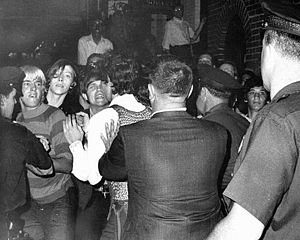
I was circumspect about my bipolar disorder for decades, so I don't blame anyone for staying "in the closet."  It is analogous to the situation gays and lesbians faced last century.  But we mentally ill don't have a Stonewall Inn where we can gather, from which we could fight back and hold proud parades.  We are lonely, and we may not deal with aloneness as well as people who have not been broken.  We are paranoid because we were scapegoated or abandoned by our families.  Many of us are not able to work and not able to pass as "normal".  We may be disabled by our moods and the severe side effects of the drugs we have to take just to keep from committing suicide.  

We see stigma where it might not exist - but that doesn't mean it doesn't exist.  It does, and it is powerful, because we don't meet this society's definition of worthwhile (successful, achieving) people, and we can't always restrain our tears or anger, and we have a harder time than most people finding effective ways to stand up to the stigma.  I wonder whether this will ever be any different.

Below, the first photo of the Stonewall Riots, which were led by homeless youth that slept in a nearbye park. The Mattachine Society newsletter reported that the Inn was their only safe place, so of course they fought for it. Other than that, "they had nothing to lose."
NY Daily News, June 29, 1969 - the Stonewall Riots