Showing posts with label Just Do It. Show all posts

Sunday, May 6, 2012

Against the subjunctive

Why do I have to write about important things?  (Are there such things?  How do you tell important from trivial?)  So I will write about a tee-shirt that has inspired me, but first I'm going to write about when Otto went to the zoo.  Age three.

At three, many children are still enlightened, and he was one of them.  One day Cassie and I took him to the Columbus Zoo, which is very nice indeed, though it has no jumping pigs.  I think, looking back, that he was finding it all very bright and confusing.  They live in the country and at that time had two St. Bernard dogs.  Was he supposed to be impressed by a mangy-looking wolf that just laid there in the shade?  But even little kids try to please you, and he trundled around with us.

When he got home, his Dad asked him, the way grown-ups do, "What did you see at the zoo?" Otto was glad to comply.

"There was this big pile of ketchup!" he said.

Unimpressed by a herd of flamingos, bored by the elephants, what he had seen that was memorable was in The Congo Room, one of their food pavilions.  It had a big ketchup dispenser, always a thrill for a little kid anyway, and a lot of ketchup had been allowed to drip down there and form a little mountain.  You never saw anything like it, and if you were a grownup, you didn't see it, not really.  But Otto did.  Strangest damn thing he ever saw. I hope he doesn't grow up to be a food engineer or stylist or something as a result.
~~~~
These marks ~ like this ~ are called tildes.  You don't care, I don't care, though having names for things is useful, or you end up having to say, I don't want the red stuff on my hot dog, I want the yellow stuff.  And (a conjunction, pretending that this sentence is related to the one before it) the following statement is in the subjunctive, because it indicates a condition contrary to fact:
If it were easy, everyone would do it.
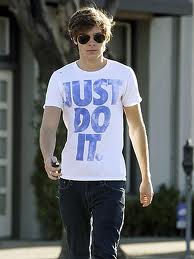
Because see, it's not easy.  What's not?  Sometimes I think everything's not, so it is useful to remember that nothing matters.  Well, I saw the above  motto on a tee-shirt at the health club recently, and immediately wanted to buy Cassie one like that - she once looked terrific in a Nike shirt that said in huge letters -

This was before this was morphed and marketed to death, and it struck me as a pretty good principle in life.

Now.  Back to the first motto.  I wouldn't have said it that way.  I'd have said -
If it was easy, everyone would do it.
Wouldn't you?  Well, maybe not.  I live in Ohio, USA, and learned my English the rough-tumble way.

I see these niggling distinctions as basically serving to indicate subtle divisions of class; in other words, my dislike is political.  I was happy when I learned, in a linguistics class, mind you, that there are two approaches to grammar.  There's Prescriptive, the kind we were graded on, and Descriptive - that is grammar that describes the way people actually talk.  So if I were you (which I'm not, that's why I use the subjunctive there), I'd get the second tee-shirt.  When you wear it, you will find out which of the people around you is a member of the Secret Grammar Police.  Then you can avoid them.

Tuesday, September 7, 2010

No comparison

Do not concern yourself with anything going on around you. Nor should you be concerned with anything going on inside yourself. Focus fully on the method and do not make external or internal comparisons.
Sheng Yen
In this talk Chan Master Sheng Yen was focusing on how to sit in meditation with a group, especially during a retreat.  The sentence I have italicized made me think, though I also know what it was to be concerned about others, especially on my first retreats.  


I suppose wandering eyes alleviated the stunning boredom of my first retreat.  I watched the head student, John - how could he sit so still for so long?  My attention went to my own inadequacy, then to my serious back pain, then to the guy who had flouted the rule of dress ("Nothing with writing on it") and was wearing a tee-shirt that said Kiawah on it.  What was wrong with him? I must have read that word a hundred times in the course of walking meditation on that lo-o-ong first weekend.  Kiawah, whatever that was, was wildly distracting.  I read the rules and killed myself trying to follow them, so why wasn't he like that?  Was he a student of Zen or not?  Why was he allowed to get away with it?  John should say something to him. Why was I so critical?  Why did I always follow the rules?  And so on.  Elaborately.


On some level I knew I should restrain this comparison to John and Kiawah.  But I did not know that I should (and could) also let pass the rich universe of reactions that was going on inside me.  My sensations, my pain, my self-criticism, my boredom, my strong desire to leave.  


And I did not yet have a good grip on the method.  No one had told me to count my breaths to ten and start over, a strategy some teachers think is essential for the first fifty years of practice.  I thought I should "follow my breath" but I was new to this, and not very good at noticing when my mind strayed.  Jack Kornfield compares this early phase of meditation to training a puppy dog to use the paper, gently but firmly.  My mind was more like a litter of kittens.  It is useless to try to herd cats.


But all this stuff is not confined to meditation.  It goes on constantly in everyday life, doesn't it?  External comparison.  We look at ourselves in a mirror and compare our nice, soft bodies to the airbrushed bodies of anorexic models and movie stars.  "Fat," we think.  Or we envy someone else's promotion or big house or hot car.  Internal comparisons and self-analysis.  Why do I this and Why don't I that. 


The method in meditation is one thing; the method in the kitchen or at your desk or in your car is quite another: just be aware.  Just do what you're doing.  Maybe a Nike tee-shirt it would help.  You could always wear it on retreat.