Showing posts with label Lithium. Show all posts

Monday, October 14, 2013

The Zen Way to a Balanced Life


 Bring it On - That is the title of this charming sumi-e painting from Nine Lives Studio.  I feel a little like that kitten - rather fluffy (gained a couple of pounds recently) and not quite sure on my feet, due to tardive dyskinesia (yes, brought on by a medication).

Nevertheless, I am leaping.  I am offering a course called "The Zen Way to a Balanced Life," to begin in November and meet for four weeks, ending before Thanksgiving.  I'm trying out a Saturday morning meeting time (10:30-12:00) so those who work during the week or don't care to drive at night can attend.  The course will meet in my home.

What, am I crazy?  You know I am.  That's actually my primary motivation for sharing Zen.  It has helped me have a life despite bipolar disorder and PTSD. 

I began meditating in 1997 because I was afraid my breast cancer would kill me.  I still get acutely anxious sometimes - there is no cure for being human - but I'm alive. Two years later my practice helped me get through the mental tornado of being yanked off  lithium - twenty years of over-medication and toxicity was harming my kidneys.  No one had told me it could do that.

Many practices begin the way mine did - with suffering so acute that you're motivated to do something.  That particular problem passed, as all things do, and then came the next car in the train of human life, which always has plenty of dark cars.  More, as you age.

Zen can help you survive these things with some grace, if only because it teaches you to let them pass.   Along the way, zazen builds some of the skills needed to live a peaceful life.  Maybe most important to me has been equanimity.  The ups and downs of life are bigger for people with emotional disregulation.

Of course bipolars are not alone in experiencing joy, depression, frustration, dissatisfaction.  We may be  more intense than the temporarily normal, and have often had more bad luck, but it's all about being human.  As the Buddha said, life is hard.  Practice helps.

You are invited to e-mail me for a description of the course.  My address is in the sidebar to your right.
~~~~~~~
p.s.  If any guest doesn't care to have a cat around, we put Tashi away.  That does sometimes mean faint plaintive meowing provides an opportunity to practice patience.
Photo: I fold myself, thank you.
Self-folding cat


Sunday, February 10, 2013

I Really Am Bipolar


I have been officially bipolar since 1978, when I was correctly diagnosed after three years of hell.  First they got me settled down with lithium and stellazine, and I don't know what else; then someone confirmed the diagnosis; you are bipolar when your condition stabilizes on lithium.  I was so relieved that I immediately accepted the diagnosis.  From there on I let psychiatrists push psychotropics on me to such a degree that I lived like a sane person, got jobs, got into a good marriage, went to grad school and got a PhD, and realized that being a college professor was not a dream, but a nightmare.  My life felt tinted gray, but they weren't the worst years of my life.

But I digress.  That's one feature of hypermania.

Still, after all these years I don't think I quite realized what it meant to be stuck with bipolar.  This truth has been forcing its way in since that meeting last Tuesday in which the shrink he said he couldn't do a thing for me.  At the moment, I am sleeping okay.  The moodswings are another story.  The regular cycling of up/down days that Seroquel had damped has returned.

Meanwhile, life goes on.  On the heels of Tom's last fall, we are in the process of figuring out when and how to move to the retirement home we like.  At first we thought I would go there into a one-bedroom, where I might have a stress-free life while Tom stayed in the house and got some things done (and didn't fall down again).  But our financial counselor nixed that - just too expensive month by month.  By that time, though, I had chosen the colors for my beautiful little one bedroom.  (They paint for you.)  And just last week I got to see them on the walls.  Here is the living room -
 I chose those colors from a favorite still life with apples.  The windowsill is not purple, but brown, and the coral is really that bright.  It seems much brighter than it did on an apple and a little paint sample.  The yellow is pretty yellow, too.  I wanted the living room to be warm and stimulating. 
Above is a view of the living room from the bedroom.  Fortunately, I was inspired to choose the bedroom colors by a serene mountain scene.  That's a kind of French blue, not too vibrant, and the window wall is the faintest blush pink.  Actually, this room is a little bright too, in daylight, but feels overall serene and pretty.

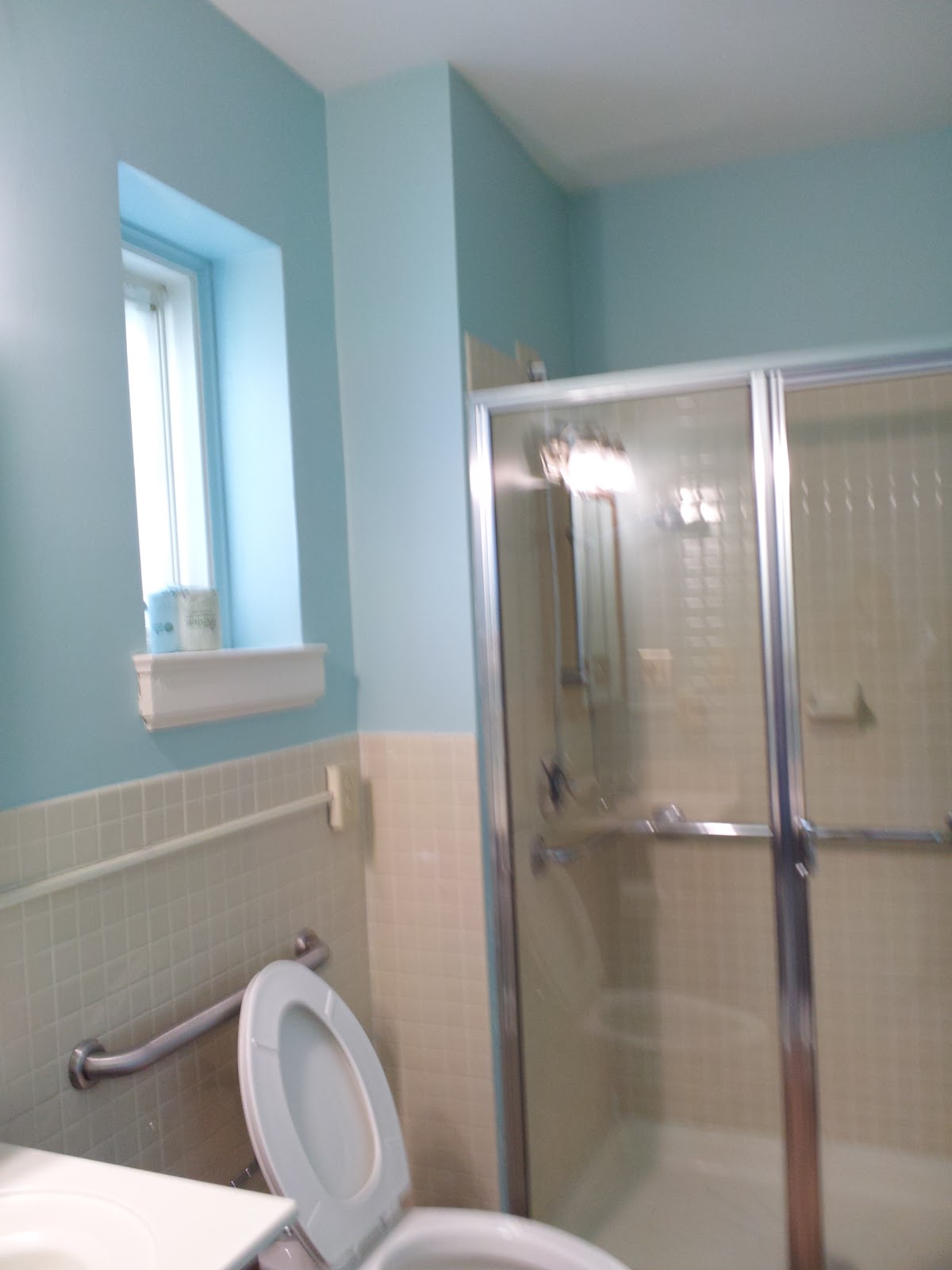
The bathroom turned out perfect though.  The aqua is well-represented in the photo to the right.  I might go for that in the next place.

Here's my point:  When the admissions officer opened the door to that warm, really warm coral and yellow, I thought, "You can tell these colors were ordered by a manic."  It was one of those small experiences that keep coming along; some people call that gradual enlightenment.

As realizations do, that truth has been soaking in.  When I feel real good, confident, joyful, that can be hypermania.  It can lead to poor decisions.  I have been revisiting memories of extravagant purchases, of spontaneous travel.  And from the depressed side I remember raising my voice at someone who was just trying to help, and saying too much in another situation.  These things are called "inappropriate behavior" in the psych wards.

 I really am bipolar.

I really am stuck with this self and its chemical swings. Whether bipolar is a disorder or a chronic illness it's hard to live with.  And I think it's true, there's no mood-stabilizer I can take.  So I need to take seriously the problem of life style, how to live well enough on up days and down days.  Getting through hypermania has challenges, but is somehow more manageable than depression.  And a depression is probably coming tomorrow.  We'll see. Sun-faced Buddha, moon-faced Buddha.

Tuesday, January 29, 2013

We're Not That Different


I'm trying to remember the last time I posted a commercial - Oh, I know - never.  But I see this one every night when I watch the news, and I enjoy the fact that we hippies are now harmless and charming in the popular mind.  And how about that message - we're connected.  Buddhism selling car insurance.

You may think you are very unlike a crazy person, especially if you have one in your life.  We can be hard to take.  I have never found a good program to teach me the techniques of managing my spectacular feelings.  I think such programs could exist, but they'd have to be extensive and expensive. I've had to work hard to keep myself from blowing up my life periodically.  Nevertheless, I think I am like other people who are considered sane (or undiagnosed), but enhanced.  A sort of high-def version, which is not always fun. And not always possible to medicate away.  Don't believe those stories celebrities tell about being all fixed up by a little lithium.  At least, I've never personally known a bipolar who could be magically turned into a Muggles.

When we’re manic, we have to manage a creative flow that can be strongly impelled, a desire to talk that can be so hard to stem it's a symptom called "pressured speech."  (Doesn't everyone have an aunt like that?)  Much difficulty sleeping, concentrating, finishing things.  Feeling really good can lead to giving all you have to the poor or, on the other hand, buying yourself a brand-new Lexus (I know a woman who did that).  It can lead to being so excited and intrusive you get every single person in your life mad at you, and that's a shame.  It is a disorder, but hardly anyone cuts us some slack.

 When we're depressed - you know how that is.  It can be like the worst break-up of your life.  It can mean really really not wanting to bother getting dressed or anything else, just sitting trying to read something but feeling distracted by pessimistic thoughts, trying to distract yourself somehow to just get through the day.  Sometimes depression leads to easy anger and ill-advised obscenity.  And, not so funny, there are the dark, quiet depressions that give rise to thoughts of escaping your misery through suicide.  I've been there, too (and would like to comment, parenthetically, that another person's suicide attempt is not about you). 

The big difference between me and formerly-normal me (my bipolar broke out in my mid-thirties) is that my moods may not be connected to any situation in my life, may just turn on and off with chemical switches nobody understands yet, like clockwork, or in respond to a change in air pressure.  Or they may be connected like anyone else's to life events like a lengthy power failure or a beautiful spring day, but more extreme. 

In other words, a bipolar is basically a human being, like you, but maybe with special needs. Special needs programs for the mentally/emotionally challenged.  That's a thought.

Wednesday, July 6, 2011

What is the Question?

It's weird to think back on how, when I was in my late forties, I resisted going on blood pressure medication, declaring that I would exercise and cut back on salt (neither of which I really did).  I was already on too many psychotropics, maybe that was it.  But I know a woman in her seventies who was very upset about going on synthroid.  You don't fix your low thyroid function by strength of will. There is something going on in us about being strong and self-sufficient, not aging, not being taken over by an outside force.  Maybe it's instinctive.  In my case, I suspect it's exaggerated by childhood sexual abuse.

When I was put on lithium at around age 35, I was told I would have to take it the rest of my life.  My long depressions and manias had been so destructive that I was glad to finally have a diagnosis, and fully cooperative.  Bear in mind that before the internet, you had to go to a medical library to research these  things.

But in 1999 the psychiatrist I'd worked with for nine years took a job out of town, and I was transferred to a new guy, who took one look at my kidney functions and yanked me off lithium.  That's a story I want to tell, and a long one.  For now I'll just say, I never should have been taken off without cautious ramping down. Psychotropics are powerful, and withdrawal can be a bitch. I know - over time I went off not just lithium, but the other nine drugs that doctor had me on. I know, read it and weep.

Once I had gotten through the withdrawals, I thought I had triumphed, and would never take those drugs again.  My creativity had increased tenfold.  I wrote and wrote, I won some awards, I did readings. I could now expect to write a poem every morning  I found out what I had been missing. I had been creative during those over-medicated years, but nothing like this. I now defined myself as A Poet.

I went along without psychotropics for over ten years, vastly aided by the discipline and calming power of spiritual practice, by Teachers and therapist, by a kind, patient husband.  Then comes kidney transplant.  I don't know whether they do this at every hospital, but at OSU they give every kidney recipient 500 mg. of steroids before the surgery begins, and another 500 afterwards.

You don't want to do this. 'Roid rage pales beside what I experienced. I got through it, I thought, and could even manage to doze off for a few hours once they gave me Ativan at night.  But once I was released and the anaesthetic wore off, I couldn't get to sleep at night.  For hours.  Worked with a psychiatrist at OSU Medical Center who tried Ambien, then Lunesta, and they simply didn't work. I tried all kinds of lifestyle things that are advised for insomniacs.  They didn't work.  What a mess. You can't heal if you can't sleep. So the psychiatrist suggested a low dose of Seroquel.  A psychotropic that can calm the fevered mind and make you drowsy. Once again, I was ready for anything that would help. And it has.

The wonderful Zen Teacher, Robert Aitken, was asked when he was ninety or so, "What is the most important thing?"

He replied, "A good night's sleep."

Ah yes.  The functioning of the human body and mind depends on it.

Right away the Seroquel slowed down my poet's mind.  In the four months since I started taking it, I have written only four poems.  I think any serious poet would think that's okay, if you're pleased with them.  I tend to see it as "not writing poetry anymore."  There you are.

I'm taking this as a sort of experiment.  I don't know whether the day will come when I try going off Seroquel.  There are things about it that I like.  I am more organized, better able to prioritize and then do those necessary tasks.  It even shows in the house, which is getting more organized one drawer at a time.I love that.


But back to my main concern.  The question is not "Should I take meds or not?"  The question is, "What do I need to do to live the way I want?"  Many young artists refuse lithium and similar drugs because they see their creativity as their central identity.  I'm here to say, it isn't.  Your central identity is the health of your body.  Once it goes, you and what you conceive of as your identity are gone.  And you won't care then, I think, whether anyone reads your poems.

Saturday, July 2, 2011

Bipolar, Borderline, Enlightened

This morning my study feels more like a sanctuary than usual. It is dim and threatening rain, a relief after days of bright heat. I had eight hours of healing sleep. There is nothing on our agenda for the whole long weekend but to relax. Our grandson, and his vital energy, are gone. Tashi is relieved - cats are instinctively wary of change. I'm getting there myself.

I want to write somehow about being labeled.

Last night we watched Crazy Wisdom, a wonderful film about the life of Chogyam Trungpa, who brought Tibetan Buddhism to the West. I first knew him as the teacher of Pema Chodron, whom I have never met, but whose books and tapes taught me how to meditate.  Recently my aversion to Trungpa's famous drunkenness and sexual behavior melted away - thank God, my standards are eroding - and I have been studying his talks on my Kindle.  So here came this film, through the Tricycle film festival.

Every psychiatrist I've ever known would feel satisfied that Trungpa Rinpoche was Bipolar and Borderline. You could make that Bipolar with schizoaffective overtones, as he had visions, one famous one in the cave of an ancient Buddhist saint. Add to that Dual Diagnosis - his drinking was legendary.

It is not news to me that the very manifestations that are called Bipolar can be seen in religious terms. I once owned a book called Are you Getting Enlightened or Losing Your Mind?  In the mid-1970's my own behavior during periods of extreme emotions/sensations was labeled "manic," but if I'd been in a knowledgeable Buddhist community it might have been recognized as the heart chakra opening, as an enlightenment experience.  Labels are strictly cultural.  Words have no intrinsic truth.

A wise Buddhist teacher might have had me eat beef, which is grounding, and kept me in dim, quiet rooms, with advanced students being with me, encouraging me to sit silent, to fall asleep, helping me come down.  Other behavior/feelings that hit later would have been labeled not depression, but despair, a spiritual condition long recognized in the Christian tradition, and prominent in Jesus's story. I would been encouraged to keep doing my daily work, to get outside and contemplate nature, to do physical forms like walking meditation, yoga, or tai chi, to sit with my feelings and recognize how they modulate and pass moment by moment. But I didn't have a religious tradition to help me.

People who are caught by the American mental health system can resist being labeled, or be grateful and hopeful that it will help. In the absence of a good community approach to extreme behavior, medications can help. Equally, they harm. Lithium cost me my kidneys. You don't know what trouble is until your kidneys start failing.  I'm sorry that a good residential training program did not exist, and sorry that very few such programs exist now.

Here is the Buddhist understanding of extreme emotions: you never "are" some thing.  You are a dance or a traffic jam, a bunch of processes that are active as long as your body is alive.  What you call "me" changes all the time.  Labels are a convenience, but we need to understand they are not reality.

Here and there are other people like me, for whom religiosity is deep experience, not "symptom". Many other people who have gone through extreme experiences and have learned how to work with their feelings, thoughts, sensations. Who use little or no medication. Who are happy and useful. I am convinced that more of us need to come forth and be willing to be labeled crazy, who know that the truth is, we have crazy wisdom.  Some frightened people will avoid us, some sick people will enjoy gossiping and feeling superior. That's life. You can't help what other people think.

Those of us who have found paths that work need to share our own experience, not the long drama of being sick and disrupted, but the important story of how we let that pass and learned to be happy.
Our Zen garden from kitchen window