Wednesday, November 28, 2012
The Truth About It
[Right about that time, this song was popularized by Three Dog Night.]
Your first yoga teacher - maybe it's like your first love: wonderful. George came to our small town and brought us yoga to candlelight and such music as an ethereal recording of the Panamian nose flute, and this was the early 70s. It was part of the revolution, which was good, but not all good.
One of his pieces of wisdom comes back to me often. He would say, as we lay there at the end imitating corpses, "It feels good to relax." And boy, it did. George was flawless. But there was one thing I still disagree with him on; now and then he'd murmur, almost as if talking to himself, "It's all good." My life wasn't. It was highly unsatisfactory. In fact, the years to follow that first yoga class would be the most painful of my life. Mania and depression almost killed me. Sometimes I realize how lucky I was to live through it, and I suspect it's true, that God, the universe, tempers the wind to the shorn lamb.
I can disagree with George's positivism today from a more respectable position, since I am 70 now, officially old. So I've been thinking about this question of how it all is for many years, more diligently than I thought about (or practiced) down dog. Now I have Zen to back me up, I believe, when I say, It's not all good. The Buddha's first teaching was that life is difficult, unsatisfactory. But it's not all bad; a lot of it is beautiful, fun, interesting, or at least feels good. What it is, it all just is.
It is.
I must admit, that looks like a bald statement, and one that hardly needs saying. I mean, obviously, it is. But I myself have spent a great deal of energy in my life trying to escape or control it. From not accepting it to hating it. At the moment I'm working to cultivate equanimity; it's been a theatrical year with some really bad depression. If equanimity came naturally, we wouldn't have to cultivate it.
But to be calmly accepting of reality is not natural; what's natural is desire and aversion, greed and hatred, and don't forget delusion. Maybe one of those delusions is that if we wear only organic cotton and eat vegan and practice a chronic smile, it will all feel good. Or maybe that's a another desire, and a natural desire, too. We are equipped to feel pain and pleasure, hunger and satisfaction. Pain hurts - it is unnatural to like it, and generally good to avoid it. But sometimes it just is. Life is still worth celebrating. Sometimes.


Monday, November 26, 2012
How to Accept a Gift
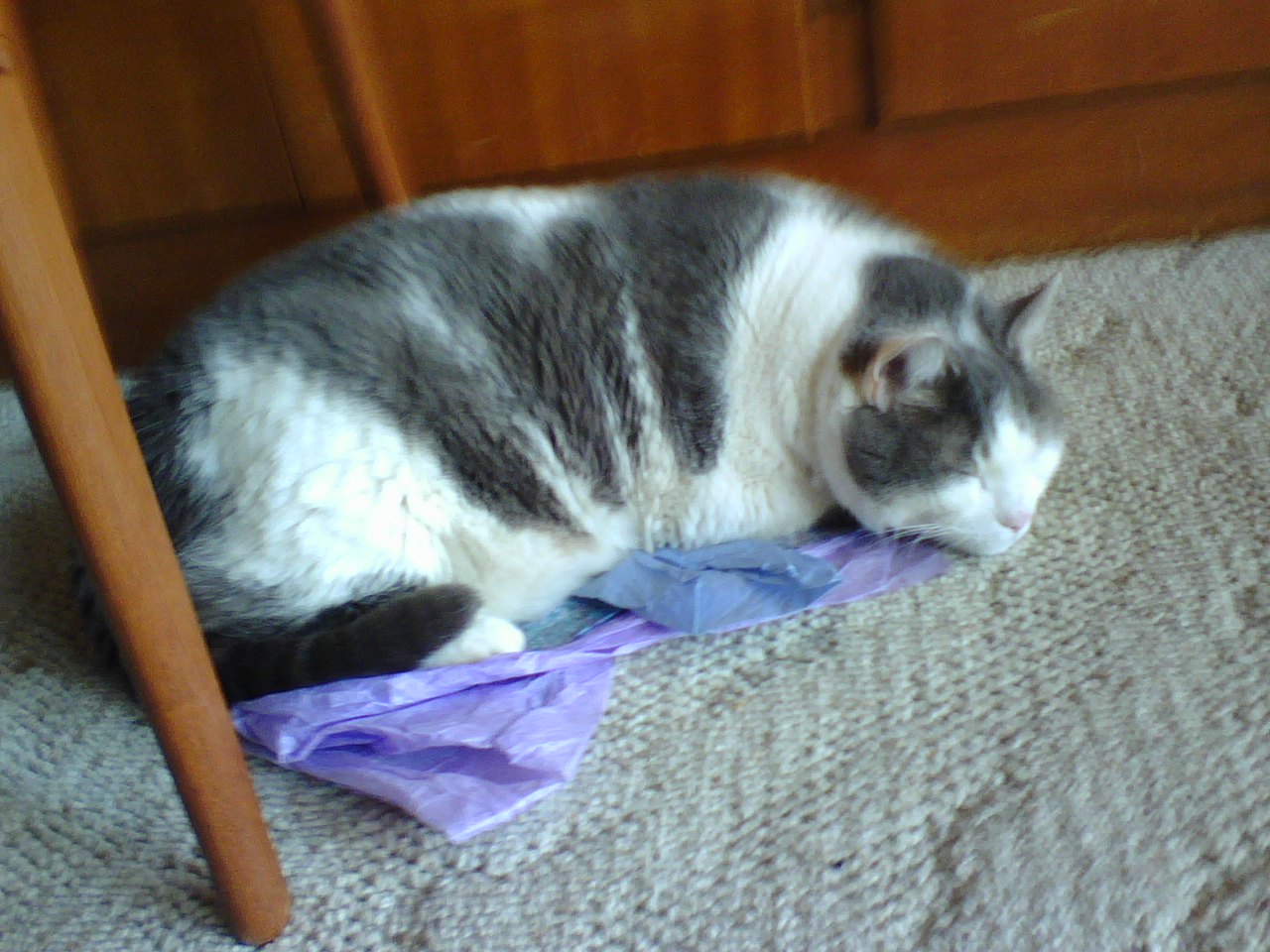 |
| Sherlock always appreciated the Christmas bounty of tissue paper |
Now, I am not going into general Buddhist wisdom of the day, which talks about accepting every [obscenity] thing that happens to you as a great blessing that gives you plenty to work with and become wise. I am really tired of hearing that, and am pretty sure it doesn't apply to my bipolar brain, which has often been given acute depression just because my happy/sad switches are genetically broken. It's some logical fallacy, I think, to suggest that a depressed mind can be glad to be depressed; clinical depression is a neurochemical disaster one simply endures by eating potato chips and watching old episodes of Gray's Anatomy, and you are not grateful for those things, either.
No, I am not talking about cultivating that dance-with-the-demons wisdom. I am talking about actual giving and receiving stuff as our biggest consumer holiday is barreling toward us here in America: Christmas. Which has nothing to do with religion for most Americans today. My subject is not giving, but receiving gifts with a generous heart.
We get out of the starting gate wrong as middle-class children in America, who are asked by Santa what they want. Who are encouraged to write to Santa, detailing the list. Who have seen enough TV commercials to internalize acute desire for some particular toy and begin nagging for it on Black Friday. Thus is formed the habit of seeing Christmas as the time when you hope to get your heart's desire. So it has nothing to do with generosity or gratitude; it's a kind of payday in the consumer culture. Though it never works for long.

As for you, a grownup, your heart's desire certainly isn't a hairy angora scarf knitted by Aunt Melba that will shed all over your new mulberry pea coat. It's so weird, and so huge, this scarf, that at first you didn't even know what it was. (Sometime, drinking wine with friends, you'll make a sort of funny-ironic story out of this.) It is totally not the right thing for that coat. And you're allergic to wool, and isn't angora wool? Doesn't she know that? You resent that failure of knowing your needs and taste. You don't wear scarves like that. It's ugly, it doesn't express your style. So you say, "Thanks," and toss it aside and let's get on with things.
Now let's turn to the other party in this transaction.
Aunt Melba made this scarf especially for you, with loving memories of you as a child. It took many hours, something you don't know, since you don't knit, and knitting always looks easy. She had to work in fits and starts because now knitting makes her arthritic hands ache. Sometimes she had to tear out rows, and figure out how to get it going right again; her mind isn't as quick as it used to be. She had to be very dedicated to get it done in time.
She'd been looking forward to this annual visit. She spent a happy hour picking out a yarn she thought was beautiful and would be warming and remind you of her love for you. Yarn is not cheap; this yarn probably cost more than the designer scarf that would have pleased you. And the scarf turned out just perfect, she thought. Your microexpression (a tiny frown of resentment at how wrong this gift is, it will go to the thrift store) does not escape her. If you were paying attention, her expression would suggest that her heart sank.
Not all gifts are this important. Suppose you meet with a girlfriend you only lunch with a couple of times a year, though it's an old friendship going way back, and you like each other. Last summer you picked up a very special beeswax candle at the Farmer's Market, thinking it was just perfect for her; beeswax burns bright and long and has its own delicate natural fragrance. You know she likes to take baths by candlelight. You went to some trouble to wrap it in a nice box with tissue and ribbons.
She says "Thanks" in an offhanded way. Okay. That didn't seem to work. Then we are on to your gift from her, some bath oil. Has she forgotten you can't take baths? a deprivation certain health problems brought about. You thought you complained about it often enough that everybody knew this little bit of hard luck. The bath oil seems impersonal, like she was just getting one more gift out of the way. In fact, is it possible she is just regifting what you gave her last year? Maybe. You're afraid so.
Now, what do you say, dear?
You say, "Thank you. This is beautiful." You look at it. In even the wrongest gift there is something to appreciate - the color, the packaging, the daintiness of it. You say so. And lavender, my favorite scent.
Because, like you, she wants her gift to be appreciated. The fact that you can't use it has nothing to do with it. This is not about you getting what you want; this is about the ritual of receiving with gratitude, even if the gift it is a child's wilted bouquet of dandelions. It is about receiving with the understanding that the gifts you are given have nothing to do with your dreams being fulfilled. It is ancient ritual, the full circle of giving and receiving. For that to work, the receiver has to genuinely receive, and be nice.
If you see some Buddhist wisdom sneaking into that, okay, it can't be helped.
Friday, November 23, 2012
What Happens When You Get Fed Up
[image: none today, to allow you to form images in your mind as you read the poem.]
I wrote this poem in 2000 when the consumer culture was going strong. At that time, Adbusters fostered the idea of international Buy-Nothing Day as a protest on the day after Thanksgiving. That year, the theme was "Enough." As in, you already have what you need. I was a fairly recent convert to Buddhism at the time, and this theme of cultivating contentment in simplicity seemed to be basic dharma. These days I think of it as cultivating equanimity rather than desire. Those with something to sell have done their best this year to get everyone into the stores crazed with a frenzy for bargains. I am pleased to see Adbusters is still at it, promulgating Buy-Nothing Xmas now. (link)
Enough
(A Utopia)
By Jeanne Desy
One year, children, everyone got fed up . . .
and stopped buying.
Nobody went to the mall that year,
nobody went to WalMart or
ate fast food or frozen pizza,
flew on a plane, bought a CD.
The economy came to a halt.
Unemployment rose to 50 percent.
The people who liked to work found work
and the rest stayed home with the kids.
Everyone planted gardens,
and cooked their own food
and cleaned their own houses,
everyone did their own laundry,
washed their own cars in the summer twilight.
People wore slippers around the house.
The market declined for designer shoes,
theme parks and day care, acrylic nails
and Prozac, cellphones and pagers.
Ringing and beeping tapered off, and
the air was spacious and quiet.
Nobody played the lottery, couldn’t afford to,
and no one bought guns.
There was not much to steal anymore,
and not much to fight over now.
Everyone had enough to eat
and a roof over their heads.
That seemed to be what mattered.
The tax base eroded—there was
no money for missiles now, no money for war.
Young men stayed home and tended gardens.
Old men designed wonderful toys,
grandmas made biscuits and everyone learned to sew.
Happiness blossomed, addictions declined,
no money for drugs now, anyway nothing to escape.
People grew their own catnip and drank tea
made with mint from their gardens,
and ate nastursiums and heirloom tomatoes.
Without ads, the TV went quiet.
There were no celebrities now,
everyone made their own music
with home-made drums and ancient guitars,
and told the old stories and wrote poems
with pencil on paper and read them out loud
over the breakfast table. Factories closed.
The planet cooled, the air cleared.
You could see the stars.
Wildflowers grew where there had been lawns,
rabbits came back to the yard, and foxes and owls.
The old folks sat on porches with dogs at their feet,
and shelled peas. Barefoot women
hung sheets to dry in the sun.
Everyone just took care of themselves
and each other, and
no one was rich anymore, so no one felt poor.
Now that there wasn’t so much,
there was more than enough.
© Jeanne Desy 2000
I wrote this poem in 2000 when the consumer culture was going strong. At that time, Adbusters fostered the idea of international Buy-Nothing Day as a protest on the day after Thanksgiving. That year, the theme was "Enough." As in, you already have what you need. I was a fairly recent convert to Buddhism at the time, and this theme of cultivating contentment in simplicity seemed to be basic dharma. These days I think of it as cultivating equanimity rather than desire. Those with something to sell have done their best this year to get everyone into the stores crazed with a frenzy for bargains. I am pleased to see Adbusters is still at it, promulgating Buy-Nothing Xmas now. (link)
Enough
(A Utopia)
By Jeanne Desy
One year, children, everyone got fed up . . .
and stopped buying.
Nobody went to the mall that year,
nobody went to WalMart or
ate fast food or frozen pizza,
flew on a plane, bought a CD.
The economy came to a halt.
Unemployment rose to 50 percent.
The people who liked to work found work
and the rest stayed home with the kids.
Everyone planted gardens,
and cooked their own food
and cleaned their own houses,
everyone did their own laundry,
washed their own cars in the summer twilight.
People wore slippers around the house.
The market declined for designer shoes,
theme parks and day care, acrylic nails
and Prozac, cellphones and pagers.
Ringing and beeping tapered off, and
the air was spacious and quiet.
Nobody played the lottery, couldn’t afford to,
and no one bought guns.
There was not much to steal anymore,
and not much to fight over now.
Everyone had enough to eat
and a roof over their heads.
That seemed to be what mattered.
The tax base eroded—there was
no money for missiles now, no money for war.
Young men stayed home and tended gardens.
Old men designed wonderful toys,
grandmas made biscuits and everyone learned to sew.
Happiness blossomed, addictions declined,
no money for drugs now, anyway nothing to escape.
People grew their own catnip and drank tea
made with mint from their gardens,
and ate nastursiums and heirloom tomatoes.
Without ads, the TV went quiet.
There were no celebrities now,
everyone made their own music
with home-made drums and ancient guitars,
and told the old stories and wrote poems
with pencil on paper and read them out loud
over the breakfast table. Factories closed.
The planet cooled, the air cleared.
You could see the stars.
Wildflowers grew where there had been lawns,
rabbits came back to the yard, and foxes and owls.
The old folks sat on porches with dogs at their feet,
and shelled peas. Barefoot women
hung sheets to dry in the sun.
Everyone just took care of themselves
and each other, and
no one was rich anymore, so no one felt poor.
Now that there wasn’t so much,
there was more than enough.
© Jeanne Desy 2000
Tuesday, November 20, 2012
Another Growth Opportunity

We should be especially grateful for having to deal with annoying people and difficult situations, because without them we would have nothing to work with. Without them, how could we practice patience, exertion, mindfulness, loving-kindness or compassion? It is by dealing with such challenges that we grow and develop.It made me feel better to send it to a friend who completely understands the irascible state of mind this kind of thing puts me in, so I thought I'd blog on it, too, and that might make me and someone else feel better yet.
Judith Lief, from "Train Your Mind"
Obviously, this quote is well-chosen the coming holiday, Thanksgiving, the day when 43.6 million Americans will travel to be with family; it's kind of a standing joke that these are people you would never have chosen as friends - in America there is a shocking disrespect for one's ancestors. Most of these travel by car, driving the highways for hours in bumper-to-bumper traffic for an average round-trip of almost 600 miles. And actually, this is no longer my situation in life due to deaths and other circumstances; I go to a Thanksgiving dinner at the church, where I like most of the people.
But not all. And one of them I just really don't like right now. For quite a few years my dislike was not a problem. I just avoided them (plural pronoun used as gender-free singular). But recently they shot a couple of arrows right into my tender spot. They were not aiming at me, and this is usually true when someone hurts you - some people just carry their big egos on their shoulders like a 2x4 and once in a while it swings around and happens to strike you, like a Three Stooges cartoon.
But - the damn arrow still hits you. I would like to pull it out. Meanwhile, this is a person I don't want to talk it through with, because I don't want to be their friend. I want to go back to comfortably avoiding them.
So I will have this to practice with on Thursday, for they will probably be there at church. Right action, Buddhists call it. Being pleasant. Not gossiping angrily behind someone's back. Not sending bolts of cold. You know. And that will just have to do. I intend to put them in the "difficult person" or "enemy" slot in my lovingkindness meditation, but right now that slot is full with somebody else. Such is life. And, since I am a creative person, my "beloved" category is full, too.
To close with a little more attitude that reflects on American history, here's Jon Stewart:
I celebrated Thanksgiving in an old-fashioned way. I invited everyone in my neighborhood to my house, we had an enormous feast, and then I killed them and took their land.Your comments are always welcome.
update: I had no trouble at all with negative feelings toward that person. A stray negative thought, but not a problem. Isn't that true for everything we worry about? (Unless, of course, it turns out to be much worse.)
Sunday, November 18, 2012
Against Cheer

I like the following response to the old question, "Is the glass half empty or half full?"
To the engineer, the glass is overbuilt.It's all in your frame of reference.
I am just messing around on a Sunday afternoon, enjoying this interview with Oliver Burkeman, the author of The Antidote, subtitled Happiness for People Who Can't Stand Positive Thinking. Here it is on Amazon, where you can look through the Table of Contents and read an excerpt. It strikes me as resting firmly on such Buddhist concepts as accepting uncertainty and being with the moment instead of trying to shape the moment or your mood or someone else's behavior to your liking.
As for the graphic, originally posted by Selin Jessa, it interprets beautifully for me: the glass is full - just maybe not full of what you want to drink. That doesn't mean you have to strive to want what you have - just be with it, not resisting, as you dangle off the mountainside (a reference to an excerpt from chapter four of the book).
Here is a bit from the end of the interview, when Burkeman was asked what he took away from writing the book:
I think what I've really learned is to have a lot of different tools at my disposal for when I'm not [happy]. It's not that I sail through life in some completely serene state, but that the problems and the obstacles and the irritations can be dealt with more swiftly when you are not locked into this idea that you have to stamp them out; that you have to make yourself feel motivated, for example, before you can get on with things that need doing; that there's something terribly, terribly wrong with not feeling incredibly excited and cheerful every moment of the day.So, hey, have a nice day, and don't cheer up.
Tuesday, November 13, 2012
What's a Buddha Made Of?

There is a very real sense that we are composed of everything we have experienced, but some things, like DNA, bear more weight than some other things, like great shoes.
I am working on conceptualizing the art I would create to represent a buddha. An ordinary small-time buddha-in-the-making. Say that buddha is 70, like me; it would have seventy-one galleries joined railroad flat style. And you go in at gallery 0, before conception. What is there? The DNA of two people, their lust, their dreams, the homes they grew up in, the scenes of their relationship flickering on the walls, the popular music of the time, of course. In my case, a film of World War II, bombs falling. You move on to gallery 1, I am born. Now each gallery represents one year......
and here I got carried away and wrote an essay that went far afield of this. There are lots of ways to play with the question, how to graphically present an individual. You could have each visitor flip a coin to determine whether they start at the present-time buddha and work backward, or take the train down to that beginning and slog through the buddha's whole life up till now. I'm warning you, some of those years would make iMAX look dull; I can see people insisting, Let me out! I said that sometimes myself. And don't forget the dull parts, the long years of slogging along the path. But wait, how to include that space that opens now and then, maybe opens more..........And while you were constructing it, the buddha is experiencing new events, breathing in new molecules, changing.....
[You can see more of the work of this gifted artist, Dan Mountford, on his Facebook page.]
Monday, November 12, 2012
What is that Original Face?

We act as if our true self was something unique to us, what makes us "special," whether by virtue of our special talents or sensibilities, or on account of the particular traumas we've suffered, or group we belong to. But our Original face is neither special or ordinary, happy or sad, white or black, male or female. What pairs do each of you put in place of Hui-neng's good or evil when dividing up the world?The whole talk by Zen psychiatrist Barry Magid sets this in context.
Of course, we make great effort to maintain that face we put on the world; no accident that Facebook is called Facebook, though it could be called TheSelfIPresenttotheWorld. But we are also at pains to define ourselves by all these terms. Surely no one is more likely to think in polar opposites than someone like me who has bipolar disorder: I am up or down, high or depressed, high-energy or lazy, creative or . . . you get the idea.
But I think undiagnosed people think the same way, though the terms may be different. To some degree it's about what you want, whether you feel like you prefer to. I have fibromyalgia, too, so I think sick or healthy, pain or happy . . . And there is weather: good weather (see picture above from last week) or bad weather (what I don't enjoy). But what is this that stands in the middle of all these words? How can I make this clear space wider?
Saturday, November 10, 2012
The Mousie and Mindfulness Express

The poem To a Mouse by Robert Burns, (subtitled "On Turning Her Up in Her Nest with the Plough, November 1785") begins -
Wee, sleekit, cow'rin, tim'rous beastie,and that opening line is justly famous. It's a long poem - people didn't have so much to entertain themselves with back then - and it ends -
O' what a panic's in thy breastie!
Still thou are blest, compared wi' me!How very Zen, I thought, the way I do, on coming across this poem today. The animal knows only the present; the poet thinks his large mind is more complicated, busy with bad memories and anxiety about the future. Before that last stanza, he has been contemplating human life and said -
The present only toucheth thee:
But Och! I backward cast my e'e,
On prospects drear!
An' forward, tho' I canna see,
I guess an' fear!
The best-laid schemes o' mice an' men,a justly famous line that touches right down on uncertainty. As I get it, the poor mouse is also uncertain when the rude poet disturbs her nest, but not until that moment. I must say this: it is not all good to just bumble around in the present; it means you don't have foresight. The Dalai Lama has commented that life is harder in the animal realm, because animals have so little control over their lives. In the moment they have to find food and water and safe shelter, and be alert. They have no emergency supplies or FEMA. Had this mousie been able to predict the plough, she might have built her test somewhere else, anywhere but in a field under cultivation. Mrs. Frisby and the Rats of NIMH, one of my all-time favorite books, centers on a field mouse, a widow in fact, who does realize the plough is coming, and furthermore has a sick child. Humans on the other hand, who are, in theory, able to imagine probable futures, build house on sand, and when a hurricane wipes them away, they build again in the same place.
Gang aft a-gley . . .
American society has latched onto mindfulness meditation as a secular activity divorced from Eastern religions and designed to lower stress and blood pressure and aid in healing. I noted with some amazement today that our health club is offering what they call Mindfulness Express meditation, a course that costs, I think, $75. Why don't people commercialize prayer like this? On the other hand, why do people feel free to secularize Buddhist practices?
I know the great Chogyam Trungpa believed that Americans needed an essence of Buddhism without a lot of folderol, so invented Shambala; and I don't know much more about it, except that a friend of mine loved it and stuck with it. Coming at us from the medical establishment there's Mindfulness-based Stress Reduction meditation, inaugurated by Jon Kabat-Zinn and eagerly adopted by the medical profession as "complementary medicine." Both men had more access to (bona fide) Teachers than I've had, and I greatly admire their work. I have always hoped that MBSR leads some people to explore the religion that gave birth to the idea of being present in this very moment. A Teacher I know hopes it opens that door.
Yet, I wonder. Even if people without Teachers can hang on to a meditation practice and do it right, if they are not getting to know themselves, if they are not attempting to practice the, ah, lifestyle of the Eightfold Path and to gain wisdom, does it get them anywhere? Or does it just enable them to stay on the hedonic treadmill, and refresh the energy to keep striving madly, and get stressed over and over again.
And that's all I know. Except that mice are so cute, it's a wonder Facebook isn't crawling with them. All those cats, I guess.
Sitting There in the Ashes
I like this, not least because it was filmed on a national news channel; and it is a sip of distilled Buddhist wisdom. (Also, it shows a few photos of Pema Chodron in her first life as an ordinary person.)
I'm curious how readers will react to this.
Tuesday, November 6, 2012
What Not to Do (to Me)

Most delicious is the comment that asks whether there are any proofreaders at the magazine. Now, a proofreader's job is to make sure that the galley faithfully renders the manuscript - it's copyreaders who, before the manuscript goes to print, correct grammar and format, mechanical things like that. This is an example of how it is always dangerous to start correcting other people, especially online.
This little tempest caught my fancy because earlier today I had begun an idle thing that I didn't think would amount to a post titled -
What Not to Do (to Me)
Wouldn't that be a great list? Things not to do, as opposed to these obnoxious to-do lists that have become a feature of the busy American life. I am inspired to think of this subject by an unpleasant incident at a recent social occasion. I was talking, just social chatter, not a big monologue, when Someone in the group interrupted to correct my grammar. (Notice that there is no obscenity in that sentence.) I'd said something like this "He told my friend and I . . . " What I was going on to say is lost forever when Someone said, "Me. It should be 'my friend and me,' because you are the object, not the subject." And he wasn't even an English major.
If you want to have some kind of aggressive social tool for refined special occasions, this is a good way to take the wind out of someone's sails. Although I have multiple degrees in English and writing credits, I was dead in the water, not because I used "bad grammar," because I was startled. Later I spent some time speculating on Someone's aggression toward me. My father's voice echoed from a long-ago day when I told him a kid was bullying me. He snorted and said, "What'd you do to deserve it?" I reminded him he is dead.
But there is always cause. I thought I must have inadvertently sounded smart, something like that, and my acquaintance might have had the kind of problem some older men have when women step out of their place. It is worth noting that this little incident put a drop of ink in the water surrounding that relationship. There you are. I'm not the only person who has trouble with right speech.
Monday, November 5, 2012
Committed to Being Stubborn

I had another opportunity today in Kroger's to practice patience in the checkout line. I stayed alert to the environment, and after a while saw that this could take a very long time, put my stuff back in my cart and went to (gasp) the self-service. Since I had three kinds of produce that had to be weighed, I learned how to do that. Yes, I am modestly proud.
I also got a writing prompt from the situation: a very old lady was holding everything up, and still might be, as she was attempting to count out some $74 in ones. When she thought she had it, the checker told her "There's only $35 here. Your bill is $74." That was when I moved on.
The lady looked very elderly, maybe 90, fragile-looking, tremorous and bent, and dressed in many shades of purple, down to her handbag and wallet and chiffon scarf protecting her hairdo; she knew what her favorite color was. Watching her I thought, You really need to let your daughter come shopping with you. I don't know whether she has a daughter, so what follows here is all my fiction.
The lady in purple does have children, a couple of them right here in town. A son and a daughter, all you need to navigate old age, if they're decent people, and let's suppose they are. They have had to take her credit card away because she was drawing money from ATMs and giving it to scammers, and then they had to take the checkbook away because she was constantly bouncing checks. They have begged her to let them go shopping with her. But she can shop alone, because she's still driving. You'd be surprised what kids will let their parents do, rather than make them mad. It's sad.
Her kids have begged her to let them do the shopping - not a chance. They need to insist, but they have. They say, "She's so stubborn."
There's a lot to think about here (like, how are you going to handle your old age?) but I set out to write about being stubborn. In my story, the old woman can't shop alone. Her endeavor was making her anxious, and the checkout lines were all backed up because she was effectively disabling one of them. She needs to relax and accept the reality of aging.
The moral of the story is this: Stubbornness is not a virtue. In fact, sticking to the way you want things to be, no matter who it hurts, is a spiritual flaw. Yet, people who would never admit to other character flaws (like having no impulse control or being mean) don't hesitate to say "I'm stubborn." And they have trained their poor children to think it's an okay fact of personality. "Oh, he's always been stubborn."
What follows from this, if you think about it, that a stubborn person is going to stick to being stubborn. In a weird way, it makes perfect sense.
Saturday, November 3, 2012
The Goal Anyone Can Set
 |
In a wider way, this applies to all of us as we age, and at any age as life naturally changes around us. For instance, an older (than me) friend was excited about a month-long driving trip she and her husband were planning when she had an inexplicable fall in the night and cracked her pelvis. She struggled with considerable pain, and not being able to drive, and finally realized they had to postpone the trip a few weeks. But as she worked to heal her husband fell and it was more serious - a seizure, perhaps. He has been hospitalized for weeks now getting all kinds of therapy and trying to adjust to medications. She told me that their life has a new design, and she doesn't know what it will be now.
That's very large, but things can change radically in other ways. How I suffered years ago! when I suddenly had a painful stress fracture and had to wear a soft cast and limp around, and stairs to my study were just too difficult. Now my feet are okay and I'm in a one-story house, and it's my chemistry. Depression comes and goes these days, and I have to cancel things. As for goals? On a slow day my goal is to endure the hours with minimal suffering. Ambitious goals, like submitting my poetry for publication - they come and go like the wind. On a bad day, I don't care, and there's nothing external pushing me. On a good day I want to do a dozen things. I don't have a steady thread of self giving me the discipline to work on major goals of that kind.
But good day or bad, I have fallen into having one goal every day: To be kind. It is not hard to be kind; it can be passive, not being unkind or doing harm. Not making the grocery store checker's life more difficult. Not snarling at a beloved person. Giving the cat fresh water. Calling someone on the phone to see how they are. Responding nicely to an e-mail or internet exchange. Sending a thank-you card. Like that.
The simple vow to be kind isn't hard, but it actually changes your stance toward the day. Instead of thinking about what you want, you are thinking about how your actions affect others. Like shining a light out in a dark room, instead of into your own eyes.
Subscribe to:
Posts (Atom)