Tuesday, October 30, 2012

Grandma for President


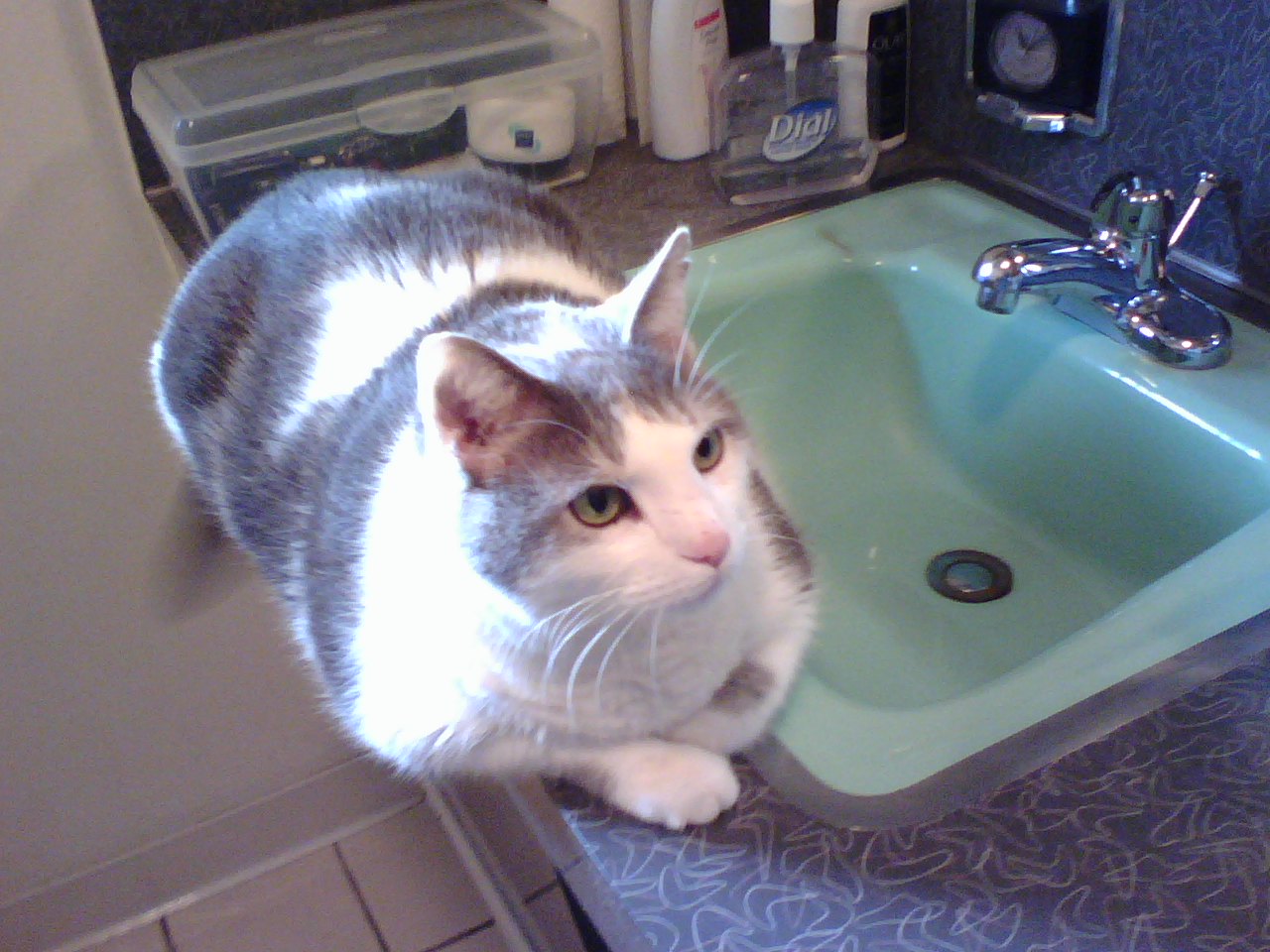
[image - completely unrelated ad starring a cat that struck me funny. I can't find any amusing campaign humor.]

So considering this long, tiresome election here in America, I fell to daydreaming about the ideal candidate. Obviously, that would be someone who does not want to be President, because it's a job no sane person would want.  Who else but me, then?  So imagine me, for a moment, with grayer hair in a sort of bun, and wearing a nice old-fashioned dress with a lace collar (and tennis shoes, of course) on a platform, speaking to a sea of cheering people.

Friends [I begin] today we find ourselves in a great big mess.  Yet, I come to you with a light heart.  For I know that at this very moment, this mess is working itself out.  It is working itself out in China and India and Russia, in Africa, all over the world.  In each and every nation, change is taking place. And there are serious people enduring long, delicate  meetings in the effort to put aside national pride and work together as one people.  For we are all one, we cannot escape our deep interconnection.  We share the waters and the sky and the air.
[An uncomfortable hush has fallen over the crowd. Is this really a campaign speech?]
So I ask of you today [I continue] to put aside not only your pride, but your hatred, put aside all your  hatreds.  To put aside your blaming and instead think deeply about your own actions, and how you help create the world we share.
[scattered boos, sounds of hushing.  You could hear a pin drop; that would be sharp.]
Ask yourself [I say], what can I do to help my neighbors?  What can I share?  How can I make this a better world with food and shelter and a decent life for every single human being, with justice for all, no distinctions? 

[murmurs in the crowd of "UnAmerican!" are shushed.  One muscular man turns and starts weaving toward the exit, shaking his head.]
And I herebye vow [I continue, since I still have the mic, which is very important in politics] that I will not be rude or unkind on the world stage. That I will endeavor to lead this nation step by step in a search for international peace and cooperation.  That all serious, important meetings will have breaks for cookies, and our children and grandchildren and our beloved pets will play at our feet to remind us what this is all about.

[stunned silence. Camera goes in on a woman with a look of amazed hope. Flashbulbs pop.  No, wait, wrong generation.  Many phones are held aloft, that's right, sending this out by video to the whole world. Cut to cheering crowds in Tianamen Square. A Chinese soldier is shown wiping a tear away.]
And so I say to you, in conclusion, Vote for me.  Because a vote for Grandma is a vote for Grandmother's Heart!
Oh my, the crowd goes wild!  Because I'm writing this story.
Seriously now.......it's not a bad agenda.

Monday, October 29, 2012

Balance

Here I am, still working on that space between Want and Don't Want.  Recently read an article that defined equanimity as that space.  On your right hand, you Want things.  On your left hand, you Don't Want things.  There is a gap in the middle, maybe a very little gap that can be made wider. 

Funny, I recall years ago listening to a talk in which Pema Chodron introduced lovingkindness meditation.  When she came to the part about wishing for the happiness of someone you neither like nor dislike, she called it "the neutral" and joked that it sounded a little ominous, like an alien.  So I am thinking that this same space in which equanimity resides could be called the neutral space.

Church yesterday was an opportunity for intensively practicing being there.  I made a point of just experiencing what was going on, without reaching out with desire when I liked the anthem or reacting with aversion when someone spoke from the pulpit in the kind of  little-girl voice that is hard for me to understand. 

Maybe because of that effort I was aware when Tom was finding it difficult.  The service was about The Day of the Dead, and it directed us to thinking about those we had lost.  And he has lost one important person after another these last months.  So maybe residing in that space made me more open, and that generated compassion.

Just thoughts, and ordinary ones.  There are so few fundamental truths that we are all singing them over and over in our own voice and in our own way, trying to get them ourselves.  It's a serious practice.  Today we are on the outer track of Tropical Storm Sandy, with lots of hope for not losing power, lots of aversion.....

Saturday, October 27, 2012

10 Good Reasons to Practice Zen: No. 3

No. 3  You Know When You're Bored

Not that I was wrong when I wrote Reason No. 1 about not going nuts because I had to wait in a line a few minutes - I just hadn't been noticing enough. That is, no matter how carefully I plan my life - always trying to have escape hatches - I sometimes find myself stuck in something BORRRING. Though I do have a certain tolerance for doing nothing, as evidenced by the fact that this lvideo of Flippy Cat doing very little makes me laugh out loud.

But I have had occasions recently to be trapped listening to some narcissist who is just not going to stop talking about herself (or himself, but the point is, never about me). A minister at a funeral who really got into selling his wisdom and charm until everybody around me was also fidgeting. A woman who launched into a monologue at a lunch about, apparently, every nature documentary she ever watched in her whole life. Do I need to go on? You know these people.

Last night I unfortunately paid money to see a film about an aged celebrity who has often been photographed at worthy activities like civil rights marches, because he was a celebrity, while hundreds of thousands of what we call "little" people really made up the action and got beat up and went to jail. The film about his life got tedious, but at least it was film, something was happening. But when the "interview" with him began there wasn't any visual to distract me. I put the word "interview" in quotes because it was in fact another person saying as much as they could about their work before the admirable celebrity launched into another ten minutes about his work.  You never want to give some people the stage.  Also, two hours is long enough for any public event.

I happen to be attracted to the basic anti-American Eastern ideal of being "small" - that is, having humility, not standing out from the crowd. Buddhism makes a point of this (as did Jesus, who was from the Middle East), but I had already figured out in my youth that being with certain relatives was at times going to be stunningly BORRRINGGG as they were pulling privilege and dispensing wisdom in far too many words, or telling a story that illuminated their brilliance or wonderfulness, and you just had to sit there, whether they were your parents or, oh, someone else's.  Some things you endure.

I believe that the narcissist's life is basically unsatisfying, and I am sorry for these people who work ceaselessly to convince everyone that they are special; I have a feeling they must sometimes, when they are not holding audience, feel lonely and unhappy. After all, they are missing out on genuine relationships, in which one person talks and wait, here it is - the other person listens.

I got subjected to a string of boredoms lately, and realized that all my mental tricks are sometimes not enough to occupy me until I can escape. That's why I'm not exactly retracting Reason No. 1, but modifying it. And here's the thing - after many years of working on mindfulness, I now realize how annoyed I am by certain people. And that means that sometimes I can avoid them.

Thursday, October 25, 2012

Be Careful What You Want

Tucked-paw restorative yoga
As sometimes happens, a comment made on my blog inspires me as being wise, and something I should write about.  It comes to this:  things often don't go my way.  My way.  The way I like or plan.

Actually, this is very serious in our lives, it's not just about small stuff like getting into that pottery class or having to visit with a difficult person (who might just be a relative).  I've seen people be very stubborn about life and death their way, hang on to life, complaining that it isn't fair for them to die at this age, they don't want to die, they refuse to die.  This is how some people respond to a very bad prognosis, such as metastasized cancer:  I'm not going to let this beat me.  It is sad to be in a group with someone like that and see them try so hard not to accept the inevitable.

We are working on the big issue around here right now, having lost so many people to death the last couple of months.  We will be offering a course at our church in January based on the book Being With Dying. A lot of this will be about accepting our own mortality.  But I was going somewhere else with this that is probably connected somehow....to a documentary we watched last night on Netflix that has me thinking.  It was called Happy.

One of the things I like about watching movies at home is that I can fool around baking cookies at the same time and making notes on my iPad.  I knew that happiness is not found through external goals, such as more- than-enough money, status, things, winning.  But what surprised me is that it depends on the kind of goals you have.  The big three are -
to help others
to grow personally, spiritually
to maintain close, connected relationships
This is so cool - the scientist who talked about this, Richard Davidson, turns out to be a long-time meditator, and friend of our beloved friend, The Dalai Lama, who himself appeared in this documentary, too, explaining how compassion is intrinsic in human nature.  That gives rise to the interesting possibility that you don't have to work on compassion - just vow not to get in your own way. 

Tuesday, October 23, 2012

Stuck With It

My husband Tom had polio the year before the vaccine came out, and it changed his body in a number of ways, most seriously, diminished respiratory capacity.  Many surgeries were done on his hands and feet that allowed him to function well in the world, and to work.  But there is no getting around some of it, nerve damage, for instance, and he does not imagine that it will ever be possible to escape or control that; it's his body, and he's pretty content in this world.

It's hard for me to imagine being as accepting as he is, since I keep building fantasies of escaping from or controlling this bipolar disorder.  A new study of DNA comes out and I think, That's it.  This is going to lead to a cure for bipolar.  In my lifetime.  This disorder broke out to stay in my early thirties, so I've been dealing with these hopes and dreams for over three decades.  I modify them at times.  There has to be a way to medicate this that would leave me perfectly normal, without moodswings.  I mean, that could happen.

So this morning when I was reading an article by Bernie Glassman, I was struck by his words.  First, a photo to suggest one reason I like Roshi Glassman.  He clowns around, lest students take themselves too seriously. (That student is Jeff Bridges, BTW.)


And here's another photo of him leading a street retreat, a plunge into living homeless.

This is quite a person and teacher. 

In the article he says -
All of us have some degree of realization and, moment after moment, are manifesting our understanding of the oneness of life. Obviously, the greater the realization, the greater the clarity, the greater the confidence.
      And with all that, even while possessing great realization, we still have our conditioning, our own particular characteristics, our own particular paths. Little of that changes overnight. In fact, there is a great deal that remains unchanged throughout one's lifetime. We acquire from a very early age strong patterns of behavior; we have physical characteristics that we and others sometimes call limitations; we have traits embedded in our DNA that we are powerless to change in this lifetime. It is like drinking from a glass and then washing it of all trace. The washing itself leaves traces. So we wash some more, try different ways of cleaning and drying, yet no matter what we do, some trace is always left......

So you can see why that speaks to me, with my inherited mental condition.  Because if I'm not careful, I get into thinking I can beat this thing, that there is a perfect point between overmedicated and undermedicated that I could sustain day after day and be, you know, normal.  This is a 70-year-old woman who has yet to perfect the art of picking up after herself.  (I work on it, though.........)

Saturday, October 20, 2012

Vaughan Bites the Lime

Henri Matisse, Still Life With Oranges (and maybe a lime)
The false self is the self of duality, the self of self-consciousness and limitation. Our true self is as wide open and unstructured as this very moment. Sesshin challenges us to experience this moment without limitation, without thinking good or evil, without thought of "how we are doing" or what we are accomplishing or failing to accomplish by our sitting. 
Barry Magid 

It's me, still working on that koan I discussed last time, which is working on me as I piece around in James Ford's The Book of Mu.  What I'm getting is that the point is just to be here experiencing reality.  You can get very fancy with koan work, but the point is almost laughably simple.  Just be open to reality.  A baby can do it. 

I wish I had managed to videotape our godson Vaughan one Sunday at brunch when he vigorously communicated his desire for a lime wedge on his Dad's plate.  He was under one year old, a dynamic, curious child.  His Dad gave it to him, he turned the lime around, quite a feat in little fingers, looking at it, squeezing it to see what it would do.  He touched his tongue to the skin.  Made the decision and bit down on that lime.  The expressions that played over his face were priceless, starting with shock and awe.  I can't describe that visible flow of direct experience.  Maybe you could try it yourself in front of a mirror.  I can't, I laugh just imagining it.

We get so fancy about life, how to live, and oh, how to fix ourselves.  People get very fancy about the Zen retreats mentioned in the quote, which are called "sesshin," and there can be a complex "etiquette" and rituals to follow.  The idea is that following all this encourages you to pay attention to your movements every moment, though it does seem easy to fall in love with all the theater of it and forget the point.

The goal is actually so simple:  just be here.  This moment.  Then keep doing that.  Being wide open.  Biting that lime.

Thursday, October 18, 2012

Living With a Chemical Imbalance

When I woke up this morning, I knew this was a good day.  Actually, that's the schedule lately, good day, bad day, like clockwork.  Very strange, but then the bipolar mind is different than boring old sanity. As I was being glad I felt good, the koan came in, the one I've been carrying around for about thirty years.  I've written about it before.
If you do not say good
and you do not say not-good
then what is the nature of reality?
That got me thinking how I could describe these days without the evaluative terms good and bad. 

one type of day is -
high-energy in all chakras - it's remarkable
active,
interested in ideas
tend to talk and write a lot
very creative
motivated to do things,
enjoy art and beauty,
filled with loving impulses -
and I like that kind of day.  Who wouldn't?

the other type is -
low-energy all around
passive,
quiet,
uninterested,
unmotivated,
struggle to just do essential things
vaguely dissatisfied with everything, little feeling
tendency to sad, morbid thoughts - 
A mood too many people are familiar with, and no one I know likes it.

Like/don't like is about preference.  You may say everybody would prefer that high-energy day, and that wouldn't surprise me.  Still, the day is not intrinsically good or bad.  Those words are assessments.

If you just describe these moods, they are primarily different energy states.  There are roughly three approaches to any mood or condition:
.  just experience it
.  try to change it
.  try to escape it
I almost left out approach #4
.  grouse and whine.

Changing the state - You learn to do that when you feel too high. Sit down, shut up, breathe. Meditation is obviously good practice for this. And a bipolar needs to do it or come across like a Labrador Retriever puppy.  Changing the low state is harder, and often I just try to escape/endure.  Now that I think of it, there are ways to work with your own energy.  I studied kundalini with an excellent teacher once (Hi, Kit), and I know there are yoga poses that build energy.  I've also done some chi gung. There's a course in that at our local rec center, and I'm planning to sign up for that.

But what about the "just experiencing" part?  That sounds very Zen. Yet - who wouldn't want to pull the thorn out of your paw?  Enduring a mood is easy to do when it's high-energy full of dopamine and serotonin; I lose myself in whatever I'm doing.  Experiencing the low-energy state - not. I'm really fond of escaping it when I can find fiction to read or a movie.  This kind of chemically-based condition doesn't seem to benefit from self-examination and self-talk the way situational depression can.  And that's all I know.  Your thoughts are welcome.

Tuesday, October 16, 2012

Love in Many Guises


Pretty Woman is one of my favorite movies.  I understand that you might think that's crazy, but I can explain.

This is a film set in reality.  The poor woman has no way to earn decent money except to sell her body.  The rich man has no intimacy in his life, with himself or anyone else, and is not particularly a nice guy; this describes pretty well the rich men I have been around.

To sell her body, the pretty woman played byJulia Roberts resorts to making herself into a cliche, with a blonde wig and stereotypical clothing of the kind associated with pornography (or, these days, found in high schools and malls).  But she has a natural goodness, a spirit and sense of humor that comes through and enchants the poor little rich guy.  In the scene above, he enjoys wielding power-through-money after the woman has been snubbed in an exclusive shop; she enjoys it too, and gets her own back.  The snooty saleswoman is left to contemplate her bad karma.

The clothes do great things for the girl; that's the Cinderella story exactly:  a great dress and shoes.  BUT she does not get the man (the proper ending of a love story) until she stands up for herself and walks out on him and sets about getting an education.  He has to humble himself and climb up her tower with roses.  And apologize.  What woman wouldn't love this story?

Oh, quite a few, maybe.  I would understand it if this movie made some folks sick, as it traffics in all this skinny youth and beauty and appearances.  But I like it, and I am a feminist.  I mean, I do not believe men ought to be in power because they're men - power in the home or the workplace or political office. I believe these institutions should be run in a democratic spirit.  I do not believe women should be pretty, not smart.  I think we should be paid the same as men for the same work.

Actually, my radicalism goes deeper.  I think we are all intrinsically valuable and equal in the eyes of eternity, and that competition is by and large a bad thing, a feature of patriarchy that creates a few winners and a lot of cheating and a lot of losers.  I don't see why a CEO should ever earn more than a janitor, whose job is dirtier, more dangerous, and less appealing.  I believe all men and women are created equal, so there you are - I'd revise the  Declaration of Independence, that's how bad I am. 

This movie is the kind of fairy tale our culture is built on.  Pretty girl gets prince.  Still, I like the feminist spin of the ending.  The idea here is that a woman can stand up for herself and make her own way without a guy or his money.  So what do we make of that happy ending?  Well, by and large chick lit and chick flicks are about love, intimate love being possible between two people.  I am contrasting this in my mind with another favorite film, The Big Lebowski, a buddy film that shows committed love between friends, the kind of guys who have a hard time attracting women, I guess. Like Pretty Woman, this is a film based on stereotypes that rises above its genre.

Fair warning:  if you are offended by obscenity, you might want to skip this clip, in which the guys are holding an impromptu guy memorial service for their friend.


Sunday, October 14, 2012

A Post About Desire That's Not as Interesting as You Hope

Oh, did I wrinkle your paper?
I'm not out to present the Four Noble Truths that are the foundation of Buddhist teaching in a scholarly way; there's a good treatment of them on Wikipedia in an article that nobody is contesting.  But in the Zen/Unitarian fashion, I have my own way of thinking about them.
1.  Life is generally unsatisfactory and sometimes damn hard.
2.  The reason we suffer is that we don't accept reality; we desire things to be different.
 I'll stop there, because my little story today is about that second truth - desire.

We often think of desire as being about strong cravings for big things, like having a certain person love you, but it can be all over the place in our lives, hiding behind the curtains, you might say.  That's where one popped out at me the other day. 

I was lunching with a friend and our talk wound down a familiar pathway about how we just can't catch up and get things done and get everything organized and nice.  Yes.  For quite a few years now we've been having that talk, which I think consoles us a little, as in "misery loves company," and if anything, we're both worse now than ever.  Or let's say, there are more messes around our houses than ever.  I mean, we've had many years to build them, and some good excuses.

I suddenly had a small realization: the problem isn't that we're messy; the problem is that we don't want to be messy.  See what I mean?  We desire our houses to be neat, clean, and organized.  We don't want to create messes all through the day, throwing unopened mail on the table, throwing dirty clothes on the floor, not hanging our coats up.

Now, I can only speak for myself, obviously, and it's myself I'm describing, not Gini.  I have more messy piles in my house, drawers, and closets than I can count.  And that is the kind of cat I am.

That was a saying I attributed to Sherlock.  In the way of male cats, he was utterly unapologetic about his behavior.  Knocking over the African violets?  He didn't care.  If you asked him, "Why did you do that?" his answer was delivered silently, with a look - That's the kind of cat I am.  Then back to washing his shoulder.  He was what he was, and in the fashion of all cats, he had no desire to please anyone else, or to change.  Cat lovers cherish this fact, which perhaps mystifies dog lovers.

I think that we humans are too estranged from our own animal nature.  It gets a chance to come out in singing and dancing and other physical activities.  Otherwise, we tend to ignore it and to focus on doing things  animals with large brains and opposing thumbs can do, like talk and compute and make things.   And we tend to think we can conquer our basic natures.  And I'm sure we do a lot of that; but all that human command draws a line somewhere when it runs up against the wall of our basic nature. 

And that's okay, too, is my point.  Basically, you are what you are, and you can't be taller than you are or have smaller feet or bigger eyes, or umm, keep things neat and tidy when you just don't have a neat tidy gene in your body.  And maybe the only problem is that you desire to be different than you are.  There's that word again.  Watch out for it.

Friday, October 12, 2012

Ten Good Reasons to Practice Zen: #2

Reason #2: You get to relax.

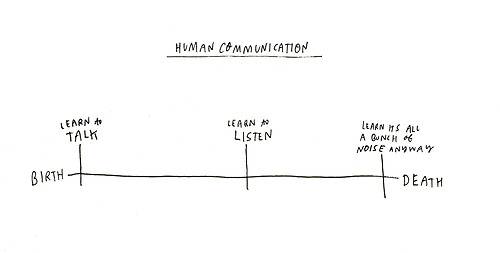
This morning I came across this, by the artist, Wendy MacNaughton.........
And it suggested to me a way to view individual human development.

1.  We start out babbling, me, me, me, want food, want comfort.  We formulate longer-term desires to achieve, to get things, to matter.

2.  If we're lucky, we gradually learn to take in the outside world.  We begin to meditate and hear the demands of the self, and acknowledge the reality of other people, to not push ourselves forward so much.  We get some freedom from the cravings of the small self.

3.  We live long enough that life keeps knocking us with the fact of death and we figure out that we are one small golden blip on the great black river, and all those words don't matter so much after all.

So there.  You get to relax your ambitions.  That's reason #2.

Wednesday, October 10, 2012

10 Good Reasons to Practice Zen: #1


       Maru demonstrates things you can do in a bucket

Reason #1:  You will seldom be bored.

Today we ate lunch at the healthy-food cafe in our health club, partly because my doctor warned me that my cholesterol has inched up these last six months over that magic number, 200.  Furthermore, he explained, my "bad" cholesterol was up, too.  I did not feel I needed to confess about my primary addiction, Lay's potato chips and Heluva French Onion dip.  But it did make me rethink my cavalier attitude about that and bacon and cheese and eggs - you get the idea.  I will work on this; I hate the idea of a statin drug, not without reason.

A lot of people wanted today's hot lunch, a turkey Reuben (which ended up bearing no resemblance to a real Reuben, of course), so I waited in line to pay.  Right ahead of me was a fire-type woman who just could hardly stand the five-minute wait.  She bounced away to get napkin and fork, came back, and then was pretty much bouncing on her toes with impatience, like your teenage boy, though she was well into her fifties, I thought.

The cafe's credit card machine is old-fashioned, so a credit transaction takes oh, maybe two minutes start to finish.  As the woman waited for hers to process, she said to anyone, "This is so boring!  I am so bored!

Later I told Tom, "The thing about Zen is you are never bored standing in line."  Now, this is true, and it is also true for sincere practitioners of other disciplines, I imagine.  My tai chi teacher talked to us more than once about using time waiting in the checkout line to stand in wu wei, balance, and breathe.  What I was doing in this line was practicing being there.

That's actually what we do when we meditate:  we are practicing being with the reality of the present moment, which is to say, reality.  During the early years of Zen practice we are taught to follow our breath, in and out, a way of focusing on the basic mechanism of the body.  Later in Zen you can take up shikantaza, just sit there watching not only your breath but also your sensations and thoughts.  You have many profound thoughts, like Ring the damn bell! or Nobody ever died from not scratching an itch.  

Nevertheless, there are times in sitting meditation when you are bored.  I suspect many people give up meditation for exactly that reason.  We Americans are the worst, I imagine, so addicted to speed and exploration and entertainment and getting somewhere and having fun.  We actually list our desires, the things we want to see and do before we die, which is called "the bucket list" after some movie. 

Maybe because of these bad habits, one of our cultural icons is a man who built a little cabin in the woods and made a big point of simplifying his life.  Henry David Thoreau.  Google him and you get over 4 million results.  I'm happy to say Buddha gets even more.  He should - the Buddha didn't get bored and give it up after two years.

Monday, October 8, 2012

You Don't Have to Like It

A good laugh helps, though
I do a lot of talking to myself about my bad attitude, a privilege I reserve for myself - I'm plenty self-critical, I don't need to hear it from anyone else.  But actually, I think I have a good attitude about life in general.  Yes, it's full of pain and loss, but I work to minimize my own suffering, and I have faith in the Buddha way, which has helped me thus far.

But I've been accused of being negative because I complain sometimes about the new losses of ability that just keep coming at me as I age.  Can't wear pretty shoes. Can't travel without great fuss and discomfort. Always hurt somewhere.  Can't drink even a little wine - it interacts with my meds and makes me dizzy and sleepy.  Said meds have increased my appetite and I gained ten pounds this summer before I knew what was happening.  And do not forget the bipolar disorder, which is now predictably one day up, one day down.  The down days are hard just to get through, just to endure.  If a down day coincides with a stress like a friend's funeral, it sets me spiraling further down and I get in trouble.  And so on, and on.

Who would like this crap?

That's my point. Yes, you can see these as learning experiences.  Bad luck and trouble can help you extend compassion to others with similar experiences.  It keeps putting mortality in your face; that doesn't feel good but it is good, I guess.  Maybe I won't be so shocked when it turns out that I die, too.  So yes, there are ways to gain from unpleasant experiences.  Fine.  That doesn't mean you have to like them.  Sometimes, complaining is in order.  I know complaining sometimes helps me bond with my equally aging and just occasionally cranky friends.

As far as I'm concerned, a good attitude is the Zen attitude:  being open all the way to experience, accepting its reality.  That is actually part of what we do when we sit in meditation.  It is often uncomfortable enough to make people drift away from the practice.  But if you accept reality, you can deal with it in reasonable ways.  If you're in denial about unpleasant truths, or determined to win impossible battles, that's when you really get in trouble and create trouble all around you.

That's all I know.   

Saturday, October 6, 2012

I Don't Ask Much......

Sherlock at his water dish
Good day -
I have been flooded with one request to resume the blog kept by our beloved Sherlock and abandoned when he left this earthly plane in 2009.  He left many writings behind, as he had learned before there were LOL cats that any cat could walk on a keyboard, but using one, that was superior.  And he took his superiority seriously.

Sherlock was with us 13 years, and his death hit me hard.  It's taken three years, and the loving interventions of Sheba and Tashi, to get me to the point where I could go back and deal with this material.  I hope to be publishing more of it.  You can read this entry here or click on the link to read it on his own blog, Sherlock Here.  

From Sherlock’s Diary:


I don’t ask much.
Food in my dish.
A dripping water faucet.
The occasional morsel of salmon or tuna. Perhaps chicken.
An open window when the weather is pleasant.
A respectably clean litterbox.
A ledge to meditate on, and a way to get to it.
Everything in the same place.
All comings and goings at the same time every day.
Everyone nice and calm.
(No thunderstorms.)
No one trying to pull me around the house by the tail.
Occasional gratuitous strokes and compliments on my eyes.
Utter freedom to explore.
Full ownership of every horizontal surface.
In return for this, I vow to be myself at every moment,
for I am the Cat.
I think that’s a pretty fair deal.

Thursday, October 4, 2012

Seeing the Light


[video:  Maru sees the light.]

Understanding that we are fragile and our lives can be snatched from us any moment is a staple of Buddhist thought. Gaining that understanding is thought to be key to awakening; some monks meditate in cemetaries or worse, charnal grounds. (The link leads to an interesting Wikipedia article, but you probably don't want to know.)

During some Zen retreats a beautiful text may be intoned by a voice from the dark outside the zendo, encouraging us to to understand that the great matter is the fragility of our lives, and we should not waste one minute of our precious time on retreat.  Along this line, here's this from an article about one of the great Teachers who brought Zen to the West, and was known for a sense of humor.
Maezumi Roshi's style was warm, dynamic and direct. He lettered a sign on the zendo reading, "If you want to clarify the Great Matter of life and death you are welcome. Otherwise, better get out!"
 So I would have said I grasped this intellectually - but Zen is never satisfied with that.  Mind is only a piece of heart-mind.  And yesterday I got a body blow that took me deeper with it.

As you know if you follow this blog, we've been to four funerals in about three months - three friends, and Tom's father.  Two of these friends were way younger than me, and their deaths shocked a lot of people.

Another couple we know has had a string of frightening events.  In April the man had his first heart attack; last month the woman took a fall that fractured her pelvis, and means she is in chronic pain and has to use a walker; yesterday we learned that the man had fainted and hit his head, and is hospitalized. Why he fainted is still being investigated.  These are older (than me) people, entering their eighties but vigorous and engaged in life, who had already had to abandon a planned trip.

The woman leads the collage group I am in, and the way we work together in silence has led to a sense of intimacy in the group.  Maybe that was why the news hit me so hard.

The way it hit me was that my body feels soft, and it is as if I can see by x-ray vision my small bones and their significant deterioration. It's that sensation, and that enhanced perception of my fragility that has me reeling.  As much as I've been reminded of my age, as near as I've been to dying, first from cancer, then from kidney failure, I didn't feel it until now.  Or if I did, I'd forgotten.  Our bodies really are soft, our skin a very thin defense; we are constantly invaded by germs and viruses and cancer cells that would like to use us as a host. I knew that, but I didn't feel it.

So I find myself remembering that chant.  Here is one version. 
Let us be respectfully reminded:
Life and death are of supreme importance.
Time swiftly passes by, and with it our only chance;
each of us must strive to awaken.
Be aware! Do not squander your life.

Wednesday, October 3, 2012

Healing Gifts

Today, for the second time, I listened to a guided healing meditation by Jack Kornfield, whom I had the great good luck of sitting with just once at Spirit Rock. It was more satisfactory for me this time, though my back still hurts - there's only so much you can do about getting old.  I thought I'd share it here, though I always feel somewhat shy about sharing spiritual experience.  I don't know whether visualization can work for everyone, but it's worth a try, and Kornfield leads it well, makes it easy.

This time my mind went back to a place that felt like a healing temple to me.  This was a small art gallery we visited during a vacation in Toronto Montreal that was simple, clean, and silent.  I rested on a bench there, not examining any particular painting, just enjoying the peace of the place.

The healing presence who came to me looked quite a bit like Andrew Weil, a healer of the body and the whole self....


And also like Bernie Glassman Roshi, whose specialty is the mind, or consciousness, and ethics. 


And when I thought about it they both reminded me of someone generous I loved in childhood.........

So there you are.

You do various things during this meditation, and at two points the healing presence gives you something.  The first time I got a small jewelry box that contained a clear glass heart pendant.  I liked that.  I do a lot of heart-cat meditation with Tashi; she prefers being held against my heart to sitting on my lap.

The second gift was even better - a small white book, the cover handmade paper.  I smiled, because I knew instantly that the book was blank, and when I opened it, it was.  So, I thought, every day is a blank page.  Anything can be written on it.

And I thought I'd pass that on.

Tuesday, October 2, 2012

I'm Nobody! Who Are You?

I am reminded of this whole problem of competitiveness by reading a pleasantly negative review of Arnold Schwarzenneger's new memoir, which the reviewer said is arrogant and self-satisfied to the extreme.  But you knew that.  The one thing I like about his story is that Maria Shriver, his wife, drew the line and left him when the story of his "love child" came out.  (It's odd, we have a term for that when a man does it - "manned up" - but no equivalent verb for a woman who calls upon her strength to do something difficult.  Any suggestions?)

Vaguely along these lines, this morning I picked up a book by Ram Dass and Paul Gorman from this heap I could call my "library," titled How Can I Help?  This is the kind of book that is on paper with a cover, so it seems like a memento of times passed.  I opened it to a story I enjoyed, not for the first time, but then, a story is new every time you read it.
     One day a rabbi, in a frenzy of religious passion, fell to his knees before the ark and started beating his breast, crying, "I'm nobody!  I'm nobody!"
     The cantor of the synagogue was impressed by this spiritual humility, and joined the rabbi on his knees.  "I'm nobody!  I'm nobody."
     The shamus (custodian), had stopped cleaning the floor in the far corner to watch this. Now he felt drawn in by this shared spirituality and joined the other men, falling to his knees and calling out, "I'm nobody!  I'm nobody!"
     At this, the rabbi nudged the cantor and indicated the shamus with a gesture:  "Look who thinks he's nobody!"
Don't you love it?  Competition even in being the very least.  Ram Dass refers to this as "the problem of always having to be 'somebody.'"  There is a Zen koan that touches on this: 
With empty hands I take hold of the plow.  
I take this to mean we try to step away from our ideas of who we are and who the other is, and realize our oneness.  And let go of our desire for our actions to have a certain outcome, and just do our work.  I think that for those of us who are aging or ill and can't "work" or even do much, emptying can just be a matter of remaining open to possibilities.  When I meditate, I like to note that I am sitting in a space, that I am a space, in which anything can happen. I don't think a day goes by when I can't give a little comfort - maybe only to the birds at the feeder - or a smile.  Just connecting.

[The title of this post is from a poem by Emily Dickinson that you can find here.]