Thursday, August 30, 2012

Coming Out

Strawberries in their green hats


If you do not say 'good'
and you do not say 'not-good,'
then what is the nature of reality? 

I think I've written before about this koan, the first one I ever came across, not counting "What is the sound of one hand clapping?" since I didn't seriously see that as a koan until a few years ago.  The above question is in the little classic Zen Flesh, Zen Bones, which was the first such book I owned.  Maybe the first I ever saw.  I must have plucked it from a bookstore shelf because the word "Zen" signified to me a life of clean, orderly peace.  (Wrong again.)

You may react to it like I did - WTF?  Seriously, in that age before the internet and its acronyms, I wondered, But how can you not judge things and like things or dislike them?  Obviously, things are good or bad.  I wondered that every time I picked up that book and read it.  Maybe that means I was "carrying the koan," as they say; not trying to decipher it, not puzzling over it; just had it in there, not making sense.

I started to understand it when I began to do loving kindness meditation (metta), which is a structured kind of prayer or intention that includes "a neutral person."  Like many people, I discovered that I either liked or disliked practically everyone.  That slows you down, seeing that.   I was dividing the world as my alcoholic father taught me by example: either "he's okay," or "he's an a------."  I didn't think in those terms.  I just liked or disliked people, an in-law, the mail carrier, the checkout clerk.  I had to use strangers in that space.  That turned out well, but that's a story for another time.

Last Sunday morning, deeply depressed and distraught over the sparsely-attended funeral of a friend, I posted a post called "In Memory of a Wild Flower."  It ranged widely, blaming our minister, Mark, for not saying good things about her, for telling many things she had kept secret during her life; blaming others in the church who had not liked Teena or me or had let me down at one time; blaming her family for, it seemed then, not forgiving her even a little. I was ready never to go back to that church again.  I have taken this post down for now, and will repost it after I revise it in light of what has happened since.

What happened was that I heard first from Mark, and his long post was clearly compassionate.  I answered, he wrote back.  Then I ran into a woman I'd targeted in that post (though not by name), who must have heard about it, and put her arm around me and was so kind and reassuring that I burst into tears.  Meanwhile, I heard from friends who suffer as I do, some of them with serious diagnoses I had not known about, some telling me, "I'm not out of the closet on this," and thanking me for saying what they felt - that the mentally ill are stigmatized everywhere.  Thanking me for being out of the closet.  

At first, I also felt horrible, wished I hadn't posted it, wished I could have addressed the issues privately face to face. I should have known better.  But I was flailing around, drowning in hurt and outrage and, at the same time, the worst moodswings I've ever had.  Before long, though, I realized that the post had led to bonding with people whose stories I had not known, who carried around the same kind of hurt as me.  So it wasn't bad or good to have posted as I did. You can't say.

I don't regret this - displaying the kind of despair and fear we have to deal with, a depth of mental pain most people have never experienced.

I was circumspect about my bipolar disorder for decades, so I don't blame anyone for staying "in the closet."  It is analogous to the situation gays and lesbians faced last century.  But we mentally ill don't have a Stonewall Inn where we can gather, from which we could fight back and hold proud parades.  We are lonely, and we may not deal with aloneness as well as people who have not been broken.  We are paranoid because we were scapegoated or abandoned by our families.  Many of us are not able to work and not able to pass as "normal".  We may be disabled by our moods and the severe side effects of the drugs we have to take just to keep from committing suicide.  

We see stigma where it might not exist - but that doesn't mean it doesn't exist.  It does, and it is powerful, because we don't meet this society's definition of worthwhile (successful, achieving) people, and we can't always restrain our tears or anger, and we have a harder time than most people finding effective ways to stand up to the stigma.  I wonder whether this will ever be any different.

Below, the first photo of the Stonewall Riots, which were led by homeless youth that slept in a nearbye park. The Mattachine Society newsletter reported that the Inn was their only safe place, so of course they fought for it. Other than that, "they had nothing to lose."
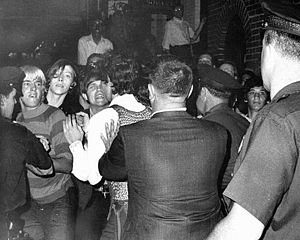
NY Daily News, June 29, 1969 - the Stonewall Riots     

Wednesday, August 29, 2012

Morning thoughts

 Facebook isn't working for me this morning, or I would post this on my Page.  It came in via my church newsletter, and was written by the Rev. Clarke Wells, who must have been a poet at heart, as well as a UU minister.  It reminds me that August is a florid month, difficult for lots of people, not just those of us with mental health diagnoses.
 
I suppose I should write something institutional or
churchly, but my heart isn't in it. Where my heart is
these days is between me and whoever it is that lays the
sun across the trees with that sudden and terrible beauty,
I've been taught all my life to believe that growing up
meant to become less vulnerable, and that getting
overwhelmed by life is what happens when you are
young.

I am here to testify to the opposite. I was driving home
yesterday afternoon on a country road, and I simply had
to stop the car near a stone fence and go into the woods
for an hour. It had nothing to do with practical matters,
or theology. It had to do with trees against the blue and
shattering light and where I am living. I report it to you
on the chance that you are as odd as I...that it all gets
more intense, no less...so that if you ever go through the
same thing, like stopping your car for an hour, you will
not feel crazy being torn apart that way.

Tuesday, August 28, 2012

In Memory of a Wild Flower

This post, originally dated August 26, 2012 has been removed for updating in light of comments I have received. 

Touching Base

[image: Thanks to Chris Hardin for suggesting this illustrated quote as a fitting homage to Teena Price, who was a wild flower.]

I have relatives who don't love me the way I wish they would, don't you?  The weather has been too hot, the air quality is so bad I have to wear a mask outside, my moods are up and down, I'm having an awful time with sleep, and I have to wear elastic on three of my four limbs, and sometimes I hate all this...... But today I am shrugging these things off (all but the depression, to be truthfull).  The universe has been giving me opportunities to see my problems in perspective.

As I wrote previously, Saturday night was a wrenching memorial service for a friend who died last Thursday.  This morning a beloved friend was at our front door to tell us that another friend died yesterday.

Greg Houston was 61 years old and seemingly in good health.  His truck went off the road for no apparent reason, and he was dead by the time the medics got there.  Greg and his wife of over 40 years are important to us, and to many, many other people, because they are lovely people who exemplify a life of compassion and generosity.  For a couple of years Greg has come over periodically to help Tom with projects around the house; it was a joy to me to hear them working together, both so polite and careful.

Yesterday Tom got an e-mail from Greg asking if he'd like help with anything.  The subject line was, as always, Touching Base.  If you want to know what it means to "lead with your heart," Greg was a fine example; Greg actually touched base; he looked at people and saw what we needed.  And he didn't just say, "Call me if you need anything."  He offered specifically to come and help with projects, and did that many times.

Many people had to be called about Greg's death, because many people love someone like that, and he was a pillar of the church.  I expect his service to attract hundreds of people, and we will all weep.

I want to say something very quietly here about the contrast with Teena's death and her service that I wrote about yesterday.  She was 76 and had been ill and uncomfortable with advancing COPD for years.  She took months to die, gasping for air.  Her death was a release from suffering, and I was glad she finally got to rest.  You feel different when someone who dies is much younger than you and vital, and it is an accident.

And it is logical that many people loved Greg and Judy.  But is it logical that so few loved Teena?  I don't know.  It's not uncommon, but it feels wrong.

I have heard from several friends who relate strongly to the post I wrote yesterday that talked about the stigma we feel if we are mentally ill or just, like Teena, unconventional.  I have thought about how many Buddhists work in prisons, often as volunteers, where they know the suffering is acute, and they might be able to offer someone a little peace.  Many others work in hospices, spending time I'm sure with people like Teena, whose own families don't want to be there, or can't.

But out in the social world there is, generally, a sharp division between the people we find easy to love and the people we avoid, or downright dislike.  Too often, people bond in groups on the basis of their mutual loathing for Sarah Palin or their mother or people with brown skin or Christians or those that have not accepted their idea of God. 

Teena was disliked for exactly the qualities that some of us liked about her:  she was open and honest, she was an original.  She said what she thought without regard for the niceties.  She was generous to me and never in my life hurt my feelings, and I never saw her say anything mean.  But she was outspoken, and had an attitude about that.

I don't know what she might have said to another woman in the church who just a few months ago told me she didn't want Teena anywhere near her private birthday celebration.  Teena had wandered into the room where it was being held, having come to church to make a payment on her pledge.  She was in a wandering condition then, liked to go spend time at Whole Foods talking to anyone who would listen, and came to church at every opportunity.  But she was not invited to that small party, not that she should have been; it was private.

I asked that friend, "You have issues with Teena?"

She said coarsely, "Doesn't everyone?"

I said, "I don't."

I didn't like that, but it didn't rankle me until Teena died.  Then I found myself furious with that woman (who has some annoying qualities of her own).  She felt entitled to hate Teena, as I gather some of Teena's children may have, too.  I was afraid that woman would show up at Teena's service, for she is another person who hangs around the church a lot.  I knew I would not contain my anger at her if she did, and I would probably regret that and it would create an uncomfortable break in our social set. But she didn't come.

I wish Rev. Mark had thought to focus Teena's service on our need to soften our hearts toward "the people we find difficult to love," a phrase he used once in a service to encourage us to say aloud or silently during the Silence the name of someone we love - or find difficult to love.  That was valuable to me.  It let me whisper, that Sunday morning, my own father's name.  My father was a shit to me, but the extent of his venomous hatred was only revealed to me after he died. When I found out that he was giving my siblings huge sums of money, and none to me because I was "mentally unstable," I was beyond hurt and angry.  I was the only kid who drove to Zanesville to visit him a few months before his death on Father's Day.  We took him and my mother out to eat.  He gave every appearance of loving our company that day.  There you are.  Life with alcoholics.  They hate you behind your back.

But saying his name in church let me open my heart that little bit and begin the long, long journey of learning not to hate him (and the rest of them, in fact).  Speaking his name with a wish that he rest peacefully let me begin the work of adjusting to that painful reality.

Some of us who are wounded have to work to open our hearts at all, for anyone.  Almost everyone needs to work on opening it all the way, to a cheating spouse, to a neglectful mother or a father who raped you or the man who killed your son in a fight.  Maybe cultivating this willingness to love is actually the fundamental practice.  Jesus thought so.  If enough of us did it, there would be no more war.  Because there would be no more concept of "enemy."  Maybe there would be no more unhappiness.  Because anger and hatred, that's hell, you know it is.

Friday, August 24, 2012

What I am really tired of (as if you cared)

I am really really tired of people who insist, in person and on Facebook and their blogs, how they don't get enough respect.  How nobody appreciates how hard their job is.  All kinds of people bitch like this, from police to lawyers to career military to chefs, and your brother-in-law.  But I'll use the example of a firefighter I once had to work on a book with (who thought, BTW, that no one should edit him). 

Ron was profoundly convinced that nobody, NObody appreciated the danger of his job, which largely entailed sitting around the firehouse and running the squad to pick up seniors with breathing problems.  He believed that those seniors and the rest of the world, the non-firefighters, were stupid people who had no idea that he could die because of their stupidity.  I was not in a position to talk frankly with him, so I'd like to do that now:  He was so proud of being anti-intellectual that it's a pretty good guess he'll never read this.  Still, I'll change the name.

Don - you.  Don't.  Have to.  Be.  A firefighter.  You volunteered for this job which has great job security, good hours, paid vacations and a terrific pension program.  If you don't want to risk your life for stupid, unappreciative people, you can quit and go to work for the Wall-of-Evil, where you like to buy things from China at good prices while you complain about people who drive Japanese cars.  WalMart or MacDonald's will pay you minimum wage and not give you full-time work.  You will have no labor union or medical plan, no job security, no pension, and no respect.  You will work on your feet and with your back until they give out.

You say you can't do that, you have a family to support.  Well, your wife could go to work too, duh, instead of sitting around painting her nails and complaining about being a housewife.  You could live like a great many people do, here and around the world, hand to mouth, paycheck to paycheck.  You wouldn't have that nice house your wife hates to clean and that yard you hate to mow.  You wouldn't have to bother having your nice new SUV detailed by stupid people who don't do it right because you wouldn't have a nice new car.  You would drive something held together with duct tape and baling wire.

And you know what - those unappreciative kids of yours who don't know how lucky they are and how wonderful you are?  You don't have to stick with them.  You can foist them off on your mother or just walk away and let Children's Services take care of it.  Drive away.  It's your choice every day of your life.

In other words, you are CHOOSING to do your job because you like the benefits of working on taxpayer's money.  And in fact, you were attracted to the danger, and still are, and to the idea of thinking of yourself as a superhero, the nation's savior.  And in fact, many many people - and I am one of them - deeply appreciate the fact that people like you are willing to do this.  (And also that not every firefighter has your attitude.)

So here's my suggestion:  learn to appreciate what you've got.  And suck it up.

Wednesday, August 22, 2012

Warning: Major, Prolonged Whine.


 [images: my dining room, after Tom cleaned up some of the paperwork pertaining to his parents' finances.  And that's not even what I'm complaining about.]

Today air quality is "moderate," which translates to bad for people like me (elderly, and on immuno-suppressants).  Worse, weed pollen (ragweed, for example) is high and forecast to be VERY high the next two days, because it is not going to rain and tamp it down.  Mold activity outdoors is low, that's good, but it will soar if it rains.

What this means is that I can't go outside.  I can't sit on a porch or patio with a friend for half an hour.  I can't walk through the rose garden taking pictures, or go out in my own yard and mess around cleaning stuff up.  If I am outside in this weather, I get so much congestion that I develop the kind of ear ache that makes babies scream with pain.  Then I can't wear my right hearing aid, and have to use hot and cold compresses to get it to drain.  In case you're wondering, I hate that.  All of it.

I haven't meditated yet today - and I hate that.  But I got up late, and I hate that, but I hate waking up to alarm clocks, and I haven't been able to sleep until 2:00 a.m. for several days, despite the best pharmaceutical interventions.  And it's 3:00 pm now.  So I am going to stop this and, as we say in Zen, sit down and shut up.  I don't feel like doing that.   It takes discipline.

But before I go, I want to mention that I'm pushing water right now, meaning drinking down whole glasses, because I have to drink 4 liters a day to prevent bladder infections.  If you think that's nothing to whine about, do it for one day.  Go ahead.  And BTW, mine has to be room temperature water, not ice water, not water without ice from the ice water tap in the restaurant, which puts me into painful esophogeal spasms, just because I am old.  Go ahead, try to get simple room-temperature water in a restaurant.  You will learn, like me, that you just have to carry your own water.

However.  Water is one more thing to carry.  I have a torn rotator cuff on my right shoulder; the one on my left shoulder is relatively healed because I had to use it heavily when I broke my arm last fall in weather like this.  No, it does not have a good chance of being repaired, and PT was just making it too painful.

So if I am bringing in groceries and I carry a five-pound bag with each hand, and my purse with water in it, pain shoots down my right arm and up my neck on that side.  This is not my fault.  I have to carry stuff sometimes.  Tom is always willing to help, but he is handicapped.  He has to use a crutch to walk; that occupies his one good arm (he had polio).  He is not in a position to carry things.  So I carry what I think I can, or use my wheeled walker (from when I had bone edema in the left ankle, which still hurts every single moment of my life).

Before you offer me a solution, like get a neighbor to help carry groceries in, I want you to try it yourself.  Go ahead.  See what it takes to round up a neighbor, see how much time it takes.

If there's a point I'm making, it's that nobody knows the trouble I've seen, and therefore nobody should attempt to tell me how to solve the insoluble problems of old age.  Because, you know what?  I also have diminished capacity, because I'm old, and process slowly, and get tired, and can't figure things out.  And I'm in a bad mood right now because it's August, and this time of year I have depressed days that alternate with pissed-off days, because I am bipolar with SAD.  That's just my bad luck.  My good luck is that today I managed to shop and get in and out of Kroger's parking lot, which was all torn up, and not get in an accident. 

Contemplating chin lift while relaxing with a facial
Old age is one damn thing after another.  You are putting patches on a vehicle whose drive train is outmoded and whose transmission clanks and balks.  The tires are bald and can't be replaced, the hood is tied down with string, and at least one window doesn't work anymore.

In old age, a new problem doesn't mean an old problem got solved and went away.  It's just one more part going bad.  Oh, and yes:  Monday night I had what I am pretty sure was a gallbladder attack, characterized by intense pain and nausea.  I had one of these last year, and I've known a couple of people with gallbladder problems, so I recognize it.

You want me to go to the doctor about it, don't you?  You would.  But then, you might not be sick and tired of doctors who have nothing to suggest but one more surgery.  I hope you live long enough to have this tremendous growth opportunity.  If you do, all I can recommend is, cultivate your sense of humor.

Okay.  Now I'll meditate.
p.s.  I did, and it helped.


Monday, August 20, 2012

Less and less afraid of death

A beautiful death
12:30 a.m. Technically, it's Monday.  It's still Sunday night for me, and I am again not falling asleep on schedule. August, all that decaying ripeness and weather.  And then, there has been a great deal happening energetically around our house; it could use a good Feng Shui cleansing - maybe I'll do that.  Just opened a window here in my study, for a start.  It's going down to 55 tonight, and it rained earlier, so the pollen count and air quality aren't bad.

Tom's sister Diane is here again for a few days, working with Tom to make sense of an estate that is confused and bewildering.  We are thinking so much about death, with their father in hospice and his dementia progressing and making him more difficult to be around. Tuesday their 90-year-old mother is having a hip replacement, and we know she might die on the table or develop anesthetic-related dementia.  The sister-in-law who is taking care of her has taken the family through choosing and cleaning a suit for Jim, a shirt and tie.  Despite this, I sense that none of the children actually believes Jim will die.

I am noticing how relatively accepting I have become of death since my father died unexpectedly some fifteen years ago.  My mother four years later, my brother the next year.  Then there was my own looming death from kidney failure.  Now it's one friend after another.  Sheer experience helps; repeated hospitalizations, sometimes with roommates who were dying, kept wearing down my sharp corners.  It's been clear to me that many people here in America handle aging and death very badly, their own and others'. 

Here are notes I made in my journal the other day about how I think Buddhist practice - both sitting and studying the philosophy - has changed me in this regard. (I see I fell into that "we" way of talking that American Buddhists seem  inordinately fond of.  Oh well.)
 ~~~~~~~~~
Tashi confronts a demon
How Buddhism helps us inch out of our fear of death -

- as we become more awake to reality, we see that death is inevitable

- as we become less egocentric, we see that we are not special and exempt

- we realize connection, our nature as a single blade of grass among billions

-as we relax our attempts to control reality, we see that it is a vast rising wave of myriad things being born, rising, crashing over and pulling under the things that went before

- we fully realize the suffering of samsara, and how it can be good to be released from all kinds of pain and difficulty

- we realize Not Knowing is a fact, and stop trying to figure everything out

- we gain skill in welcoming the moment, friendly demon or otherwise

Thursday, August 16, 2012

Getting Through a Bipolar Hurricane


Tuesday night
I just hung up the three shirts I took to Zen tonight, not knowing what I'd need over my tee - the doctor's office today must have been at 65 degrees, and I wanted my fleece jacket.  So I took a short-sleeved denim shirt, a long-sleeved flannel shirt, and a fleece shirt-jacket.  This is why we old ladies get classified as fussy, because we really don't want to catch a chill.  And we've learned.  The hard way.

I seem to learn everything the hard way.  The reason I say that freely is that I'm pretty sure that's not a personal fault unique to me, but just the only way we monkeys learn.  I imagine there are people smarter than that; I hope they know how lucky they are.

But my point was about being messy.  I came home tonight wanting to get a card ready to send to Jacques, who's in the hospital with a painful and serious condition............
~~~~~~~~~~~~
Fast forward to Thursday.
I did get Jacques' card done and out, though our general disorganization made it a challenge.  But it turned out to be a rotten day for me, and I didn't get much else done.  That's been my life for several weeks - up, down, up down.  And sometimes UP
then d
           o
             w
                n........
                          ..... . ;(

 If you're not bipolar, the way this differs from your life is that the ups and downs are occurring on their own internal clock, which has nothing much to do with your actual emotional life.  There is a mysterious switch that turns on dopamine and serotonin, feel-good chemicals like that, gets them flowing well, then uh-oh, they are flooding.

Everyone likes hypomania.  Everything is beautiful, you are confident, you love everyone and want to make art out of everything.  You begin great new projects.  It was in that frame of mind that I took the above picture, just loving the subtle colors I saw from my car in the Safe Auto parking deck at OSU. And by the way, that frame of mind can make it hard to sleep, even when you're very tired.

But the day before that I described in my log as "indescribably wretched."  I remember crying as we did my weekly pills.  Days like this I don't make any progress at all on great projects; I am doing well to take a shower and get Tom to take me to the health club, and force myself to exercise on the Nustep.  If I can find something, anything to distract me on Netflix or a book, that's good.  Those days are just something you get through.  Maybe like huddling down during a hurricane. 

The day I took that picure I was at OSU to talk to my psychiatrist about all that, and he prescribed an uptick in one of my medications.  A week later it seems to have leveled the moods somewhat.  Somewhat.  There is no cure for bipolar, like most of what ails you.

If I have a point to make it is that my life (and Tom's) is definitely made easier by the years of daily practice.  Sitting Zen is especially good for me when I'm being wow, really !creative! and have a thousand things to do, and want to do them all, and start new projects, too.  Nothing is better for mania than pulling the blinds and sitting still in a dim room, preferably cool.  And not moving, not scratching an itch, not answering the phone or writing down the new ideas for great projects that are dancing through your mind.  Letting your muscles relax and your breathing and heart rate settle.

And oddly, sitting is pretty good for neurochemical depression, too, though not in the large quantities of a retreat, in my case.  (Learned that the hard way, of course.)  It can be healthier for me to seek distraction.  But sitting there once or twice a day practicing looking at your sadness and lack of volition, standing back a little mentally to witness them, then letting them move on, not sticking to stories that easily balloon into your whole difficult life.

I'm just here to testify.  That's all.  I haven't found much to read on Zen for bipolars, and other mental afflictions.  Yet we are people who need the help Buddhism can provide just to get by.  I'm beginning to think I might have to write that book.  That should tell you I'm having a good day.

Tuesday, August 14, 2012

Absolute and Relative Worlds


Tintinnabulation by Robert Green

I already wrote a poem this morning, and here it is.  It's interesting that it is times of upset and confusion that generate poetry.  August is that for me, and this morning I'm afraid I'm coming down with an infection.  I wrote my friend, It feels odd, as if I went back into a very familiar room that has a certain scent and quietness, like a Victorian novel in which nothing much happens.

The title of the poem refers to a Tibetan Buddhist concept that there is a world of timeless eternity (great natural peace), and then the small messy world of us (samsara, its relentless pounding waves), but they are not really any different.  They are mingled (nice word).  It is easier for me to think in the common metaphor: we are lotus blooms with feet in the mud.  There is a jewel in the heart of the lotus. 

     Absolute and Relative Worlds

                          by Jeanne Desy

Nature goes on, vast and nonjudgmental, 

turning leaves into heaps of trash -
it is as if a song is playing far away, 

deeper than my own tintinnabulation
quieter than the soft pervasive tone
of the central unit.  It is a stream of songs 

about the rising waves, the Western wind,
being asleep in the deep.  It is faint and blue . . .  

it is interrupted by the cat, who is nervous
because Tom is in the shower, 

and the door to her box is closed.


Tibetan healing mandala

Sunday, August 12, 2012

Life after Intimations of Mortality

I have a feeling I won't finish this, or even make it into something, but I have to write today, because today marks the fifteenth anniversary of my real life.  That began August 12, 1997 with surgery to remove the cancer in my breast.

Real life actually began for me around six weeks before that, when I got the postcard from the James asking me to come back in for magnified mammograms.  I stood there at the antique oak table I had stripped and refinished when I was younger and always had energy to spare, looking at that handwritten message, and said, "Uh-oh."

And I was right; that was the beginning of bad news.  Slowly over the next weeks of more films and then core biopsy, then meeting with the surgeon, I got it:  I could die.  I would die some day, and it could be just like this, from something invisible, a cancer that had not formed a lump, that my heredity did not predict, that was discovered only because someone sent me a reminder letter and I gritted my teeth and went in for my annual mammogram, six months late.  A destroyer that was invading my body without my knowledge or consent. Since then, I've had two friends die of metastasized breast cancer.

You do not begin your real life until you know that the day is coming when you will die, and you don't know when, and you can't count on any future.

Is that all I have to say?  Well, I count my meditation practice as beginning on that day, though I may have begun sitting with healing visualizations before the surgery; you pick a date.  (When were you born, in fact?  Think about it.)  Until then, my life was a horrible f----- up mess in which I knocked around doing things, led by my head, my instructions, my conditioning.  Then I began to study Buddhism with fierce devotion.

Now I lead with my heart.  I'm still an awful mess with an unfair quotient of suffering, including anger at people who keep insisting that if I only think POSITIVELY and eat horrible food and exercise twice as much, not only can I live forever, but I'll feel constant radiant joy, and that means my suffering is all my fault.  I hate those people, I mean, I'm angry at that lie, and all the others that take your life away, and focused anger at certain totally deluded well-meaning idiots is the form it takes.  And sooner or later I'll get all of them defriended, or at least I'll figure out how to hide from them.

It is not always easy, being alive and in touch with your feelings.  But sometimes it is.
Easy.  And pleasant.
And often I'm grateful to be alive.


~~~~~~~
[images: At top, our beloved Sherlock.  He used to meditate with us.  After 20 minutes, he would get up and leave the room, anticipating the clock.  When he began to die three years ago, he didn't know what hit him; neither did we.  It was hell for him and us. I still miss him. There will never be anyone like him.  Just above, Tashi, who enlivens our life now, attempting to sample a sunflower after Cassie's wedding.]
]

Friday, August 10, 2012

Domestic Goddess

Domestic Goddess

This morning the collage group I belong to didn't respond to my idea that we create The Porpoise of Art (watch this space), and I think we settled on the idea of balance.  Then, as usual, I went off-road. (You don't have to do the assignment is one of our principles.)  Looking at the array of magazines from which we can cut out images, I picked up a Women's Day dated September 1953. 

That month and year I turned eleven.  This is a moment when a child is anticipating going through puberty and growing up.  Women's magazines like this were my travel guide back then.  An ad for a sewing machine at the front of this issue evoked memories of being a girl dreaming of grown-up life, and the drawing in that ad became the center of my collage.  Everything in the collage  that's black and white was cut and rearranged from that ad.

As I made this collage, I remembered having seven crinolines for under my circle skirts, and I felt the sweetness of the aspiration for femininity and for a well-ordered home.  The dream was only superficially about having a man love you and owning a house and having nice furniture and cooking and cleaning.  It was also about home and family, a beautiful refuge. 

I could write a book about the harm done to me by the patriarchy, especially as filtered through my parents, who never questioned it.  The idea was that the man was a good breadwinner and the woman took care of  their lifestyle.  There was no room in that dream for loving and marrying people of the same gender, or not marrying at all, or not having children, or the two-career marriage, not for most of us. There was not room for women being smart, though a few plain girls were doomed to be.  Despite this prison of expectations, there was something of value in the idea of a home and a dedicated homemaker.  And also in valuing softness and femininity. 

Anyone could tell you I am so far from being a domestic goddess.  Yet, I found as I made this collage, that that aspect of the dream still held appeal for me, and I was glad I recently bought a pink tee with ruffles around the neckline.

Monday, August 6, 2012

You Call That a Good Day?

"Every day's a good day."  I've written about this Zen saying before, and still haven't got there.  Yesterday, for instance, I had pain in eight places, and a London pea-soup fog of a mind, and insomnia.  And missed a terrific sermon at church, I hear, because I couldn't get my head clear enough to get dressed.  But there was one good thing about yesterday:  it moved on.  Things change, and that is sometimes a blessing.

This is probably the dead-on koan for anyone with bipolar disorder.  And it would apply as well to anyone who is handicapped by chronic illness and/or pain.  A day with pain a good day?  Please.  I find myself having to think about this a lot.  There must be something I don't get.

I tie it to the famous verse on the seasons by Wumen that you may have seen recently on my facebook page, The Dalai Grandma. Here is my own (constantly changing) rendition:
In spring, flowers; in autumn, the moon.
In summer, breezes; in winter, snow.
If idle things do not hang in your mind,
every season is a good season.
 It's that third line that is tricky, and is translated various ways.  As I get it, it refers to being stuck hard on your preferences, ideas, plans, bucket list - all those things in our minds that are not the present moment, that are not the current reality.

We are funny about our preferences.  For one man I knew, liking butter pecan ice cream was not merely a preference; it was him, part of his identity, a thing to know about him.  For another woman who felt validated when other people needed her, being active and useful was not a preference or a pleasure, but a religion. She had to be useful. It's who she was; so slowing down with age was unthinkable, a failure - wrong.  There are many people in America these days, the Baby Boomers who are now entering old age, who are committed to the delusion that youth can be maintained forever; you just have to exercise harder and not eat anything good.

Good days and bad days.  The verse and the koan make me question how unhappy I get when I feel like I did yesterday.  I was probably having a flare-up of fibromyalgia, for which no cure is known, due to major weather systems moving around.  And I may suffer extra mentally with these because I have a bipolar mind.  What is good about being in pain and depressed?

One answer I've come up with is that illness can teach us.  For instance, I know people who are disabled by mood disorders or pain or chronic fatigue, and I do not think they can just up and fix themselves if they'd only try.  I understand how disabling these things are, and how invisible.  There's that.  And, as I said starting out, it makes me appreciate the constant change of carbon-based life, which sometimes goes in directions I don't like.  Yes, good luck can go bad. On the other hand, bad luck can change, too, and some days it does.

Saturday, August 4, 2012

It doesn't have to be sad?


[Above: A miniature design by Szymon Klimek.  It is solar powered and made of zirconium and brass plate.
Dimensions 11,5x9x7cm. Goblet high 30 cm. Thanks to the blog Book of Joe for finding it.]

Friday night -
I've been thinking about the article I started reading last week in a magazine in a waiting room.  It was about a home hospice nurse, and was titled "It doesn't have to be sad."

Death, they mean.  Just now I logged on Facebook to say goodnight, and learned that a friend, a woman I met only once who was in kidney failure like me, has died.  She did not get a transplant.  She was a year younger than me.  What is this feeling?  Maybe it's like suddenly going cold sober.  Just like that, a life gone, over.  It makes my mind go to poetry, searching in my memory for the right poem.  Only poetry handles death profoundly enough, and maybe music.

If you follow this blog you know that Tom's father has been slowly dying for some months now, losing a pound a week in skilled nursing care.  His mother has serious loss of judgement and a very bad memory, and is scheduled for hip replacement surgery for a worn-down hip that has her confined to a wheelchair and in pain.  All this, and turmoil over the financial aspects of caring for both of them, has been a great strain on the kids.
~~~~~~~~~~
Saturday -
I woke up hearing Leonard Cohen's Alleluia in my memory, and understanding it a little better.  Thinking about accepting death, as I often have, doesn't get me there.  It seems it often takes an exact language to move me to understand something.  But emotions I understand.  Sad is how you feel when someone dies, isn't it?  If you don't have to feel sad at a death, then what do you feel?

I know one thing you can feel: relief.  This I know because long ago I read a book by Jessamyn West, a fictionalized memoir of her sister's death from cancer titled A Matter of Time.  You can buy that book now on Amazon for $.01, plus shipping $3.99.  These are ex-library editions.  My own library, which is voted year after year the best public library in the nation, does not have it.  That made me sad.  For a while. But that's life: it goes on. In the words of a poem by Swinburne, "Even the weariest river winds somewhere safe to sea."

Tom's parents are very old, 93 and 90.  They lived to see not just grandchildren, but great-grandchildren.  Jim had over 30 years in retirement.  Five years ago a stroke robbed him of much of his personality and coherence.

Just today I came across the astonishing work of art and craft shone in the video above.  I included it here because I love it, and tremendously admire the patience of good artists and craftspeople.  As I think about it, I remember how we make art to find a certain order in life*, so I believe it fits here after all.
~~~~~
*I know, not every artist.  But it's true for me most of the time.

Thursday, August 2, 2012

More Cool Boredom


This is a video in which not much happens - just two "natural enemies" hanging out. It epitomizes the kind of day I've been happy to have: cool boredom. I see I blogged about this last Tuesday.  So I suppose I don't have much conceptual to say.

I started my day - or did I end yesterday? - enjoying the smell of clary sage, which is supposed to be "balancing."  I doubt that that alone can cool a bipolar down in August, but what do I know?  It's a nice smell, unusual, hard to categorize, but a little piney.  Wikipedia says it "has a lengthy history as a medicinal herb, and is currently grown for its essential oil."  My oils are mostly Aura Cacia, which is sold in the sweet hippie-spiritual shop in our neighborhood called Pearls of Wisdom.  Descriptions of this herb's medical use go back to the 4th century BCE. 

Pearls is a great place to buy things like an endless-knot pendant or a votive candle holder carved out of rose quartz (which is believed to aid in kidney problems).  Quartz has a measurable vibration.  Just saying.  And I do have such a candle-holder, a gift from Tom one birthday.  He is a scientist, majored in physics, so he understands what a huge amount we don't know in this universe.  Don't Know is also a Zen concept, and that reminds me of a charming story I read recently in another blog, Wild Fox Zen.
Reminds me of a story James Ford told me which I see will be in his new book due out in September, If You’re Lucky, Your Heart Will Break: Field Notes From A Zen Life.
Way back in the late ’60′s he was given zazen instructions at San Francisco Zen Center and then brought into the zendo to sit. Then …
“…I was ushered into an interview with a senior priest. Dainin Katagiri Roshi, then called by the title sensei, was on duty. I made the bows as I was instructed and sat awkwardly before him.
He asked how long I’d been sitting.
I estimated three, maybe five minutes.
He said, “Good. Keep that mind.’”
There is a point there that Zen students know - as we ripen in meditation practice, we develop what Joko Beck called "tricks" for amusing ourselves or evading aspects of our reality that are trying to catch up with us.  In Zen, we are reminded to approach not only meditation, but every moment, as if we'd never been there before, never done that before.*

Back to my day.  I sat over the Thursday NY Times with Tom - my favorite paper of the week.  I clucked over the follies in the Style section, and Tom told me about the craziness in the Home section.  Ate a good breakfast, cereal, walnuts (for Omega-3), dried cranberries and organic milk.  Did my stretches and meditated.  Did weekly pill box which took a long time, but that was okay.  No rush.  Air quality is bad today, and so are molds in the air, and I don't have to go anywhere, so I'm not.  I'd have to wear a surgical mask if I did; the immunosuppressants have made my allergies terrible.  Made tuna salad for lunch, with cucumbers cut up in it (they are cooling). Made tuna melts in the toaster-oven.

And so on.  That kind of day.  Not manic, not depressed, just a nice cool day appreciating our air-conditioned and filtered air, our shade, and especially, being retired.

* If I had never seen this computer screen before, I'd be flabbergasted.