Tuesday, March 31, 2009

New Voices


Above was done with colored pencil and watercolor by Mary Lee Eggart from a lovely series, A Book of Hours.  I particularly enjoy this medium, and have studied drawing enough to accumulate a lovely array of Prismacolor pencils, and to realize what patience goes into a sizable drawing - this one is one in a series called Book of Hours. I think every shade of every color is found here, as well as the influence of monks who illuminated manuscripts, botanists who detailed the features of plants and birds before photography was available to anyone, and folk artists.

I suspect that even in the near-past of crazy abundance, very few pencil artists made a living in ways connected to their art. I suppose pencil drawing strikes many people as too close to ordinary to deserve respect. We have all held pencils, after all, and drawn in the margins.

What I learned when I studied drawing was that to make something I liked, I would have to learn everything about creating visual art. Then I would have to learn this specific medium, the pencil. It is so friendly and easy to undertake. Even the shavings are pretty. But a full-scale drawing takes countless hours. I am not a long-distance runner.

I can still think, though with some confusion. These days I find myself immersed in deep and wide questions about art. I am looking at it from an art critic's point of view, thanks to gifts from my neighbor, Terry Barrett. And I see it from the point of view of a poet on a small raft in a wild sea of cultural change.

This morning I received an e-mail announcing that a standard anthology of bright new voices will not be published this year. Yesterday I received a rejection from an academic journal, and found myself going to their website to see whether the journal itself is being shut down. (Not yet.)

For poets and serious writers - those of us who work at art for its own sake - the karma goes like this: fewer full-time enrollments in creative writing programs, because suddenly everyone sees the need to make a living. Fewer teachers hired; new jobs frozen. Academics who used to have released time so they could run a journal are now told to teach full-time. And where is the money to produce the journal going to come from? The journal may be dear to the professors' hearts, but you have to pay the electric bill first.

It was a strange little current of its own, the academic approach to literature and the arts, the underwriting of journals that published all those clamorous new voices; the whole enterprise. By and large, the poems found in these journals are difficult, demanding a patient, educated reader. That reader no longer has a department budget for subscriptions; and may be out of work. S/he does not renew the subscription, because Art is not a necessity.

We discuss this now and then, my friends and I, and we maintain that art is necessary to the soul. But if you come down to bread or roses, you need the bread to keep the body alive. I suppose it has always been everyone's task to find some way to survive, and at the same time, to have a niche in our days, in our lives, in which we nourish our souls.

Friday, March 27, 2009

The Lone Mountain Path


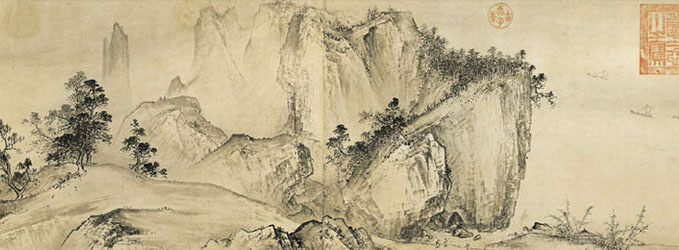
[Pure and Remote Views of Streams and Mountains, Xia Gui]
I don't want to do much typing today - trying to rest my back, which is improving. I came across this in an essay by Kobai Scott Whitney about a very imperfect Zen Teacher, and found it refreshing.
Meditation practice, at least in the Zen tradition of Dogen, is about mind and body dropping away. Small, lively, individual mind and grasping, needful, individual body can recede, if only temporarily, into the background of experience.

Thursday, March 26, 2009

Out of depression

Last night I went to bed thoroughly low. Awoke around 3:00 obsessing about a person who had done me what felt like major harm. I lay there a while, aching, then clicked channels to consider my options. I take medication at bedtime, including melatonin, that leaves me groggy in the middle of the night, so I didn't want to call it morning with barely four hours of sleep. A bowl of cereal often helps me get back to sleep, but I felt I just couldn't eat. The obsessing continued. It wasn't going anywhere. I thought, I have to stop this. So I started counting my breath.

This is the most ordinary thing you can do in meditation. You count on the outbreath, and let it go all the way out. In, out one; in, out two, and so on. It is not a falling-asleep technique, but a way to harness an overactive mind in sitting meditation. I counted my breaths to ten, started over, and fell back to sleep.

I am doomed to be up when I wake up at 5:00 a.m., which I did, so I got up and made my way to the kitchen. Making coffee, I thought, I have to address those issues. Sixty-six years of living have taught me to understand when my depressions are about something more than corticosteroids. I was pretty sure this one (and the muscle spasm in my back) were about the calamity of lower kidney function, a real blow. With it came the need to get ready for dialysis just in case, and the onset of painful and crippling neuropathy. The Constant Reader knows I have been avoiding shopping for a walker and making an appointment with the vascular surgeon. What better way to avoid hard things than get profoundly depressed and throw out your back? I'm not saying that's the cause of anyone else's back trouble or depression. This is just my story, how things work out for me.

I went to the computer and started researching wheeled walkers with benches. Right away I got into this, reading reviews, thinking about whether I want a pink one that signals breast cancer survival (decided against it). From there I went right on to the Kidney Foundation website, and read the basics about vascular access. More data, and an intriguing question of where to put the access when one arm has lymphedema and you need the other to take blood pressure and lab draws, both constant facts of my life.

By then it was sunrise, and a poem began to write itself. That kept me busy until Tom got up at 9:00. He and the cat are pretty predictable, the kind of beings a poet should have around.

And I felt cured. A hot shower was wonderful on the back. Then gentle workout at McConnell and the Precor stretcher. My back was practically cured by the time I hobbled out. Home, I made the appointment with the vascular surgeon. Tom and I agreed to go look at walkers tomorrow, after acupuncture.

I believe sometimes we animals need to go into our caves. It can be a dark room, and no one disturb me; or depression can come in to protect us - that lid over feeling while your deep mind works it out. If I really permit my fear and despair, and don't hold on to them, they run their course.

Today was rain, rain, but I have a new slicker from Land's End (see photo). It is very optimistic, with a soft cotton orange lining. And the daffodils are coming out. They like the rain better than snow, and are taking in nourishment for next year without a thought of how they'd rather things turned out.

Wednesday, March 25, 2009

Sticky karma

[photo: a companion animal getting hemodialysis]
Monday night I was talking to Tom about some emotional issue. Maybe about calling a vascular surgeon, which I had not even put on my to-do list for a week now. Maybe about a friend who disappointed me. Maybe I was declaring that I really had to fill the prescription for a wheeled walker, which I'd put off doing for three weeks now. Whatever I was talking about, pow, this bright red ball of pain struck my upper back. I have arthritis in my spine, so I thought the worst, a slipped disc. And I thought, no, not something else right now.

This was pain, about 8 on that scale of 1 to 10, and 10 when I raised my arms to take my tee-shirt off. It disturbed my sleep, coming forward every time I changed position, and it worried Tom - could it be my heart? Women experience heart attacks wierdly. But the next day, the doctor examined me carefully, and became convinced it was a muscle spasm. The muscle relaxant he prescribed has helped. Knowing it wasn't a problem in the spine helped too. And I started to think about why it happened.

It gets obvious now and then that an abused child lives inside me, and is animated when I feel threatened. If there is a magic button you can push and get rid of the million experiences of a dark childhood, my therapists hadn't found it, though they had helped me gain some relief. Post-traumatic stress is what it is.

The walker, that's just an ordinary desire not to be so old. I'll get over that; I do want the thing so I can rest when I walk. But seeing the vascular surgeon involves a more complicated story.
That's what my Zen teacher, Daniel, would have called it, a story; a fabrication in my mind about what hemodialysis will be like, an imagination of dreadful futures.

Mental emissions. I was full of them. Getting an access installed in my arm had meaning far beyond the surgery; it would mean admitting that I really might need hemo fairly soon. And that I would actually do it. Don't want! my abused child was crying out, and I wasn't listening, so my back seized up.

She is/I am afraid of dialysis. The fear starts with being invaded, and goes on to being held down, unable to move. I haven't seen my father's monument these twelve years since he died; I am his real monument, testimony to his cruelty.

My fear extends to another echo of childhood, the possibility of getting a mean nurse. I am afraid I'll find myself in the care of Jan Davis, the nurse I had when I was on dialysis for a short while two years ago. They exist, nurses without compassion. That's who's on your shift. You are stuck with them, like you were stuck with a mother who never gave you cookies and milk after school.

Buddhism says that enough practice will liberate you from your conditioned self. That may be true for some whose childhoods weren't as damaging as mine, who started practice earlier in life. I suspect I was wrong about liberation, anyway - that it only makes you able to recognize your self and control your behavior, but doesn't wipe the past away. How could it?

I felt like taking the day off today, putting heat on the spot, doing some gentle yoga (and blessing the teacher, Kit Spahr, who taught me so generously). No to-do list today. Just random unimportant stuff. Clean out my sewing box and pack up the stuff for machine sewing to store downstairs until my daughter inherits it all. Contemplated summer courses at the local art school. E-mail offered courses sponsored by the James Cancer Center; I signed up for two. As for dialysis, I am taking Scarlett O'Hara's path today - I'll think about that tomorrow.

Tuesday, March 24, 2009

Embracing the new day

[calligraphy by Sengai]
I haven't been blogging much. I was thrown by the nephrologist's recommendation, in the face of labs that show decreased kidney function, that I get an access surgically installed, so I am ready for dialysis. There are logical reasons to dread total loss of kidney function; hemodialysis is simply not adequate to keep you healthy; and is fraught with problems. Add to that a psychological dread of being strapped down, helpless to move because you are tied in to a machine that is taking blood out of you, filtering it, and putting it back in. Your safety depends on a dialysis tech doing their job.

But this upsetting news has been pushed aside by the sudden development of a painful and limiting disorder related to kidney failure. It is described in this quote from the Neuropathy Assocation web site:
Peripheral neuropathy is caused by damage to your body’s peripheral nerves. This damage disrupts the body’s ability to communicate with its muscles, skin, joints, or internal organs. It is like the body’s wiring system breaking down.
Some of the symptoms I am experiencing are--
* constant burning and freezing pain
* sharp, jabbing pains
* extreme sensitivity to touch (feet can't stand bedclothes)
* muscle weakness
* difficulty walking; the pain exhausts me
* tingling, numbness

You get the idea.

Pain is pain, a sensation. You experience a lot of it, sitting on retreats, and you learn how to accept it and watch it change, along with everything else. I can ignore my burning feet when I'm here at my computer. It's getting up slowly and limping to the kitchen that's hard. Then it's hard when, walking back, I spill coffee on the floor - that's the muscle weakness. "Losing your grip" isn't funny.

Meanwhile, I am debilitated by anemia, another side effect of kidney failure. The good thing is that my nephrologist is willing to order doses of an EPO drug for me to inject myself at home, saving the hours wasted driving to a doctor's office, sitting around waiting, just to get a simple injection. The bad thing is that the wheels grind slowly, and it will be at least the end of the week until the stuff arrives in the mail. Meanwhile, I am anemic. That alone makes you tired and lackluster, easily out of breath. Believe me, you are your red blood cells. I hope if/when we get my red blood cells up over 11, I will remember how to spell. What an odd thing to lose (and I was spelling champion of my third grade).

There are so many dissatisfied perfectly health people in the world, doing things they don't want to do. If I had my health back - if I get a transplant - I swear I would never waste an hour. I would never forget my gratitude at just being able to walk, able to stand and cook something good. Able to think clearly again.

As for troubles, I'm not done yet. Last night while I was doing nothing, I pinched a nerve high in my back. It makes it painful to be upright, and to pour a cup of coffee. I think that's about my osteoporosis, another byproduct of kidney failure (and kidney patients can't take the bone-building drugs). I'm hoping the acupuncturist can fix it.

Meanwhile, it is today. And a beautiful spring morning. One special daffodil has already bloomed and is on our altar, and I'm expecting more today.

What does Buddhism say to help me? The Five Remembrances (on the bottom of this page) remind me that human beings get sick and age. All the face creams and plastic surgeries in the world won't change that. Remembering that truth, I think of friends who are in worse trouble than me. They parade before my inner eye, valiant people who are facing death.

And there is the central truth of Buddhism - reality. The only thing real is this moment - not all your fears and sorrows, not your preferences and disappointments, those mental emissions. This moment I have the sensations and the form that I have, and all I have to deal with is now. It is simply a new day. When we sit in meditation, we just sit like a frog in the present moment, training in being here. The bell rings, and we get up, and continue to be here with whatever we confront.

Saturday, March 21, 2009

Not just wishing


It takes actual doing.

I cannot help but observe that we often are content with merely
wishing and praying for the happiness of others, whereas for our own purposes we do everything we can for our betterment, not just wishing!

-Becoming Enlightened
His Holiness the Dalai Lama

Wednesday, March 18, 2009

Not just another Facebook app


It is definitely spring, bringing spiritual renewal whether we make an effort or not. I wish everyone a walk like I had at twilight last night, just moseying along, no destination or goal except to be with . . . to take in the energy of spring and of my quiet neighborhood with all its old trees. It was every bit as restful as sitting meditation.

However, there are no substitutes for sitting. This leads me to recommend The Big Sit, sponsored by Tricycle Magazine. I don't sit regularly with a local sangha, so I like the sense of support I am feeling from joining this internet sangha. It's kind of like a nice gel/foam cushion for your practice. It has already started, but they invite us to join anytime. I especially like "The Value of a Vow," which has reminded me once again to take my life seriously.

Tuesday, March 17, 2009

Only connect


Today was a big day - my first visit to the kidney doctor since my labs - and my general health - went downhill. It was a satisfying visit; he cares about my comfort, and wants to keep me off dialysis as long as possible, so we are on the same page. On the other hand, he feels it is time to visit a vascular surgeon and get an access installed, so I am ready to go on dialysis whenever necessary - a moment that no one can predict. Sometimes you get more reality than you want.

Afterward Tom drove me to the lab to get a blood draw. Among other things, the kidney doc needs to verify my ferritin level so he can get some EPO shipped to me, to address the anemia that follows from kidney failure. EPO will give me more red blood cells, without which life is not worth living, or even possible.

It was a very good blood draw, an experienced tech with a sense of humor. I told her she should be doing musical comedy. We agreed, we'd all like to be paid for clowning around.

Coming out, I found the reception area empty except for one man, the sort of morbidly obese person you might see on TV but seldom out and about. He was leaning back in his chair catching his breath. I noticed that his gray hair was in a little pony tail, and he had a pleasant face. I smiled at him. In the back of my manicy brain was the thought that people usually look away from anybody with a disfigurement or handicap.

He smiled back, and surprised me by asking, "How are you doing?"

I was hobbling along, the neuropathy worse with every step. I try to concentrate on standing up straight and walking normally, but the pain in my feet and legs has a mind of its own.

"About as good as you," I replied, laughing. After all, there we were, getting blood draws in the hospital lab because we are both ill.

He laughed too. He had a nice laugh.

Slowly walking on out, I felt how warming it was, that moment of connection between strangers. Illness tends to isolate us. It's something to remember when someone is sick or dying. Sometimes we stall, we can't think of how to "help" someone. Speaking from my experience with cancer, deaths in the family, handicaps, I'd say, Don't try to "help." You can't heal us or find some magical way to make us happy. All you can do is give a little comfort or pleasure, and a sign that you have empathy. A heartfelt card is nice; a visit is great. The best gift is when someone is willing to be with you and acknowledge your truth without drama. Acknowledge that you are still a person; fat, crippled, dying, I am still me.

Here is the quote I took my title from today.

Only connect! That was the whole of her sermon.
Only connect the prose and the passion, and both will be exalted,
And human love will be seen at its height.
Live in fragments no longer.
Only connect...

--E.M. Forster, Howards End

Monday, March 16, 2009

"Slow down, you crazy child . . . "

Several years ago I learned that tai chi Masters never use more than 75% of their energy at one time. The idea of slowing down and using the minimum required energy for any task fascinated me.

At that time, I was in the early years of daily meditation practice, and pain from my fibromyalgia was announcing itself more insistently. That sort of thing can happen as you begin to pay attention. If I sat still, my neck began to hurt in about 90 seconds, and I had to stretch it a little. Then it would begin to hurt again 90 seconds later. I had long ago been diagnosed with fibromyalgia. Now I was more aware of my chronic pain, more troubled by it.

I tackled the problem with my usual vigor, began tai chi classes (adding two classes a week to my full schedule), and bought a book on fibromyalgia. There I read that it was essential to slow down. The book suggested that those of us with this pain disorder were too intense. I thought, They’re writing about me.

The authors said fibros should take a ten-minute break every hour. Stretch, relax, walk around, do something different. I found that almost inconceivable. Waste ten minutes every hour? How could I? I had so much to do! Homemaker, cook, caregiver to my mother, whose dementia was advancing, and to my husband, whose post-polio syndrome meant he couldn't do much else but work. I was learning to write poetry, and really wanted to steal hours every day for that. (I still do.) And I loved gardening and had kept adding gardens until it was all much too much for me. Then there was church work. And spending a day a week babysitting my new grandson so my daughter could have some time off.

It was all really important, and it all demanded to be done right now. I have to make a point of having compassion for that past self when I recall this crazy-busy time.

This particular period of addiction to all kinds of work crashed, as things will, when, tired and distracted, I ran a red light one day. The accident totaled my pretty little Acura and hurt my back, and the driver of the car I ran into threw a tantrum at me, so that I began crying and cried for 24 hours. Then I became afraid to drive, afraid for a while to even get in a car.

I had been running on empty. Now I had sailed off the cliff, so to speak, and mid-air I had a chance at a fresh start. Sometimes, lying on the floor with my legs on a chair to rest my back, I would listen to Billy Joel's Vienna. It is a beautiful song, and wiser than I knew.

Obviously, I recovered, with somewhat shuffled priorities, slowly overcame my driving phobia and finally bought a new car, a 2000 Honda Civic. It's not as sporty as the Acura was, but that's okay. I am a more cautious driver now.

Saturday, March 14, 2009

A 4-minute meditation


We were privileged to attend a presentation of his work by this artist, Charles Csuri. It is breathtaking projected on a huge screen. So are his digital paintings, which are very large and are showcased on the walls of the OSU Supercomputer Center. He began with a degree in art, and was fascinated by the possibilities of the computer from the moment he had access to one, using punch cards.

I was inspired by his passion for his art at age 87. He told us he is launching a new and revolutionary idea/art in two months. We were pleased to hear him talk about his fascination with Buddhist thought and ideas.

If you want to sit still and relax for four minutes, absorbed in beautiful visuals and music, here it is.

Just spring


Yesterday you saw some tiny green buds on a bush.
You don't know whether to write a lyric poem or a to-do list.
You find yourself putting away your winter clothes.
You are helpless against this impulse.
The cat is shedding.
You went through the accumulated mail, all of it.
The kitchen counter is clean.
You desire to clean out the refrigerator
and get the car washed and vacuumed.
and start writing a novel.
You are thinking it wouldn't be so hard to put in a rose garden.
It's certainly spring.

Friday, March 13, 2009

Sweeping the Temple Steps

These days my awareness that I live in what John Tarrant calls "The Fortunate and Ongoing Disaster of Lay Life" has been heightened. For one thing, I have been reading a lovely book, Zazen, Jacob Blatte's diary and photographs of his experiences with Japanese Zen and culture. One of the photographs shows a barefoot monk sweeping the leaves off the temple steps with a handmade broom. Another shows a monk raking the curves into the gravel in the stone garden. The comment is that you must make the rake yourself, every prong, in order to do the raking well.

I love stuff like that. But I just emptied the dustbin on the Roomba, my beloved robot vacuum, cleaned its brushes, and set it going in this room. I suppose its whine and its gentle banging into the walls would disturb an entire monastery of people dedicated to noble silence. In the enormous canon of Buddhist writings, there is nothing about vacuum cleaners, let along robots.

Like many lay practitioners, I sometimes mourn the fact that I can't practice "real Zen" - residence in a center, frequent contact with a Teacher, wearing a robe, observing the schedule and rules of silence that force personal impulse and ego down. Daily chanting with others, sitting several times a day in an immaculately clean room wholly dedicated to meditation, in the community formed when people meditate together. Yes, that's my idea of the Lotus Land. I'm sure that somewhere in all that I could sneak off and write a poem.

This issue of staying out here is concisely discussed in Al Billings' blog, referenced in the link above. Like him, I honor a deep commitment to my spouse, and to my daughter and her family. Like Gary Snyder, the Zen poet, I feel deeply rooted in my neighborhood, and connected to neighbors and nearbye friends. And what about the cat?

Here he is now, in my first video, originally titled Sherlock Frightens the Roomba. (I did want to edit it, and cut out the later part about Tom's toes, but that would entail learning to use new software, sigh.)

I comfort myself remembering the stories of people who crash after leaving residency. Jack Kornfield tells how, when he returned from Asia he found within a week that he knew all about meditation, but nothing about getting along with people. As I remember the story, he disrobed and entered college in psychology.

I know from my own experience and others' that retreats, which mimic the monk's immersion in practice, change us. They accelerate our facing our reality, they stir us up, they motivate and inspire, even when we think they haven't. But the real work remains to be done when you get home, where there are still floors waiting to be swept however you can best do it.


Thursday, March 12, 2009

How to be really important after you die


[poster by high school student Meghan Walsh]
Today is national Kidney Awareness Day. As it happened, I got my monthly blood draw at the OSU transplant center, so they can quickly check me for a match anytime a kidney comes in from a deceased type O donor. I've been on this waiting list for a year, answering the phone every time it rings; the average wait is three years.

Thousands of people die every year waiting for an organ, many of them kidney patients on dialysis, which extends life for a while at great cost and often with many difficulties. I'm walking a tightrope now, still getting along without dialysis. Stem cell research on organ regeneration isn't going fast enough to give me hope.

If you are not already a donor, you can go to this site right now -
http://www.donatelife.net/CommitToDonation/

Some twenty years ago, Tom had to talk me into becoming a donor. I'm an intuitive person, and I felt seriously spooked about being cut up and having my parts distributed after death - I wanted all of me to go up in smoke at the same time, as if it were a question of integrity.

Well, I've seen a lot of death since then, and I have a different understanding now. Like, dead is dead. You're gone, and your body is going to turn into something else, whether soil or flame and ash. But, amazingly, your organs can live on in someone else's body and save someone else's life. You won't mind. It's nice to think you might look on with a smile.

Wednesday, March 11, 2009

Love the monkey

I was sorry recently when our minister said in a sermon that he had tried meditation for six months, but "I couldn't stand that monkey mind." I was afraid this statement, backed by a minister's authority, might have the unhappy effect of assuring people that an unpleasant experience is enough reason to give up practice.

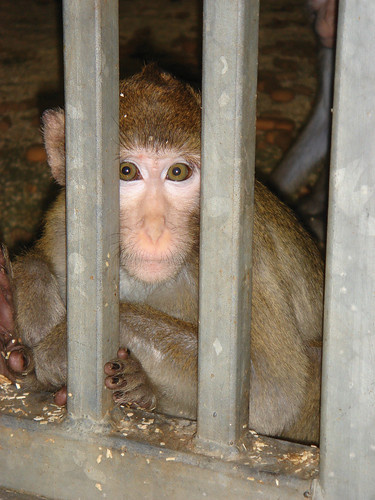
"Monkey mind" is a common metaphor in Buddhism - the mind as a nervous monkey, jumping from branch to branch, chattering and shrieking. No peace and quiet, not the bliss we are all hoping to find.

But the fact is, this is not just about mental activity. In itself, an active mind can be delightful. Sometimes we seek it out in scholarship and debate. Some people enjoy flashy movies with car chases and explosions and confusing plot twists, or concerts with smoke and mirrors and surprises in the aisles. The monkey mind people can't stand is something more than just excitement and sparking thoughts. And it is not Creative Monkey, brimming with ideas now that he has a little space to think, or Planning Monkey, who won't let go of the to-do list. It's worse. I'm talking about Obsessive Monkey. It's this one people can't stand. I know it intimately.

It got me right away on my first weekend retreat. Everything was wrong. The basement space we ended up in was ugly and crowded, not anyone's idea of a spiritual space, and smelled of mold. I am allergic to mold. It was hot, very hot and humid in that airless room, a thunderstorm in the offing. I was sweating. I hate to sweat. The chair I sat on was vinyl, and I was wearing shorts. Whenever I peeled my sticky, burning thighs off the chair and readjusted myself, the noise was loud. The leader cautioned me to stop doing that. I burned with embarrassment.

In a lengthy lecture on Zen etiquette, all new to me, we had been told we had to come to every sit, had to walk in a line to the dining hall holding our hands in a certain posture and looking down, and they were going to wake us up at 5:00 in the morning. I was too shy to ask if it could possibly be true there wasn't going to even be any coffee before the first sits. (Yes, it was true, proving to me that I could live through even the most extreme hardship.)

It was insane. I felt somewhat like I had been dropped into a really bad high school play written by someone with issues. And my body was giving me fits. I have fibromyalgia, and trying to sit up straight in that stupid vinyl kitchen chair made my back hurt all the way up to my neck. My head ached, my jaws ached, my shoulders seized up with pain. You weren't supposed to move, not that moving helped for very long.

I had been meditating for about two years at this time, but my method failed me now. I could only think of how incredibly miserable I was. Quickly these thoughts became an obsessive anxiety: I can't stand this heat I don't tolerate heat well Tom knows that could I get him to leave he won't leave tonight, he's like that, he always sticks things out maybe I can get him to see how much I'm suffering he could get a ride home with someone else maybe he would leave tomorrow, maybe at noon maybe we could compromise marriage is supposed to be about compromise. . . . Hot, it must be a hundred degrees in here, when is it going to storm, I can't stand this I can't stand another

Suddenly the teacher at the far end of the room shouted into the quiet, Sink into the heat! Everything in my mind crumbled and fell to the floor, as at the same time my stiff, suffering body relaxed and I exhaled. I felt -- well, there. Relaxed. I was just sitting in a chair, no longer resisting the discomfort with all my heart and soul. The monkey fell quiet.

From there on the retreat became a memorable experience, and I will always be grateful to that teacher, Daniel Terragno, for his kindness to a novice. By 9:00 Saturday night, the end of a full day of sitting, I felt clarity and peace. I recall going into our room and turning on the big floor fan, looking out the window at a field of golden grain gently waving in the twilight, and thinking I had never seen anything so beautiful. I was perfectly happy. When I told the teacher that the next morning, he smiled and said, "This too shall pass."

Thinking about this experience reminds me of the importance of having teachers whose job it is to help you cut through your stuff, to surprise you out of your obsession, to assure you your experience is normal and encourage you to stick with the ups and downs.

Lay people, even those who have teachers, meditate at home most of the time, where Obsession Monkey can catch us off guard. His chatter may be about some problem with another person, someone who hurt you, a painful memory, an anxiety, a symptom you're not attending to - in short, something you'd rather not think about. My experience is that I have to turn the volume down on the chatter and sit for just a moment with whatever feeling it is arousing. And then return to my breath. And return to my breath again. That doesn't mean I can ignore the issue.

When an obsession is loud and persistent, it's a psychological or life problem that we're being called to pay some attention to off the cushion. It isn't coming up for no reason, and it isn't irrelevant. It's coming up because meditation gives us the space, the occasion, to meet our real self. This is exactly the time not to quit practice.

In other words, love the monkey. That monkey mind is actually our friend. It is us, our own mind demanding we pay attention to our own reality. It is one of the ways a steady practice leads us toward a more peaceful and satisfying life.

Monday, March 9, 2009

Eating a Big Mac, for example

[Chad Foster, of North Huntingdon, Pa., gazes at the world's largest Big Mac sculpture (14 feet high, 12 feet wide), at the grand opening of the McDonald's Big Mac Museum Restaurant in North Huntingdon, Pa., on Wednesday, 2007. (AP Photo/McDonald's Corp., Henny Ray Abrams)]

It happened again today. I was in the shower thinking about the things I want to do today, matching them against my priorities, revising my mental schedule, when Lakein's Question came to mind:
What is the best use of my time right now?
The answer popped into my head: taking my shower. I could - just do what I was doing, take a shower. Instead, I was sending my thoughts out for a planning session. As I say, this is the second time this has happened in the last week, and it is happening the way Alan Lakein advised in his book: the answer popped spontaneously to mind, and I knew it was the right answer.

What a pleasure it is anyway - a hot shower with Caswell Massey rose soap, in your own comfortable bathroom, the electric heater turned on, the towels just the kind you like. Over and over, it's the same simple lesson - just be where you are, do what you are doing, do it all the way without sending some part of yourself somewhere else. So often that turns out to be enjoyable. In a way, it's the other face of something I write about more often, the need to let our demons in the door.

At one retreat, Daniel Terragno Roshi talked about this issue of holding parts of our experience at arm's length. "If you're going to make a mistake," he said, "do it. If you want a Big Mac and you decide to have one, enjoy it." Of course, we serious Zen students could be heard gasping in the noble silence. But here and there you could see a mischievous smile.

Sunday, March 8, 2009

Working the problem

[calligraphy: This by Rev. Nonin Chowaney]
I am aware that some lovely, intelligent women read this blog for inspiration. Others especially like it when I can deliver inspiring words with a sense of humor. That can be a constraining persona when life doesn't seem very funny.

Yesterday morning Tom and I made the effort to go to a videotaped talk put on by the Zen group that meets in our church. We haven't sat with that group for a while, all the problems of our low energy and various handicaps (for instance, his electric wheelchair can break down if you take it through rain or snow). As soon as we walked into the pleasant lounge where the sangha had gathered for this, I felt how pleasant and comforting the quiet atmosphere was. There is a nice energy to people who have been meditating together for an hour. I'd forgotten.

One of the men brought me an overstuffed chair, thankfully, because I hadn't thought to bring the gel cushion I am using now to diminish the impact of the arthritis in my hip. With some effort, the volume on the laptop was adjusted so I could hear it. Pause for explanation.

For well over ten years I have worn hearing aids. Hearing loss is another one of those unfortunate things you get for having the wrong parents. I am on my second pair of hearing aids. These are digital and programmable. They cost $3500, and that was a bargain price, though why that should be, I don't know, when you can buy a fabulous electronic device for one-tenth that much, Maybe because most people who need hearing aids are old and confused and demoralized, and nobody really wants to help us with the hard stuff when they could be off hiking. Maybe because the customer base is too tired and too sick to mount a public campaign. I don't know. But that's the playing field.

A little footnote to my life-threatening health problems this past year was the growing perception that the hearing aids weren't working as well. I went twice to Echo Hearing, where I bought them. The women there did an exam and determined my hearing hadn't really changed, but couldn't get it together to obtain the cable they needed so they could reprogram the aids, bring them up a notch. Frustrated by two fruitless visits, I went to someone else, a bonafide doctor, who didn't examine my hearing at all, or suggest changing the reception, just cleaned them briskly and charged me $50. At that point I had exhausted whatever yang I had to spend on this particular handicap, and gave up.

At best, hearing aids aren't very good, not nearly as effective as glasses. They amplify everything, all the background noises like fans and people shuffling their feet that your natural hearing mechanism somehow sorts out. They are intolerable in noisy places, but essential to enjoy a one-on-one conversation. If I don't have them, voices are muffled, cottony, like a foreign language, and I wear out trying to understand. For years now I've found that I can't hear people talk in group situations. This was one of the factors that drove me out of teaching in 1995.

I was okay during the talk yesterday, a wonderful talk about simply meeting reality. But in the quiet, thoughtful discussion afterward, I could only understand two people - Tom, to my immediate left (my good ear), and Margaret, to his left (a good, clear voice). Everyone else was very yin, which is what meditation does to you, quiets your energy. Soon I felt like a cat watching a tennis match, not understanding what was going on, just watching the ball go back and forth.

If you want to know just how in touch with reality most people are, let them know you can't quite hear them. Ask them to direct their voice your way. Almost no one continues to do this for more than one or two sentences. What does that mean? To me, it means they are concerned with expressing themssselves, not with communicating to me.

Knowing that, I didn't interject my handicap into the conversation yesterday. What's the point? I just sat there and thought, I need one of those Phonak things the doctor told me about. This is a sort of receiver you wear around your neck. It has to be coupled with a microphone set in the middle of the group. Right. Or do I want a scooter more?

I do want a scooter. Last summer I didn't walk down to the brook at all, and this year I am worse, with arthritis and neuropathy in my legs and feet, and declining kidney functions depleting my energy even more. It is time to admit that I'm never going to be better than this, and do what I can to adapt.

Hearing is about being social. The scooter is more about being personally more capable. My most important use of a scooter would be to wander around the ravine, though only on the roads; to be able to be out in nature. Just that. If I get one that breaks apart and is easy to manage, or had a special lift installed, I could put it in the van and go to the arboretum, or the conservatory or museum, or gallery hop, or go to church and sit in it in coffee hour and not be relegated to the old people's ghetto, the tables off at the side of Fellowship Hall. I could use a scooter at the grocery store, if it had a basket; the electric shopping carts they supply are awful. I could take the scooter down to the Cultural Arts Center for the Thursday conversations with artists.

So my thoughts went. At the same time, to go to the Thursday conversations, or enjoy the Zen discussions, or even Fellowship Hall, I need to be able to hear.

The vast insurance conspiracy doesn't think so, and won't pay for hearing assistive devices. On the other hand, some people get Medicare to buy them scooters. I could try that route. Maybe it would come through before I die. It sounds too hard. And right now, our attention is focused on getting a generator installed to help us survive the long power outages we are getting around here, with windstorms knocking down the old trees and the whole infrastructure aging and susceptible. We need electricity to run Tom's ventilator and the pump I use every day on my lymphedemic arm, to say nothing of the computers that are our chief contact with the world.

What is the inspiration in all this? Precious little, and it isn't funny. It is discouraging, more so when people your age are bopping around traveling, dancing, gardening.

But there is something to be said here in praise of Zen, something that encourages me to keep up my meditation practice. Just sitting with other meditators for an hour in that peaceful space forced me to bottom out on these problems, look at them squarely, and think about what I could do.

Working the problem is not the same as "having a positive attitude," a stance which is constantly urged on me by a dear old friend who doesn't know any better. She was telling me recently, blithely, that I could travel around the world and they would have scooters waiting for me at every airport. Oh yeah. Well, I have had some experience with travel arrangements of this kind.

And, she added, I would be as good as new. No one needs to be handicapped in this day and age, she said.

I know she needs to think that, insists on thinking that, and I don't try to change her. I don't even get annoyed anymore, for I admire her courage. But the fact is, you never get to be as good as new. The best you can do is adjust to the new normal. By the time you do, it will have changed again, and not for the better. That's not pessimism or a bad attitude; it's the truth.

Thursday, March 5, 2009

The Zen of Not Knitting

This winter I established to my own satisfaction that knitting is not meditation - and it is not Zen. Having begun four projects and finished one, and put the gently used yarns in the Cupboard of Discarded Arts, I think knitting is much more like the unexamined life.

You begin wandering in the candy store, imagining a lovely unique creation. Here is a sweet yarn - puppy love! You invest in the materials (which cost twice as much as you expected) and go home to begin with a light heart. Tongue between teeth, you cast on, proud to make this beginning.

And it soon becomes clear that the yarn doesn't handle like you thought it would. You persist.

After an hour or two you notice you made a mistake way back, who knows how, when you were trying so hard to do it right. Trying to fix it makes it much worse.

Eventually you get it going smoothly. But you can see now that the whole thing is going to take many more hours work than you thought, and frankly, not be as pretty as you thought. And now that you've got the stitches down pretty well, your mind is free to tumble all around unhealthful thoughts because, face it, knitting is the same old thing, not that interesting to watch. Chopping carrots is much more interesting - at least you could cut yourself. That's why people like to watch TV or talk while they knit. It's boring. Anyway, you already have a scarf. Several, in fact.

Here is a moment of realization. You can now take the road much taken and just keep slogging along doggedly because, darn it, you said you would. You had a goal. You don't want to be a quitter. Or you can sigh and put the project aside, in that corner of your mind stacked with small guilts - all the things you really meant to do. (Don't you hope you don't find yourself on your deathbed whispering, I only wish I'd got the laundry caught up?)

Is there a middle way through this muddle? The way I see is too simple by far, and as Lao Tsu said,
The Way is simple but the crooked path is more popular.
Let the project be in the past, let it flow away. Go do something more rewarding.

If that doesn't want to work, you can try thinking of the knitting as an experiment, like a first marriage. In an experiment, there is no success or failure, at least in theory. You try something and see what happens. Think of it as not being attached to the outcome. That's Zen.

Tuesday, March 3, 2009

Jumbled in a box

A recent article by Virginia Heffernan, who blogs on digital culture for the NY Times, explains how much better Google could have done in putting up the archives of Life magazine. There is always someone like that watching, waiting for you to finish so they can tell you what you did wrong.

Heffernan is a very good critic, and of course, the world has a real need for critics in many forms, teachers and editors, for instance. I have had both of those jobs myself, and I can tell you that correcting other people is no way to win the Miss Congeniality award.

But I digress (which could be the name of this blog, actually). What caught my attention was Heffernan's statement: "My least favorite way to see photos is the way I keep mine: jumbled in a box." She is referring to the way Google threw the whole Life archive out there for you to rummage through helplessly before calling to arrange for a dumpster.

The image called vividly to my mind the box buried in my closet and, I understand, in many other people's, too. The box that calls out in this faint, hopeless voice as you hurry past, Organize me. The volume is about to turn up on voices like that as spring comes, bringing the restless urge to empty the junk drawer on the dining room table and then run out and buy a Golden Wings azalea. Then too, there's always the larger, more intractable mess of life itself and of Wun. who is frequently tempted to start another diet as the weather warms up.

Today, everyone had bad hair, something about the weather or the wierd energy of winter dying while spring holds back. But today's photo is not a picture of bad hair. It's sedge grass, which grows that way, not in a nice neat carpet, and people pay money for specimens like this. This is not my photo; my very nice photo of grass is somewhere in that box of slides.

I admire grass, and trees and cats, and the sky for that matter, for they share one wonderful trait - they never question what they are. I maintain this makes it well worthwhile to have a much smaller brain, or none, and the limited imagination that comes with that. I can't imagine sedge grass saying, "I didn't ask for this triangular stem. Anyway, who wants to grow at the edge of a [expletive] wetlands? You can have it!"

No, if it could speak, the sedge grass would be saying, "I am absolutely perfect the way I am." It likes its hair natural.

One of my Zen teachers used to say emphatically in talks, "You are enough. You are okay. Now, get to work." Well, that's the challenge of being human, you can work on yourself. You can even work on working on yourself while understanding that you're perfectly alright the way you are. Just grow, like sedge grass, which follows its own pattern.

I like the idea. There is not enough literature starring vegetation, and look what grass could teach us. No "get to work" there. Just bask in the sun, drink in the nourishment, sink your roots in your particular soil. No problems with want/don't want. I doubt that that the grass ever wonders whether it might not be more fun to be a frog. All day, every day, it's recess.

Sunday, March 1, 2009

Will work for fun

[dishtowels from Anthropologie]
One of the benefits of being disabled is not having to work - and not having to look for work. It helps to be 66, and of a generation that felt entitled to retire (and actually got to accumulate pensions). Now we keep hearing that many people will have to work all their lives even as there aren't enough jobs for the young.

There are a lot of people popping up to help people look for work these days. They don't seem to know anything more than people knew 25 years ago, when I found myself out of a job I didn't like, and took a career change workshop. It was a small-group format packed with good advice and useful exercises. The only trouble was, nobody did the assignments. So in that way it was much like school of any kind. And the assignments were the hardest ones you ever had, starting with refining an objective: What do you want to do?

The teachers - most of whom were self-appointed, which is not uncommon among career counselors and life coaches - were idealistic. Their ideal: you have a chance now to change your life, to set out to get the job you'll love. The fact is, none of us could actually think that way. All we could think of was a paycheck. All we wanted to know was how to get someone to pay us for something. Our secret job objective was "Anything," we joked, but you weren't allowed to put that on your resume. I imagine that's why many in the small class still hadn't come up with an objective or a resume by the end of the six weeks.

I remember getting hung up in one session that included a presentation of your dreams and talents, and group brainstorming on ideas for work you could do. People thought I should write children's books, and I knew they were right. It was what I had been doing in my free time for years. How could I explain to them that it's almost unheard of to make a living at that, hard to break in even then, and if you did get a contract, it fell through; or it took two leisurely years before the book was published and you got any money. This is why artists who don't live at home have "day jobs" - something that pays the rent.

It's actually very hard to make a living doing something fun; after all, a whole lot of people want to do that. In fact, there is probably a shortage of people who actually do want to work rather than play.

Moreover, if you're paid to do something, I fear it would not be so much fun anymore; it would turn into work. I experienced this after I got paid for having fun, that is, got a no-string arts grant to encourage my writing. Applying for a grant is tedious and maddeningly bureaucratic anyway, not suited to the artistic temperament. And once you have seen you can actually get money that way, you become anxious to do it again. Artists live with the particular danger that we might commodify our work, twist it in order to make it marketable and forget why we started doing it in the first place. Many somewhat successful people end up teaching their art form; but by and large teaching drains a huge amount of creative energy and eats your time. And it is definitely not the same kind of work as strolling in the woods, maybe writing a haiku.

What is the question, anyway? How about, How can I earn enough to survive and be content with my life? This goes in many directions, and might include noticing what is enjoyable about the work you do now, or have done. I can't help thinking of my neighbor Cindy telling me the other day that she loved the sun so much, she was enjoying scooping up the dog poop in the yard. I did understand, though I don't think I'm that spiritually advanced.

But I do enjoy some common, ordinary tasks, like ironing linen and cotton dishtowels. The clean smell of the steam, the beautiful way towels turn out, how pretty they look stacked. Women of an older generation often agree with me; some of us remember how tedious it was to iron five or six white shirts a week, trying to beat your best time (15 minutes), so that dishtowels were a sort of break.

When the lymphedema in my right arm got bad two years ago due to an unlucky accident, I decided I should give up ironing, except sometimes a collar and placket. No more dishtowels. The arm is problem enough if I behave. This is the kind of little relinquishment you do on a daily basis as you age. If I had a positive attitude I'd say it keeps life interesting.